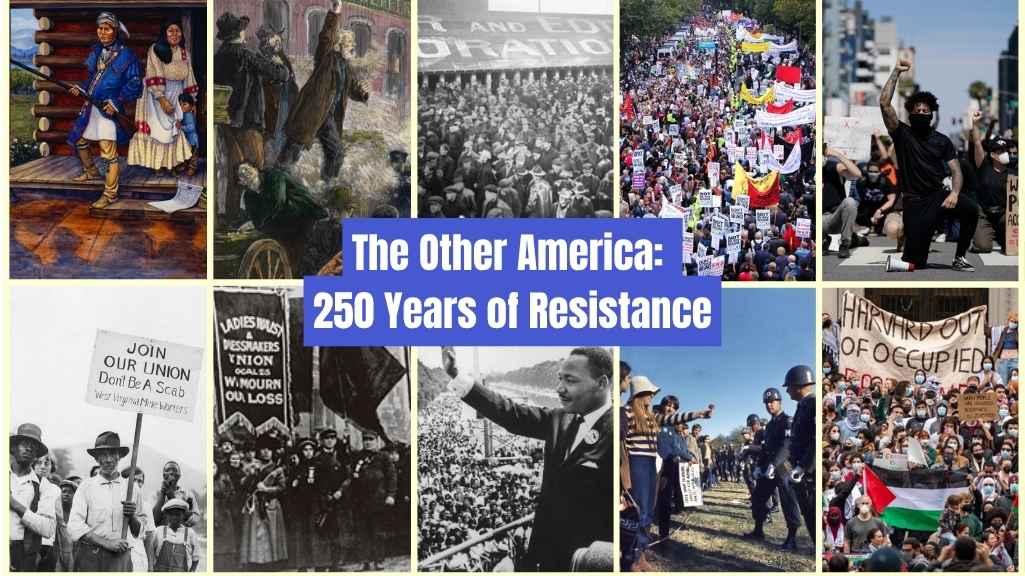
The founding of the United States was inseparable from settler colonialism. In its initial years, the westward expansion of the country was not an inevitable march of the so-called “manifest destiny,” but a process of conquest, removal, and dispossession. The Indian Removal Act and the Trail of Tears remain among the clearest examples of how the new republic expanded through violence against the native indigenous peoples. Nonetheless, these communities were not mere spectators to this oppression but actively resisted it. The Cherokee Legal Resistance in the 1820s, the Red Cloud’s War in the 1860s, the occupation of Alcatraz in the late 1960s and early 1970s, the Standing Rock resistance against the Dakota Access Pipeline in 2016, to name a few, all reveal a continuous struggle for sovereignty, land and dignity by people of the First Nations.
Moreover, neither did American independence mean freedom for all non-native people. The country that supposedly speaks about liberty, in practice tolerated and protected slavery. In particular, close to three-fourths of the delegates to the Constitutional Convention were slave owners. Under the rubric of “states’ rights,” slavery and later Jim Crow laws were defended for generations. Women were denied the right to vote for a substantial period of time. Chinese immigrants were targeted through exclusionary laws in the 19th century. Even till this day, the prison system in the United States perpetuates many of older patterns of racialized control and exploitation. Against this, though, there has always been resistance: abolitionists such as Frederick Douglass, Sojourner Truth, David Walker, and Harriet Tubman raised their voice against slavery; the Civil War and Reconstruction sought to formally integrate enslaved people with equal rights into the country; the suffragette movement was waged to grant women the right to vote; and later the struggles led by figures like Martin Luther King Jr. and Malcolm X sought to challenge the renewed forms of discrimination and racial oppression faced by people of color.
The American government was also no friend of the working class who had to fight for every gain they have won. The Haymarket Massacre, the Ludlow Massacre of 1914, the Taft-Hartley Act, the Red Scares, the firing of PATCO workers under Reagan, and the rollback of New Deal protections show that all through these last 250 years, repeated violence and repression was used against labor. Yet workers responded by organizing and sometimes with militancy: the Great Railroad Strike of 1877, the Haymarket struggle for the eight-hour day, the unionization drives of the 1930s, the rise of the American Federation of Labor/Congress of Industrial Organizations (AFL-CIO), the Flint sit-down strike of the 30s, more recently the Occupy movement, and renewed labor organizing at Amazon warehouses, Starbucks stores, and the 2023 strike by the nearly 150,000 members of the United Auto Workers (UAW) union are some prominent examples.
Since the 20th century, the powers that be in the United States have also been shaped by strong anti-communist sentiments and imperial ambitions. The Palmer Raids, the House Un-American Activities (HUAC), McCarthyism, and the persecution of radicals sought to crush socialist and communist movements in the country. These actions also resulted in overreach, encroaching into the civil liberties of the people of the country. Internationally too, the U.S. imperial power was projected through violent coups and sometimes through outright wars in Nicaragua, Iran (both in the 50s and also more recently), Vietnam, Guatemala, Cuba, Chile, Iraq, Libya, Venezuela, and elsewhere. Furthermore, through its military, diplomatic, financial support for the Zionists, the United States has been directly complicit in perpetrating a genocide against the Palestinian people. Nonetheless these reactionary measures also germinated resistance: Eugene Debs and the Socialist Party of America, the Communist Party USA, the Seattle General Strike of 1919, the Black Panther Party, the Socialist Workers Party, Workers World Party, strong anti-war movements (such as during the Vietnam and Iraq wars), the May 2006 immigrant rights strike, the recent mass protests and student encampments in support of Palestinian rights, and today’s renewed socialist resurgence such as the Democratic Socialists of America (DSA) and newly elected New York City mayor Zohran Mamdani, the Party of Socialism and Liberation (PSL) to name a few.
250 years since its birth, the United States cannot be looked at as a simple celebration of a democratic republic. Its history is marred by slavery, settler colonialism, labor exploitation, racism, patriarchy, anti-communism, and imperial ambitions. Yet in parallel to that runs another history: that of resistance and struggle. Often led by women, people of color, progressives, socialists, communists, workers, and peasants, this tradition has followed American power like its shadow - exposing its hypocrisies and fighting for a more just future.