

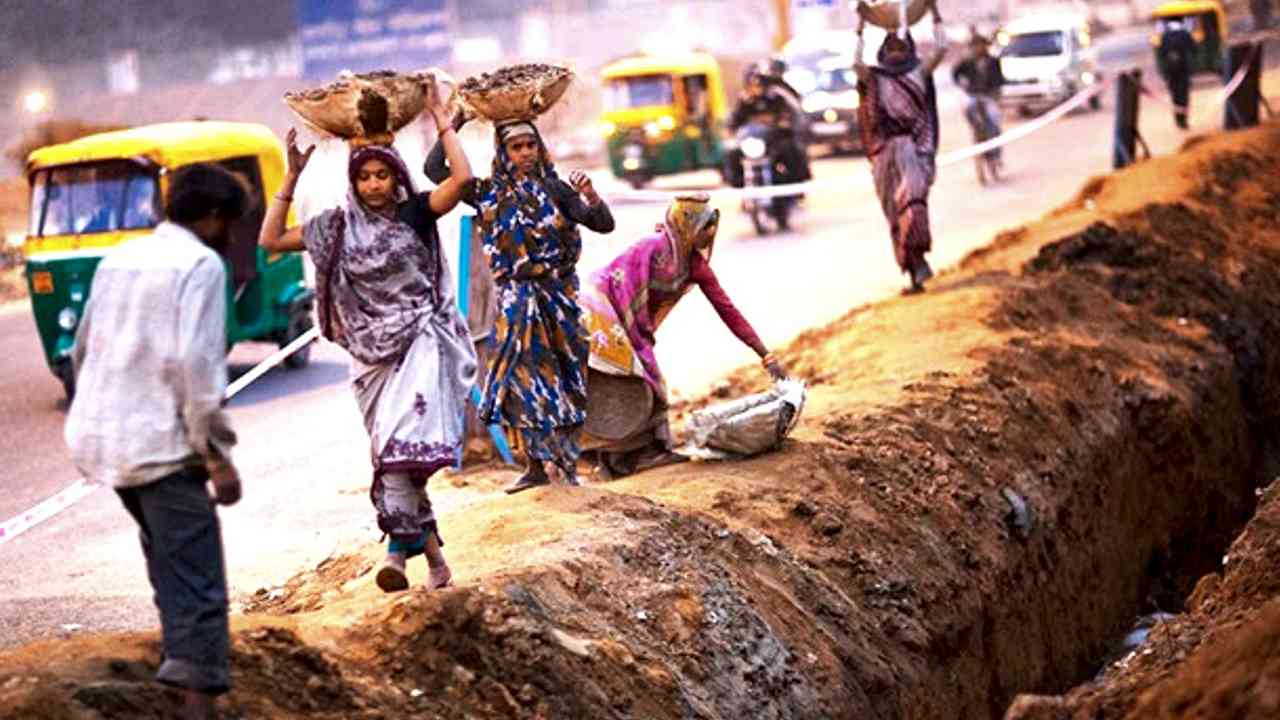
This movement of labour is driven by India’s enormous geographical inequalities. Consider the differences in per-capita income. Bihar’s per-capita net state domestic product — the value of state income divided by its population — was Rs. 69,321 in 2024–25. The corresponding figure was approximately Rs. 3.88 lakh in Telangana, Rs. 3.81 lakh in Karnataka and Rs. 4.93 lakh in Delhi. These figures reveal the vastly different income and employment opportunities available across states. Delhi’s per-capita income was more than seven times Bihar’s. Wage data tell a similar story. In 2024–25, the average daily wage of a male rural construction worker was approximately Rs. 923 in Kerala, compared with Rs. 389 in Bihar and Rs. 308 in Madhya Pradesh. These figures reveal the scale of the wage gradient within the same broad occupation. By migrating, a construction worker from Bihar may obtain substantially more than is available at home. The destination wage need not be fair or sufficient, particularly after accounting for urban rent, food, transport and periods without work. Dire economic conditions in the origin state, nevertheless, compel workers to travel hundreds or thousands of kilometres for wages that may remain exploitative.
Migration has been a near-universal feature of industrialisation. Cities have historically expanded by drawing workers from villages and less industrialised regions. The distinctive problem in India is the scale and persistence of regional inequality. Capital, infrastructure and secure employment are concentrated in a limited number of urban and industrial centres, while large parts of the country remain labour-supplying hinterlands. India does not possess a national labour market in which capital and employment are evenly dispersed. It possesses islands of concentrated capital connected to vast regions that reproduce and export labour. According to NITI Aayog, Indian cities occupy only 3% of the country’s territory, but contribute approximately 60% of its GDP. At the time of the 2011 Census, Bihar was only 11.3% urbanised, compared with 45.2% of Maharashtra, 48.4% of Tamil Nadu and 47.7% of Kerala.
The failure of industrial policy to disperse productive investment has left states such as Bihar with widespread underemployment, low-productivity work and depressed wages. Employers in richer regions can then recruit from this large reserve army of labour. A migrant whose options at home are extremely limited may accept wages, hours and employment conditions that a settled worker with stronger local support can refuse. Contractors deepen this imbalance by controlling recruitment, transport, accommodation and the payment of wages. Indeed, many migrant workers do not even have fixed establishments to live in their destination city, often living, for instance, in the construction sites they work in. Low statutory wages, inadequate and irregular implementation, the absence of formal contracts and legal and illegal restrictions on trade unions further reduce workers’ bargaining power.
The problem, however, is not that migrants voluntarily “take” local workers’ jobs. Employers use workers’ unequal circumstances to make them compete against one another. Where trade unions and common wage standards are weak, access to a large and replaceable workforce can place downward pressure on the wages and conditions of migrant and local workers alike, transforming interstate disparities into a source of profit and capital accumulation. Capital takes advantage of a large reserve army of unemployed or underemployed labour in origin states, while using the threat of replacement by migrants to restrain wages in the destination economy.
In most cases, migrant workers are hired in contractual positions. The principal employer hires a sub-contractor, who then recruits workers. The workers are thus tied to the contractor, with the principal employer outsourcing legal responsibility. The frequent absence of written contracts or proof of employment, coupled with low minimum-wage enforcements, allows for wages less than the statutory minimum. Migrant workers accept these low wages, due to little recourse, and because despite being underpaid, the wages may be more than what they may have received in their origin state. Employers also outsource other responsibilities, such as accommodation for workers in the destination state. Workers often live in destitute conditions in the destination state – with many workers sharing small living spaces, or at times living at the construction site that they work in.
To make matters worse, the migrant worker often lacks social security and political power in their destination state as ration cards and voting rights are tied to their origin and not destination. Migrant workers, therefore, are not politically represented at their destination. Blue collar migrant workers are overwhelmingly men, with their families continuing to reside in origin states. This places a disproportionate burden of domestic reproduction on the women in origin states, including childcare and care for older members in the household. The male worker having been relieved from this responsibility can be made to work longer hours under strenuous conditions in the destination state. The village, thus allows for capital accumulation in the city by taking on a disproportionate responsibility of unpaid domestic work, effectively subsidizing the city.
The logic of this system was explained by Milton Friedman, one of the most influential defenders of free-market capitalism. Speaking about Mexican workers in the United States, Friedman argued that immigration was beneficial only so long as it remained illegal. His argument was that undocumented workers would perform jobs employers needed while remaining excluded from welfare and social security. Interstate migrants in India are, formally, of course, citizens with equal constitutional rights. Yet, Indian capital derives a similar advantage from keeping their employment informal. Migrant workers are legal enough to build cities, operate factories and deliver commodities, but informal enough to be denied contracts, social security, political representation and effective protection from wage theft or dismissal.