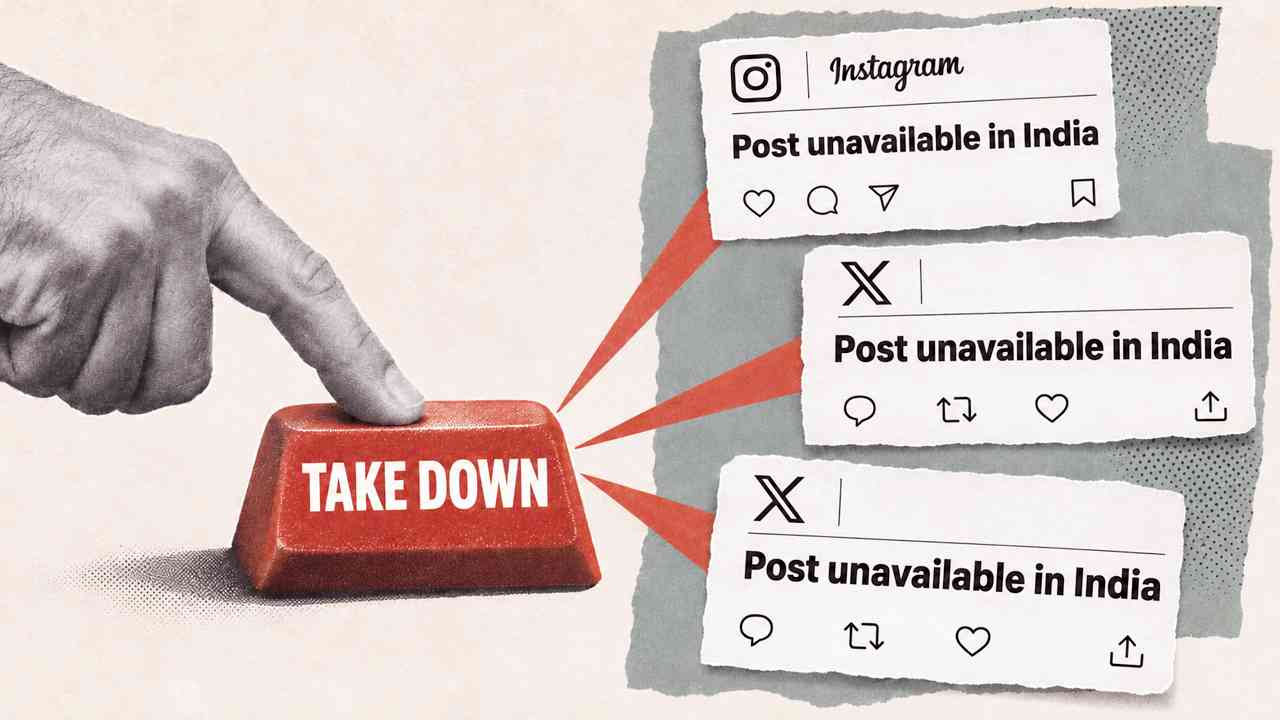
I don’t employ the two terms – unprecedented and senseless – flippantly. For evidence of having no precedent, consider Meta’s recent transparency report. It reveals that just in the first half of 2026, Meta made an astonishing 5.4 million pieces of content unavailable to Indians because of regulations and legal requests. For comparison, the same number was around 41,000 in the six months preceding this period.
To make sense of the lack of sense of how the censorship is being directed, let’s take the example of LiveLaw, a media site focusing on legal reporting. Between 27 and 30 October, three of LiveLaw’s videos were removed from Instagram. Two of these concerned developments in cases regarding Special Intensive Revision (SIR) of electoral rolls, and one was about a legal challenge against the Transgender Rights Act. None even amounted to dissent from or opposition to the government, they simply reported on court proceedings. The kicker is that two of these videos were removed within a span of fifteen minutes of upload! The short time span indicates that the content was never actually viewed or reviewed by anyone: forget reasoning in legal orders, there is no application of thought at all.
How we’ve landed in this Kafkaesque situation is the result of a series of amendments to the rules under the Information Technology (IT) Act that the BJP government has enacted in the last five years. In the May issue of Liberation, I covered the legal institutionalisation of this ruthless architecture of censorship.
Pertinently, an amendment in 2021 asked major social media platforms to deploy “automated tools” to proactively block “unlawful” content. This requirement was so broad and absurd that it immediately met legal challenges and operational resistance from social media platforms. Then in February 2026, the government narrowed the requirement to two categories, and one of these categories is content “exactly identical” to what was already censored by previous orders. The government followed it up with two secret advisories – which were thankfully leaked to the press – that added more pressure for “enhanced diligence”, particularly against “unverified or misleading claims regarding the imposition of emergency, restrictions, police action or other official measures.”
And the social media platforms have complied, and more. In a typical sequence of events, the Modi government directs posts to be censored: everything from a citizen calling Modi “useless”, Rahul Gandhi waving the Indian flag, or CPI(ML) Liberation leaders flagging the Delhi Police’s vandalism of an Ambedkar portrait.Then social media platforms employ tools – which are also opaque to the public – to take down similar content. As another example, consider the ridiculous cascade of events: a post about Burhan Wani is targeted with censorship, a digital rights organisation’s post about the censorship gets censored, Scroll posts about that and gets censored!
Here, the social media platforms – mostly in the hands of American tech companies that have now shed even their flimsy pretence of support for human rights – are also to blame for simply caving to illegal orders. Meta has been particularly overzealous and is removing political content by filtering on keywords – _en masse_ without rhyme, reason or notice. Under the scanner is everything from Hardeep Singh Puri’s appearance in Epstein’s communications to statements about the murder of Ankita Bhandari.
Where some topics are entirely off-limits and prior restraint on speech is the default: that is what the so-called digital public sphere looks like in the Hindutva vision.