Genesis
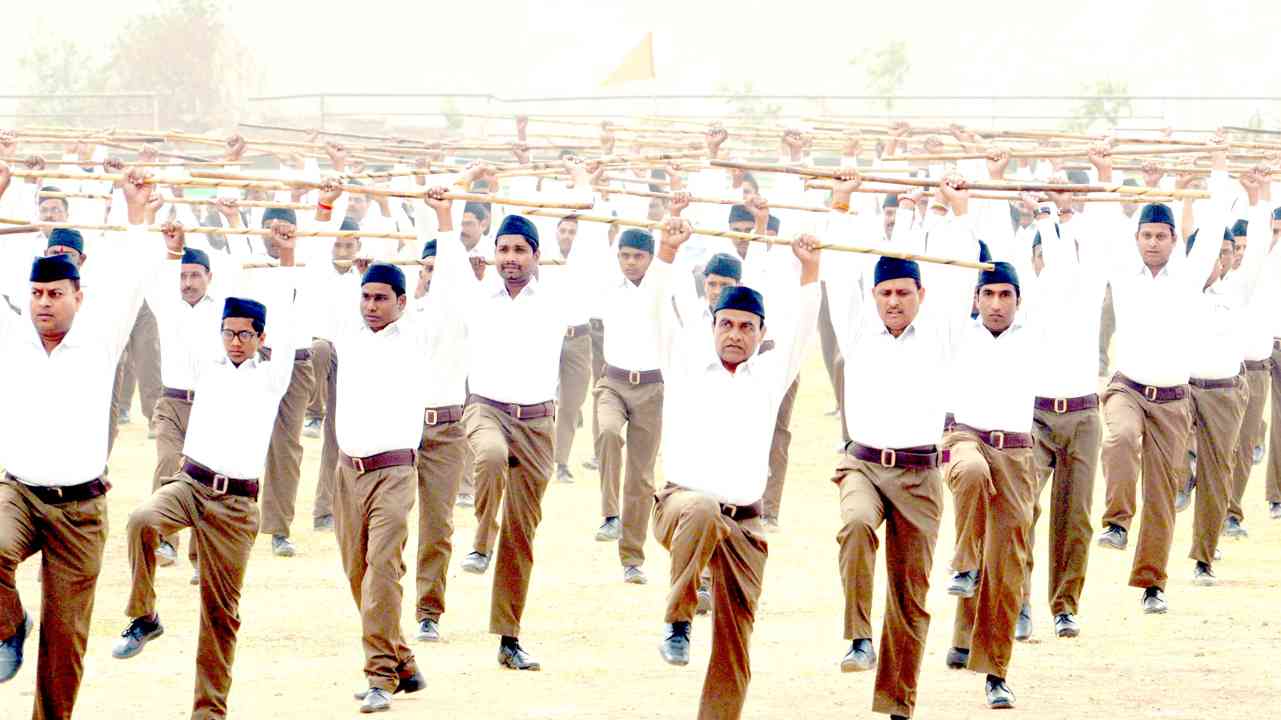
The centenary of the RSS is understandably an occasion for celebration for its leaders, members, sympathizers and sycophants. However, among those who find themselves at odds with its project of Hindu Rashtra – and they constitute India’s majority – the occasion is hardly a happy one. For those resisting the RSS’s majoritarian, divisive and violent politics, the RSS centenary is yet another milestone in India’s path away from equitable development, freedom, justice and progress.Several factors have contributed the ascendancy of the RSS to a position of dominance. Working in partnership with its political wing – the Bhartiya Janata Party (BJP) – and its multifarious front organizations, the RSS has utilized the crisis of capitalism, the weakening of liberalism, the political vacuum created by the setbacks to 20th century socialism, post 9-11 Islamophobia, and other national and international circumstances, to cement its place in Indian society and politics.
The recent success however has a long back story, which is crucial for understanding its current dominance. How did a political and ideological project clearly at odds with India’s diverse character, pluralist traditions, and progressive currents, manage to systematically damage each of these?
Founded in 1925, the RSS right from its inception sought to build a Hindu majoritarian state in India, inspired by European fascism. This majoritarian project was culturally rooted in Hindu conservative responses to modernization, and in a deep-rooted Islamophobia among sections of Brahmins who resented the political power of Muslims in pre-colonial India.
This Hindu conservative reaction began with the early 19th century Dharma Sabhas and continued through the revivalist movements later in the century. While these created certain potentialities for Hindu majoritarian politics, the RSS was quintessentially a product of 20th century transformations. The Morley Minto Reforms (1909) introduced an overlap between religious identities and political communities, and enabled the imagination of a Hindu political community within a modern electoral politics.
The rise of mass nationalism in the 1920s further activated the freshly constituted Hindu and Muslim political communities, this time on an unforeseen scale. MK Gandhi and Jawaharlal Nehru preferred to mobilize these communities on pluralist and secular lines. However, the RSS adopted the opposite approach, choosing religion as the singular basis for political identity formation.
The RSS conveniently and opportunistically de-prioritizing the freedom struggle, instead focusing its energies on reshaping India into a Hindu Rashtra. As freedom came nearer, the organization increasingly infused the political sphere with its communally divisive and violent ideas, contributing in no small measure to the 1947 partition.
Despite its growing influence, the RSS’s Hindu-centric vision occupied a marginal space in Indian politics on the eve of independence. The partition of the subcontinent along religious lines undoubtedly strengthened the potentiality of Hindu majoritarian politics in India, but the RSS’s Hindu Rashtra project did not fit easily with the historical, social and cultural realities of post-colonial India.
The rhetoric of cultural revivalism, espousal of Brahminical values including untouchability, opposition to the Indian constitution, and association with Gandhi’s assassination, put the RSS at odds with the prevalent moods of democratization and decolonization, especially with socialist, secular, modernist and developmental ideas which held sway over the entire world in those times.
The Hindu Rashtra project was also plagued by definitional problems. On the religious plane, the ‘Hindu’ in the Hindu Rashtra did not connote a uniform set of doctrines and religious practices. Besides, the majority of people who were Hindu by faith did not subscribe to the notion of a singularly Hindu political community. The RSS therefore needed to create a modern Hindu religious identity, and a Hindu political community coeval with it.
Among a host of strategies that it adopted to perform these tasks, two in particular paid the RSS handsome dividends in the long run: refiguration of Hinduism as culture rather than as a doctrine, and a functional distance of the RSS from electoral politics.
Strategic Choices
The RSS de-emphasized doctrinal Hinduism and favoured a cultural Hinduism more suited to the modern times. The daily routine at shakhas, the syllabi in Sangh sponsored schools, and everyday activities in its front organizations, presented Hindu religious doctrines and practices in a condensed and ritualized form, prioritizing emotional association with ostensibly Hindu cultural pasts over intellection.
The RSS of course launched the Vishwa Hindu Parishad (VHP) in 1964 to consolidate ostensibly Hindu sects and communities, but it continued to delink modern religio-political Hindu identity from strong doctrinal identification. This emphasis on cultural and symbolic modes enabled the Sangh to use diverse means – from television to social media – to populate the public sphere with its ideas.
The refiguration of religion as culture also enabled the Sangh to appeal to the new post-liberalization professional classes. Economic liberalisation had enriched these classes, but it had also left them searching for roots and a cultural identity in a globalized world. From India’s towns and cities to the American Silicon Valley, the RSS was able to pull a substantial chunk of these classes towards itself through its model of cultural nationalism.
At a doctrinal and practical level, distinct communities that the RSS brand of Hinduism claims under the Hindu umbrella are diverse and hierarchically differentiated. Many do not even identify as Hindu, viz. Lingayats, Adivasis. De-emphasizing doctrinal association and insisting on cultural and political unity has allowed RSS to downplay these internal contractions in Hinduism.
The RSS’s functional distance from politics has been rightly criticized as double speak: the RSS claims to be a cultural organization but its Hindu Rashtra project has always been deeply political and it has used its front organizations to push this forward. But behind this double-speak lay a carefully chalked out strategy rooted in the core character of the RSS.
The Sangh always believed in the restoration of a Hindu political order. The founders of the Sangh belonged to a region that gave birth to the last and probably the only empire – the Marathas – which invoked Hinduism to legitimize itself. The political nostalgia of the early RSS leaders indeed had a historical basis.
However, under the historical circumstances of decolonization and democratization, a theocratic state was impossible to build. Unlike the Communists, the Sangh did not have a revolutionary theory that could structure their approach to politics. Politics was essential to build a Hindu Rashtra but it was a terrain that they had to tread with caution.
The RSS therefore floated a separate political wing – the Bhartiya Jan Sangh (BJS) in 1951 and the Bhartiya Janata Party (BJP) in 1980. While the BJS and the BJP’s importance was never in question, the Sangh did not necessarily accord it unquestioned primacy over its other wings. This allowed them to influence politics without getting subsumed by its vicissitudes, and enabled them to maintain a large cadre base outside the sphere of electoral politics. Neither did the RSS want to unilaterally control the BJS/BJP: granting partial autonomy to the political wing has been a key part of the Sangh’s strategy and that continues till date.
Through the use of BJS/BJP, the RSS made membership of the political community incumbent on specific demands rather than a comprehensive program. Right from the BJS days, the RSS formulated and stuck to three main demands – Ram Mandir at Ayodhya, enactment of a Uniform Civil Code and the abrogation of Article 370. These three represented three distinct but interconnected facets of the Hindu majoritarian ideology: Hindu reconquest of sites associated with Muslim political rule, a Brahminical personal code, and opposition to Muslim political power. These demands continued to the cornerstone of the BJP as well.
Notably, the BJS/BJP never espoused an economic program. It has always been economically opportunistic, espousing Swadeshi and Gandhian socialism till the time those ideas had some salience, then embraced neoliberalism, and subsequently championed crony-capitalism. The project of Hindu Rashtra has always lacked a proper economic agenda, and hence the Sangh Parivar has done its level best to weaken critical economic discourse as a register of politics.
The Unfinished Democratic Revolution
The RSS – with its roots in Brahminism – has consistently subverted or opposed policies and laws that favour equality; be they affirmative action for backward castes, personal freedoms for women, labour rights, and so on. Its discomfort with the Indian constitution stems from the constitution’s programmatic espousal of a democratic agenda which, if implemented in letter and spirit, would strike at the heart of the caste order. This is a veritable counter politics to what the constitution espouses.
Notwithstanding its clever tactical adjustments, the rise of the RSS to a commanding position would not have been possible if the soil had not been left fertile for the growth of such counter-politics.
This is where Babasaheb Ambedkar’s pertinent observation about the challenges we faced in implementing the constitution becomes pertinent. He had remarked during the adoption of the constitution that its promise of political equality might fall flat in the face of a deeply unequal socio-economic landscape. This discrepancy might enable Brahminical and capitalist forces to sidetrack the democratic process, he had feared.
A look at the memorandum ‘States and Minorities’ which Ambedkar had prepared on behalf of the All India Scheduled Castes Federation in 1947 gives us a glimpse into the kind of transformation he envisaged to democratize the base of Indian society. In this memorandum Ambedkar described India as United States of India, and promised for all its citizens a set of fundamental rights with comprehensive judicial protection against executive tyranny, unequal treatment, discrimination and economic exploitation.
The memorandum wanted the state to organize the main spheres of economic life including agriculture on socialist lines through comprehensive nationalization and collectivization, within the framework of parliamentary democracy. To lend stability to state socialism it wanted the Constitution to guarantee it in a way that every government would have to abide by it. A universal affordable public education was another of these guarantees. These transformations in the spheres of education and economy would potentially create a level playing field in all spheres of life as well as a sense of public morality based on equality, fraternity and other equalizing values.
Article II Section III of ‘State and Minorities’ provided a whole range of protection for minorities: against a communal executive, against social and official tyranny, against social boycott. It granted substantial power to governments to spend money for any purposes beneficial to the minorities. The idea behind was to not only protect but also empower to minorities and create a bulwark against majoritarianism of all kinds.
Most of these provisions found a place in the non-enforceable parts of the Indian constitution. Even enforceable parts were implemented only partially, which meant that interconnected structures of caste, class and gender inequality and oppression were far from being substantially uprooted. This left the door open for the rise of a counter-politics to try and undo certain aspects of the post-colonial democratic transformations, and to damage the democratic structure itself.
Notwithstanding the current dominance of the RSS, it must be noted that the RSS is still struggling to become the hegemonic force that it so wishes to become. The rise of RSS might have caught India’s democratic forces by surprise but their combined power is bound to overwhelm the RSS and undo its impact over a period of time. The Saffron counter-politics is a twisted testament to India’s significant democratic achievements, but it also carries a warning about allowing a democratic deficit to persist.
We are faced with a twin task today – to save the constitution and to bring about a democratic renewal: a reaffirmation of faith in the constitutional principles and their implementation to the fullest possible extent. At the ideological level, this requires a consolidation of peoples’ democratic traditions — Gandhian ideas, Dalit Bahujan Adivasi traditions, Marxism, feminism, democratizing currents within religions (e.g. Bhakti, Sufi etc.), progressive regional traditions, and so on. There is a need to identify their strengths and bring them together. and isolate the Savarkar-Golwalkar tradition.