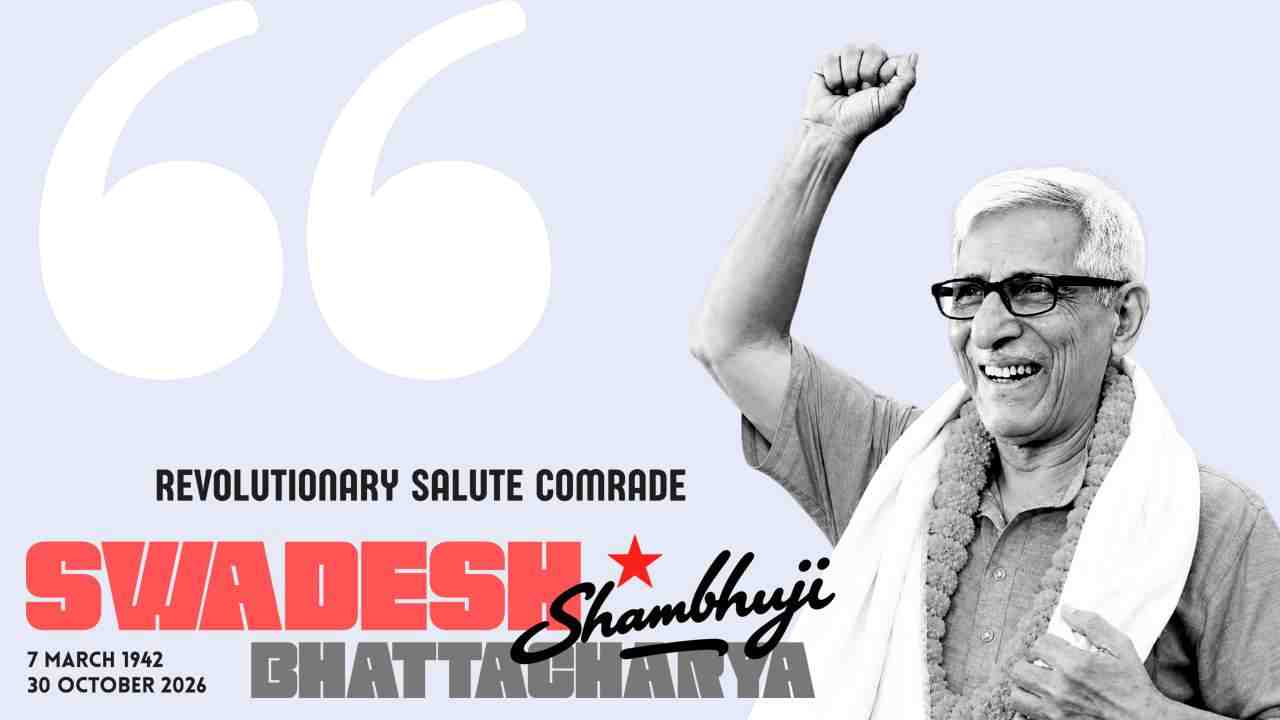
Swadesh Bhattacharya
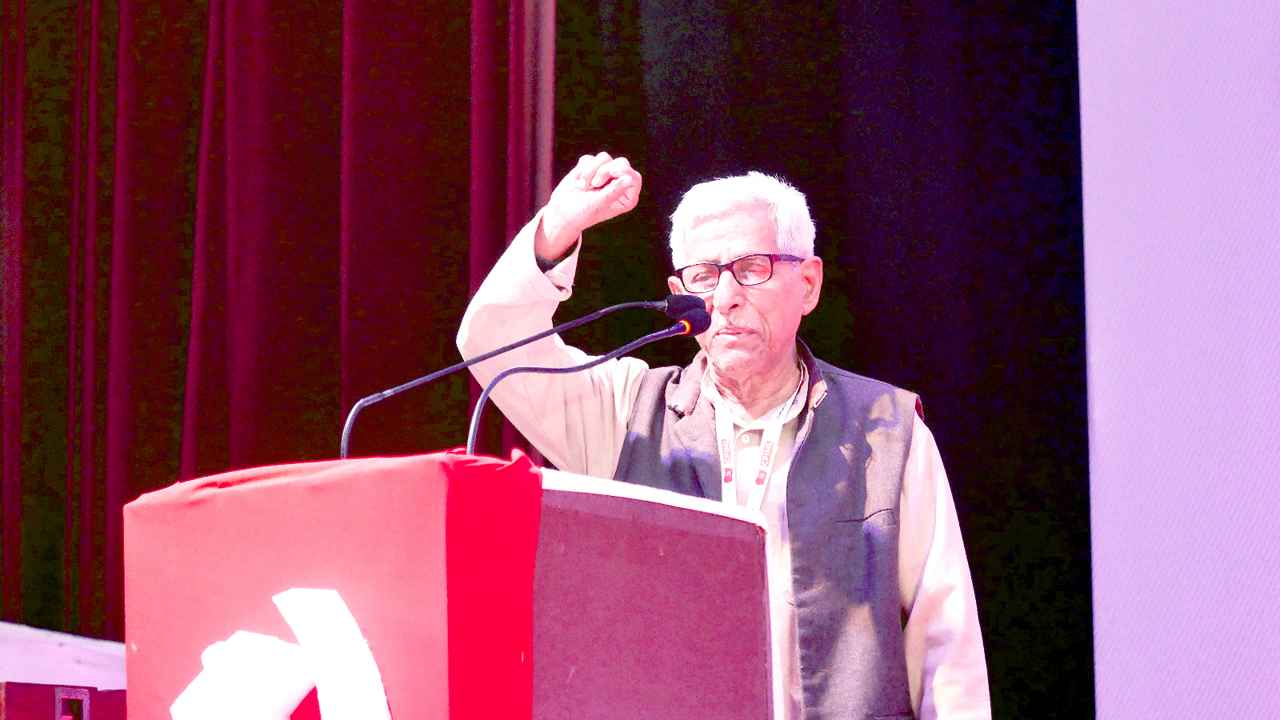
(FROM THE ARCHIVES | Reproduced below are the excerpts from the Inaugural Speech delivered by Comrade Swadesh Bhattacharya at the all-India Party Convention at Bhubaneshwar, 2004 on the occasion of the thirtieth anniversary of Party reorganization.)
Today on the 28th of July 2004, we are completing thirty years of our revolutionary journey since the reorganisation of the Party on July 28, 1974. In these thirty years we have passed through many ups and downs, but we have faced all odds in a firm and determined way. At every turning point of revolutionary advance or retreat, the entire Party has always marched in unison. In the changed conditions after the first major confrontation with the state, our Party alone correctly grasped the essential shift in emphasis indicated by Comrade Charu Mazumder in his last writings and developed it further.
We began our journey with a small three-member Central Committee headed by Comrade Jahar and basing on a fresh upswing in peasant movement in Bhojpur and Patna. The reorganised Party had a State Committee in Bihar, a leading team in West Bengal and sections of comrades in Ballia and Ghazipur of UP and Delhi.
...
From an underground structure operating almost solely through armed units, the Party has gradually developed mutifarious structures and taken up the most challenging and rigorous job of combining parliamentary and extra-parliamentary struggles while retaining and expanding the effective strength of people’s resistance and evolving all forms of class and mass organisations and struggles. This is something unique in the history of the Indian communist movement.
...
There can of course be no scope for any sort of complacency. We are still a small party and we cannot claim that we have solved all the unresolved questions of the communist movemnet in India in theory and practice, in combining all forms of organisation and movement. The Party must address these problems and find out positive and concrete solutions to pave the way for our desired development at this juncture.
From the parliamentary arena to the sphere of panchayats and people’s resistance, we often face in our practice wrong trends and sometimes even distortion and degeneration. We have to combat these wrong trends and weed out the expressions of distortion and degeneration in our practice. We have to streamline our class and mass organisations in terms of mass base, movemental orientation, independent functioning and on the whole in terms of attaining and reinforcing our cherished revolutionary credentials. And to do it all, the Party, its leading bodies in particular will have to attain much more wisdom and learn the necessary art and skill to guide and lead the entire movement through effective motivation of all its functional apparatus. Party Central Committee members in particular and State leaders in general must enhance their direct involvement not only in formulating concrete policies and tactics and orientating the organisation and movement in respective fields but also in actual implementation and enrichment of those policies and tactics.
We must revive our fine traditions of integration with and reliance upon the masses and of selfless sacrifice for the masses which reflects our distinction from the anarchist activities of outfits like the PWG and MCC. We should not forget for a moment that our attitude towards our martyrs and their families and towards our comrades in jail must reflect our genuine concern for our heroes and become a source of inspiration for the comrades and the masses who dare to brave all odds as also for the younger generation. This forms an essential component of Party work.
Our experience of using the parliamentary institutions down to the panchyat level to conduct effective exposure of the bourgeois system and provide added impetus to class struggle clearly shows that it is not at all a simple and easy task and that the job cannot be left to the elected representatives alone. Party committees must formulate policies and plan exposure campaigns and agitational measures and ensure effective involvement of elected representatives in carrying out such plans under the leadership of the Party.
The Seventh Congress of our party had explicitly cautioned us in this regard. Yet the threat of encirclement by contractors and vested interests remains very much real. In real life we do find ‘a section of political activists gradually degenerating into petty fortune-seekers’ and trends like ‘gradual reduction of the role of elected people’s representatives to a mere agency of implementation of official schemes’ and proliferation of corrupt practices. Such a malady afflicts the entire apparatus of a communist party by making the party. It detaches parliamentary role from the revolutionary perspective and promotes the tendency of looking at parliamentary role as a reward for work and sacrifice and increasingly as a career opportunity. Such tendencies have made inroads in our party too and they cannot just be wished away.
Party committees must heighten their grasp and vigil to provide effective leadership to this complex practice. They must identify the wrong tendencies and wage a determined ideological and political struggle to correct them. The message should be loud, clear and bold that there is no room for fortune-seekeing or parliamentary careerism in our Party.
Comrades, we take great pride in the revolutionary tradition and credential of our Party. We have always upheld the Leninist teaching that mass poverty and backwardness is an inescapable corollary of the capitalist system and in such conditions it is not possible for the entire proletarian class to reach the desired level of class consciousness. We will therefore always need a group of class conscious leaders who will inspire and motivate the proletarian army with the great socialist ideology, who will unify the proletariat and lead it in struggle. As a militant alliance of leaders the party of the proletariat will numerically always be much smaller in relation to the size of the proletariat, but the party will surely be wiser than the proletariat in class consciousness and experience and it will have to be organisationally compact and cohesive.
Our Party has never been averse to practising freedom of thinking and lively discussions and debates on varied ideas and opinions while strictly adhering to unity in action. The Party however rejects any trend that may reduce the Party to a mere band of philosophers or free-style revolutionaries. It has been our tradition to promote and practise a high level of inner-party democracy while ensuring unreserved subordination of all to the majority opinion cum collective decision and unconditional commitment to revolutionary work with due adherence to the norms of accountability. Ours is a party of revolutionary struggles. Naturally, the Party cannot be satisfied with mere acceptance in words, it insists on actual deeds, it insists on concrete practice and definite implementation of Party decisions in every field of activity.
Comrades, we inherit the revolutionary tradition of exemplary sacrifice, hard struggles and selfless service, the great tradition that has been upheld and enriched by our great martyrs and departed leaders including Comrades Charu Mazumder, Comrade Jahar, Comrade VM, Comrade Nagbhushan, Comrade Ravi, Comrade Jayant and Comrade Anil Barua and hundreds of Party cadres, fighters and struggling masses. There can be no obstacle which we cannot surmount, there can be no weakness which we cannot overcome.
On this great occasion of the thirtieth anniversary of Party reorganisation, let us renew our communist pledges. No force on earth can stop our advance. All we have to do is to break our shackles and rise to the occasion. At this favourable juncture of national politics, history beckons us to march at the forefront of the Left movement. Let us enhance our efforts and multiply our initiative.