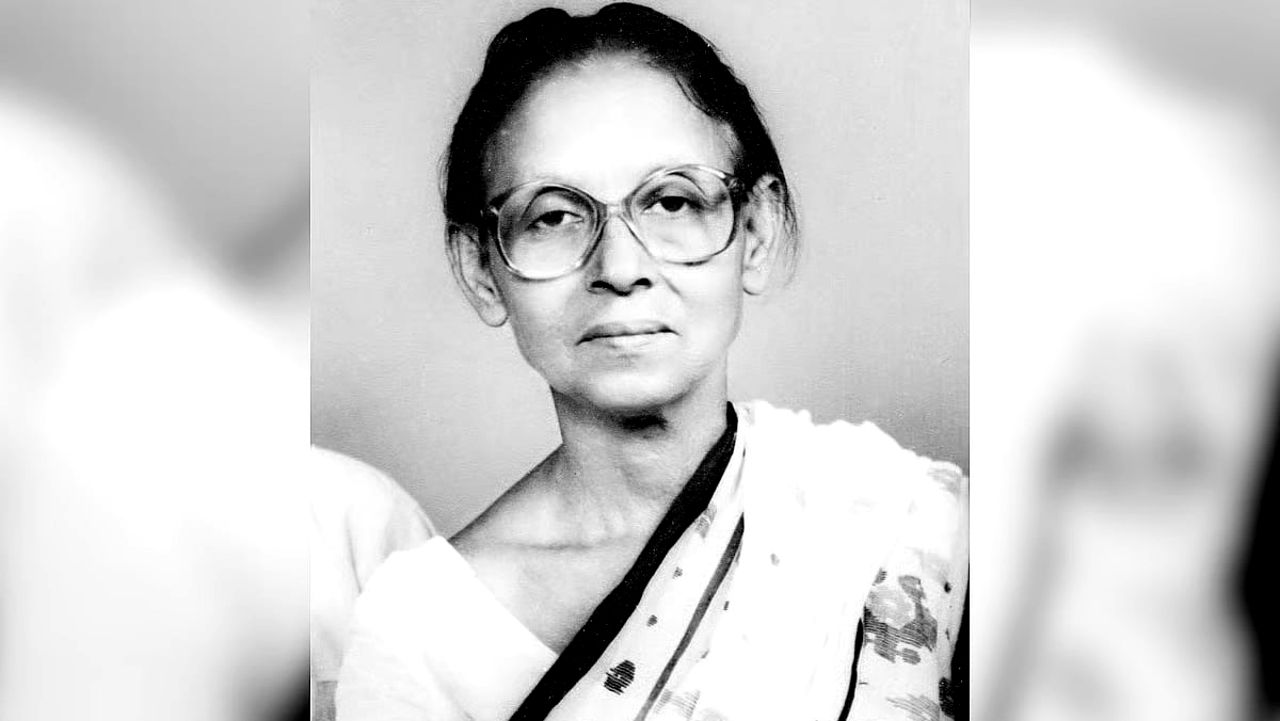
Ila became a member of the Communist Party in 1943, at the age of 18 years. This was also the year of the infamous Bengal famine in which lakhs of people perished. Ila became a member of ‘Mahila Atmaraksha Samiti’ and worked in the langarkhanas distributing cooked food. She was a Bengali Honours graduate and an established star athlete who was selected for the 1940 Olympics. Unfortunately, the Olympics that year was cancelled due to the on-going World War. She then got married to a communist whole-timer, Ramendranath Mitra (aka Ramen), who was the son of a zamindar in Ramchandrapur. This transition from a liberal father’s house in Calcutta to a conservative zamindar family in the far-off Ramachandrapur was difficult for Ila, despite Ramen’s communist ideals, as it was unthinkable for a daughter-in-law of a zamindar family to engage with common people. With great difficulty, she convinced her mother-in-law and opened a school in the area, which then became her outlet to engage with the masses. However, this soon encountered issues when the conservative Muslims in the area alleged that a ‘mleccha’ was out to violate the purdah system of their women. However, poorer Muslims countered this allegation by counter questioning that the purdah of the Muslim women is not violated when they work in the houses and fields of the zamindars! The opposition quietened thereafter, and thus, the school that began with a mere three students began to flourish, where decades later, a college was being run!
When the Noakhali riots occurred after the gruesome killings in Calcutta, Ila and other women activists went to Hasnabad and stayed there for nine months, where there was relative calm. Ila later reminisced that communalism, feudalism and domination of men over women went hand in hand. Meanwhile, the movement against zamindars who were unwilling to part with two-thirds of the produce, continued unabated. This made it no longer safe for Ila and Ramen to live in their house, and therefore, they went underground. Initially, it wasn’t easy to live with the Santhals, as there was distrust that Ila was a woman of the zamindar house. But, she slowly began to earn their trust by helping them with domestic chores and learning their language, and this helped her transform into a new avatar – Ranima – as she was fondly called.
The Santhal, Muslim and Hindu peasants rallied around her and their struggle became more militant with occasional clashes between the peasants and henchmen of the landlords. This was also a time when Ila was in the final stages of her pregnancy, and gave birth to a son in 1948. The police were on a relentless look out for her and Ramen, and due to this, she had to leave the house after 16 days of giving birth. The police frequently entered villages, beat up people and burnt down huts. In retaliation on January 5th, 1950, about 5,000 peasants attacked a police party and killed all of them. This incident happened so suddenly, that Ramen and Ila were unable to control the mob. Severe repression followed, where villages were burnt down, and hundreds of people killed. People fled their homes. The peasants repeatedly requested Ila to be taken to safety, but she refused to leave until everyone was safe. Dressed as a Santhal woman, she accompanied a group to Ruhunpur station, where she was immediately captured, as her attire could not hide the sparkle of rebellion in her eyes.
She was subjected to severe torture and physical abuse. The police repeatedly tried to force the peasants to confess that it was Ila who had instigated them to kill the police, but the peasants did not relent to the pressure. Several of them were killed in front of her eyes, and the resultant trauma devastated her. In the Rajshahi jail, she was reduced to mere bones and everyone thought her death was imminent. Ramen then daringly came to visit her “for the last time” in disguise, and brought along Mohan, their six-year-old son. They didn’t recognise each other.
After having failed to implicate her in the mass killing of the policemen, and upon the advice of doctors, she was granted parole. In 1954, she left for Calcutta with Dr. KS Alam, whose medical treatment and the care of women inmates of Rajshahi jail, ensured she remained alive. However, she never fully recovered despite treatment. She completed her Master’s Degree in 1957 and then settled for a teaching job in Sibnath Shastri College. All the while, the East Pakistan government made repeated efforts to bring her back, but thanks to the efforts of CPI and leaders like Aruna Asaf Ali and Hirendranath Mukherjee, she was given Indian citizenship. All her life she worked for the party, and was elected as a Member of the Legislative Assembly from 1962 to 1977. She consistently worked for refugee rehabilitation, peoples’ education, and particularly women’s education. In 1962 during Indo-China war, she went to jail with other communist stalwarts. She lived in Park Circus in 1964-65 when riots broke out in the city. Even when engaged in cooking, she would come down, clad in saree and ‘khunti’ in hand and stand amidst the mob daring anyone to attack her Muslim neighbours. She was an active participant in the Food Movement of the 1960s. During Bangladesh Liberation war, her house was an open shelter for Muktizoddhas – the same after Naxalbari in 1967. Her door was always open for young men and women who were on the run or living underground. Using her powers as an MLA, she saved many from arrest or encounters. From 1970-74, she was arrested three times mainly for taking up the peasants’ cause. In her later years, she began translating progressive literature. Her translation of ‘The Girl from Hiroshima’ fetched her the Soviet Land Nehru prize. She also translated a biography of Lenin. She took active part in installing the statue of Lenin in Esplanade and naming a major road in the area as Lenin Sarani. The present state government is trying to undo the same, a reflection of the terrible time we are facing now.
Ila Mitra’s entire life was dedicated to the peoples’ cause. She was a true revolutionary, India’s own Mother Courage.