Most of the protesting workers are non-unionised and contract workers across key sectors such as energy, automobiles, garments, and associated industries, where large production units employ in thousands. They are deprived even of statutory minimum wages, which themselves are insufficient to meet basic monthly expenses given the price rise of essential commodities, inflation, etc. Working conditions are as exploitative and degrading, with 12-hour shifts often without breaks, requiring workers to remain standing throughout. Legally mandated provisions such as double wages for overtime and weekly holidays are frequently denied. In cases of workplace injury or illness, workers often bear medical expenses themselves. A significant issue raised by women workers in Noida concerns sexual harassment and the absence of effective internal complaints mechanisms.
The protests now spread to newer regions, including parts of Rajasthan and Uttarakhand. State responses in BJP-ruled states are aligned with industry interests, involving intimidation, threats, provocation, and heavy police action against workers. Uttar Pradesh Chief Minister Yogi Adityanath has issued warnings against those “spreading industrial unrest”. Several leaders of trade unions in Gurugram and Noida, even those who were not linked to factories where workers held protests, the Yogi government began implementing a well known pattern of persecution. On the very first day of the street protests, it declared that the workers were linked with Pakistani elements, naxalvaad, urban naxals, etc., and that such links will be duly investigated. Many activists who went to Noida in solidarity with the workers were arrested. Hundreds of workers have been detained from roads, homes, or factory premises. Now UP police claim to have arrested the ‘mastermind’ from Tamil Nadu - who is after all an engineer by profession and an activist actively supporting workers' demands.
These developments reflect the actual mindset of the UP and Haryana administrations hellbent on denying workers any democratic space to peacefully raise their voice against semi-slave exploitation of wages and labour time.
The arrests in Noida were made by police so indiscriminately that some minors and non-workers were also picked from roads and sent to jail. There are deliberate procedural violations by police, including not informing families of arrested workers or providing copies of FIRs.
The activists of All India Association for Law and Justice (AILAJ) accessed two FIRs in Manesar and Gurugram filed by the police, and have said that they bear grave and immediate consequences for workers. The addition of “sweeping and serious accusations, especially ‘attempt to murder’ in FIR No. 94/2026, conspiracy, common object liability, and offences framed as attacks on public servants, jointly and severally, have the predictable effect of making bail harder to secure, prolonging incarceration, and sending a chilling message to all workers that participation in collective protest may be answered with inflated and false criminal charges”. AILAJ activists were also detained by Gurugram police when they tried to meet workers on the streets, and were escorted out of the city.
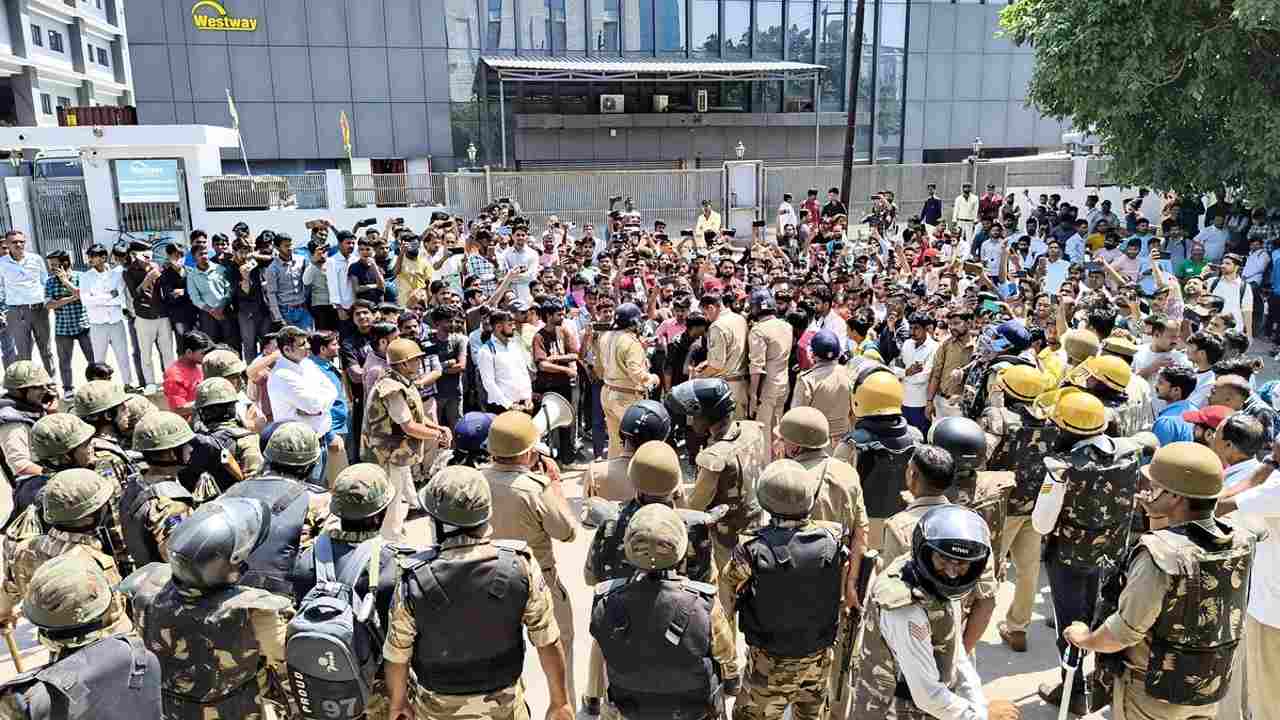
April began with protests across multiple factories in the Gurugram–Manesar belt, continuing a broader national trend. Workers from companies such as Honda, Munjal Auto, Richa Textiles, Satyam Auto, and Pricol gathered at factory gates to demand wage increases. When management did not engage, many moved onto public roads while maintaining peaceful protest. Authorities too tacitly sided with the factory managements and resorted to violence, lathi-charge, tear gas shell and arrests by the police. Braving all repression, the number of participating factories more than doubled in the next two to three days, and the number of protesting workers also swelled to many thousands.
On April 9th, the Haryana government announced a 35% increase in minimum wages. However, even the revised wages remain inadequate. With reported monthly earnings ranging from Rs.8,000 to Rs.13,000 for long working hours, without any weekly holiday, the revised wages are still seen as insufficient. A study by the All India Central Council of Trade Unions (AICCTU) estimates a minimum monthly requirement of Rs.42,000 for a family. The Haryana State Minimum Wage Committee had recommended Rs.23,196 in December 2025. With 35% increase a worker’s wage in unskilled category comes to be only Rs.15,220 per month, which is grossly insufficient.
Nevertheless, this wage increase was viewed as a victory for workers' collective strength. The message spread quickly to the whole NCR region and workers in NSEZ Noida phase 2 came to the factory gates to raise their wages. Many big industries, including Motherson, Richa Garments, Dixon Tech saw peaceful flash strikes for two-three days without any violence. The agitating workers maintained polite dialogue with whoever came to talk to them from management, administration or police. But on April 13th, there was heavy police repression on workers on the highway. Many claim this situation was a result of provocations and threats by managements and police. Indiscriminate arrests were made in huge numbers.
Following these events, the Uttar Pradesh government announced an interim wage increase of 21%. Despite this, protests continued to spread across additional sectors and factories in Noida and surrounding regions.
Parallel developments have been observed in other industrial centres across Uttar Pradesh, Rajasthan, and Uttarakhand, as well as in major NTPC power plants in Bihar and Jharkhand.
The new labour codes have structurally weakened worker protections by facilitating flexible hiring and firing, redefining wage calculations, permitting longer working hours, restricting the right to strike at 14-day notice, hence making all genuine strikes illegal. It has diluted safety and maternity protections among many other rights accrued to the working class, while giving a free hand to sham contractors and employers.
Prominent intellectuals, writers, citizens and cultural organisations have issued a joint appeal calling workers’ wage struggle, a part of a broader defence of democratic rights and human dignity. They have called to actively come in support of the workers struggling against state repression.
On April 19th, lawyers and activists held a press conference in Delhi raising concerns about police actions in Noida, including allegations of wrongful arrests and targeting of activists. They cited cases such as the arrest of writer and activist Satyam Verma in Lucknow and the detention of poet and activist Katyayani, among others, and criticised actions against individuals associated with Mazdoor Bigul.
The All India Central Council of Trade Unions (AICCTU) has condemned the arrests and detentions and said the police in Noida have targeted activists and even lawyers who were trying to provide legal assistance to workers. Comrade Amar Singh, District Committee President of the Gautam Buddh Nagar unit of the AICCTU, was placed under house arrest along with several other union leaders on April 13th. Rajiv Dimri, General Secretary of AICCTU has said the ongoing protests clearly indicate that workers across the country have become fully aware of the nexus between corporate profiteers and the Double-Triple Engine BJP governments. AICCTU warns the government and employers against using violent force on the workers protesting for bare minimal survival needs. These protests shall only intensify further if the demands of the workers are not met.
====

Cost Of Living Crisis Can No Longer Be Ignored
(Some points raised in the opinion column by Himanshu, Indian Express, April 21st, 2026 article titled – “In Noida and beyond, workers’ protests are proof that cost of living crisis can no longer be ignored”)
The cost of living crisis can no longer be ignored. Since January 2026, inflation has increased, with food inflation rising even more, and LPG prices reportedly acting as a trigger, reaching Rs.400–500 per kg. At the same time, regular wages in urban areas declined by 1.2 per cent per annum between 2011–12 and 2022–23, with a corresponding decline of 0.6 per cent per annum in rural areas. More than 310 million workers registered on the E-Shram portal report that 94% earn less than Rs.10,000 per month. The latest Annual Survey of Unorganised Sector Enterprises (ASUSE) 2025 shows average monthly earnings of Rs.10,376 in rural areas and Rs.13,012 in urban areas. Stagnant earnings alongside rising inflation have persisted for nearly a decade, a trend also highlighted in the Economic Survey, which notes declining incomes of regular and self-employed workers.
===
How Workers’ Exploitation is Systemic
The financial data of
Samvardhana Motherson International Limited shows that its revenue has
steadily increased from Rs. 57,370 crore in FY21 to Rs. 1,13,663 crore
in FY25, while profits have risen from Rs. 1,243 crore to Rs. 4,146
crore over the same period.
At the same time, a large section of
shop-floor and contract workers earn around Rs. 13,000 per month, or
roughly Rs. 1.5–2 lakh annually. With a workforce of around 90,000, this
indicates that workers receive only a very small share of the total
value generated within the company.
Even without a detailed cost
breakdown, it is evident that each worker is associated with the
production of substantial economic value, given the scale of revenue and
output. However, their wages remain low and close to unviable
subsistence levels, while the value they help generate is increasingly
appropriated, as reflected in rising profits.
In this company,
revenue has nearly doubled over five years, and profits have more than
tripled, but workers’ wages—especially at the lower end—have remained
stagnant. This indicates that increases in productivity and output are
not translating into proportional increases in wages. Instead, a growing
share of the value produced is being appropriated as surplus.
Workers
earning Rs. 8-13,000 a month are contributing to a rapidly expanding
enterprise, yet they receive only a fraction of the value they help
generate. In effect, a significant part of their labour time remains
unpaid.
As revenue and profits rise, wages remain near subsistence
levels. Data points to a clear pattern: the expansion of capital is
built on the systematic appropriation of surplus generated by labour.
Dixon Technologies, Kent RO Systems, Richa Global Exports, and Spark Minda are among the companies that have come into focus during recent worker agitations in April. Although they operate in different sectors, a common characteristic among them is the persistence of low, near-starvation wages, even as revenues and profits have grown. In many cases, real wages have remained stagnant or even declined. (See the table)

(Compiled by Saurabh Naruka)