
Citizenship is at the heart of the constitutional order. As the Supreme Court of India (SCI) put it in a 2004 judgement (In Re: Section 6A of the Citizenship Act, 1955, para 9.), citizenship grants people the right to bear rights.
On 2 May 2025 the Ministry of Home Affairs (MHA) sent out “secret” guidelines to all states and union territories to fast-track the verification of suspected Bangladeshis and Rohingyas. This order gives draconian powers to the state/UT authorities over Indian citizens merely “suspected” of being Bangladeshis or Rohingyas.
Before examining the order let us refer to the events in Gurugram through which the “secret” order came to light.
From 18 July, there were stray reports of Bangla speaking working class people being detained by the police under the suspicion of them being Bangladeshis. Such news had been reported from various parts of Delhi as well over the last few months, especially during the weeks leading up to the recent Delhi Legislative Assembly elections. The Gurugram verification drive however seemed different from the Delhi incidents: much bigger, more draconian, and impacting migrant workers’ lives and livelihoods en masse.
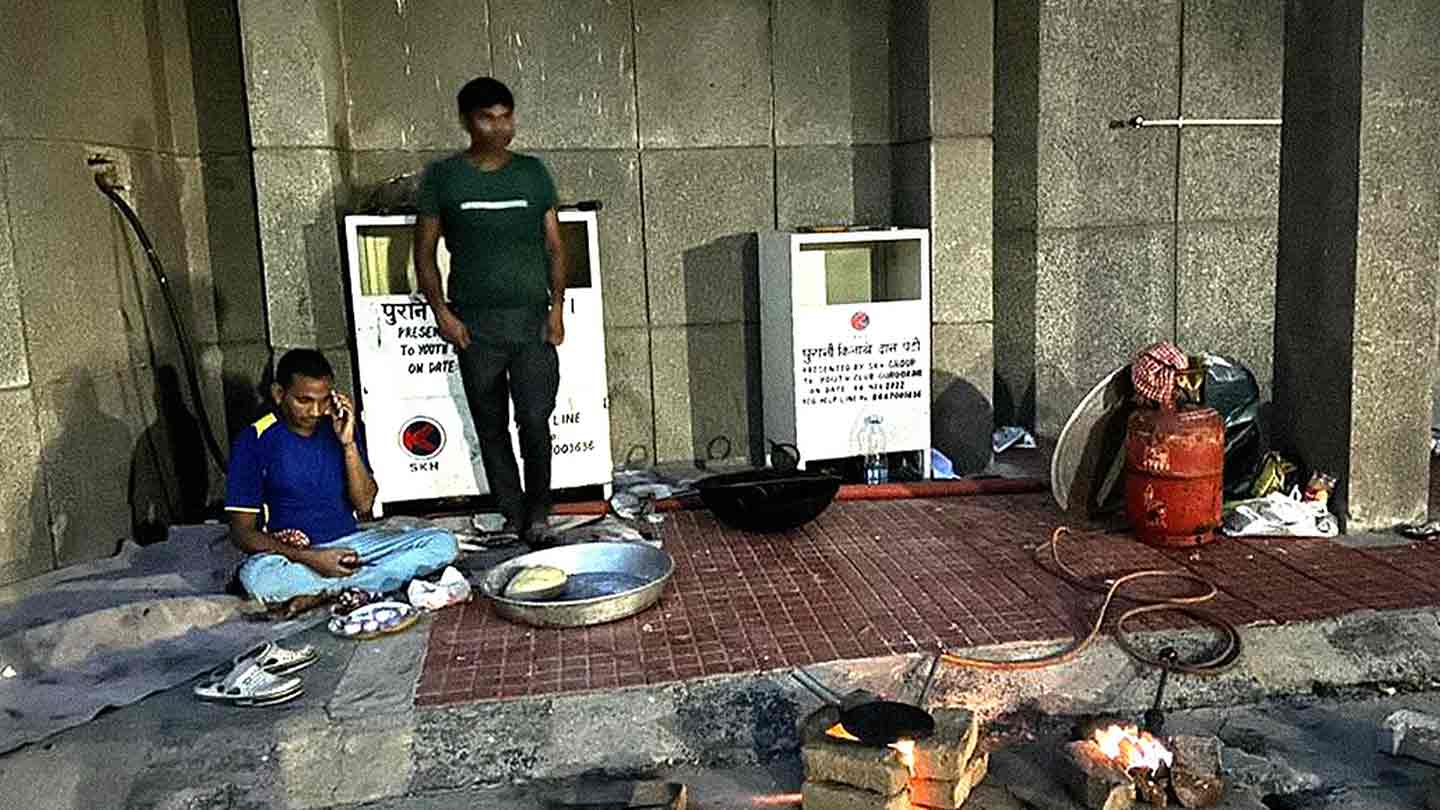
By 19-20 July, there were reports of detention centres in Gurugram. To verify these reports, a CPI-ML team visited Gurugram on 22 July. The team found that the community centre of Sector 10A had been converted to a makeshift detention centre. It held seventy-five (75) male workers. Sixty-five (65) of them were from Assam while ten (10) were from Nadia and Murshidabad districts of Bengal. All of them spoke Bangla as their mother tongue and were Muslims. They all worked in the informal sector – mostly as cleaners, construction workers and domestic workers. Some worked as security guards, drivers or street hawkers.
Upon further enquiry by the team, they were informed by the police officials at the Sector 10 Police Station that the detentions were pursuant to an order of the Gurugram District Magistrate (DM). The order, dated 22 July, referred to a letter by the MHA which issued Standard Operating Procedures (SOP) to the police for deporting illegal Bangladeshis and Rohingyas. Based on the SOP, the police opened four Special Holding Centres in Gurugram for detaining illegal migrants from among these two communities, and initiated a special search operation from 18 July – the DM’s order stated. Community centres of Badshahpur, Sector 10A, Sector 40 (West Zone) and Sector-01 (Manesar) had been converted into Special Holding Centres. Together they held over 250 detainees on 22 July – all Bangla speaking migrant workers and predominantly Muslim.
The police gave us a copy of the DM’s order but refused to show the letter from the MHA. CPI(ML) contacted the journalists who had reported on the letter. We learnt that the officials at the Home Ministry had asked the journalists to take hand-written notes from the letter, and refused to share a hard copy with them or to even allow them to take a photograph of the letter. CPI(ML) subsequently obtained a copy of the letter containing the guidelines through trustworthy sources.
On 25 July, CPI(ML) GS Comrade Dipankar Bhattacharya led a 15-member delegation of CPI-ML leaders, civil rights activists, lawyers, journalists and concerned citizens of Gurugram to meet the detainees and other affected residents, and to protest the administration’s arbitrary acts. The delegation visited workers’ colonies in four different parts of Gurugram, including two detention centres, and met with the Police Commissioner and other concerned officials.
The visit had a big impact and played an important role in halting the exercise temporarily. CPI(ML)’s interventions have also led to the creation of a Migrant Solidarity Network in Delhi-NCR which has brought together democratic minded citizens against different forms of attacks on citizenship especially in the context of migration.
Legal Analysis of the MHA Guidelines
The guidelines contain the first-of-its-kind instructions for detention of people on the mere suspicion of being foreign nationals.
The guidelines invoke the Foreigners’ ‘Act, 1946 and the Citizenship Act, 1955, with regard to the treatment of foreigners / illegal immigrants, but extends detention to Indian citizens who might be “suspected” of being nationals of Bangladesh or Myanmar. Neither of the aforesaid acts allows for detention on mere suspicion. The guidelines are therefore illegal. Even section 3(2)(g) of the Foreigners’ Act, which authorizes detention without a stated reason, applies only to foreigners and not to suspected foreigners.
The guidelines grant blanket adjudicatory powers to the executive without any check whatsoever. This goes against the basic structure of the constitution. While the SOP authorizes detention under suspicion and grants the police all the powers of verification, it does not provide:
(a) a clear basis on which suspicion can be cast on Indian nationals
(b) the procedure by which the verification is supposed to take place
(c) the documents which migrants should keep ready for verification
(d) an explanation as to why existing documents like Voter card, Aadhar card, PAN cards and even NRC certificates
(e) a verification certificate following the exercise which would grant immunity to migrants from similar drives in the future
(f) an explanation for the 30-day rule, by which a citizen can be adjudged to be a foreigner if the police fail to verify his citizenship within 30 days of detention
(g) the suspected Indian citizen a right to appeal his detention or, in case he is adjudged to be a foreigner, any such adjudication.
The lack of a right to appeal – a citizen’s detention or his adjudged status as a foreigner – is a clear violation of the rule of fair hearing.
The lack of clear basis for casting suspicion makes the exercise arbitrary and deeply racialized and class-ist. The Gurugram police openly stated that suspicion fell “naturally” on Bangla speaking migrant workers with “Muslim” names.
There is no provision of compensation for the loss of livelihoods of workers during the period of detention or due to the unwillingness of employers to keep them in their jobs following detention. This violates their right to livelihood under Article 21 of the constitution.
It violated India’s obligations under international law – the Universal Declaration of Human Rights (UDHR) as customary international law and the International Covenant on Civil and Political Rights (ICCPR) – which require citizenship decisions to be transparent, proportionate, and grounded in fair procedure.
Implementation in Gurugram
Speaking to the workers, the CPI(ML) teams found that the detentions were mostly performed by plain clothes people who arrived in unmarked vehicles, and bore no badges of name or identification. From various locations, multiple people were picked up and taken away to the holding centres. After holding them, they were asked to prove their citizenship, wherein documents such as Aadhar Card, voter ID card, ration cards, PAN cards etc were not considered sufficient.
The detained men were held in the police station for extended durations, the period lasting up to a week for some individuals. There have been isolated reports of police brutality, torture, and confisca to ally the fear tion of their valid Voter, Aadhar and PAN cards, and unfounded accusations of their documents being fake. In several instances, the detained individuals were asked to accuse some people from their colonies of being Bangladeshi, if they wanted to get released.
We understand that the authorities verified the detained peoples’ addresses through the police stations in their states of origin (Bengal or Assam), but did not provide the detainees with any certificate of verification before releasing them. This makes them vulnerable to future detentions and harassment.
The authorities seem to be identifying suspects based on three parameters: speaking in Bangla, having “Muslim” names, and living in workers’ jhuggis. The biased and discriminatory attitude of the officials came through clearly when we questioned them on their procedure for identification.
The arbitrary nature of the procedure has allowed anti-social elements and politically motivated groups to step in and harass migrant workers. There have been several reports of such groups beating people up and threatening workers to leave. The police, when questioned, completely denied knowledge of and responsibility for such acts.
Credible reports have emerged of the continued detention of ten (10) migrant workers who had initially been held in the Sector 40 detention centre. Government officials have stated that their detention process has been initiated. The identities of these ten people are not in the public domain.
The migrant workers have received little social support from their employers or landlords. Residents’ Welfare Associations have officially asked residents to cancel the gate passes of domestic workers who have not reported for work due to this drive and presumably fled. The CPI-ML teams met a contractor who was taken to a police station and beaten for allowing suspected Bangladeshis to live in jhuggis on his land.
The verification drive has culminated in a climate of tremendous fear among Bengali speaking migrant workers. The affected communities have expressed total confusion and uncertainty over what documents were considered “valid” and what process was being followed for verification. The climate of fear is evident, with no clarity or communication from the state machinery to allay the fear. In some areas, the police threatened the workers to leave by 1 August or face dire consequences. Thousands of families have returned to their home states fearing arbitrary detention and torture. This has had a devastating effect on their homes, their livelihoods and on the education of their children.
This was clearly not a one-off verification exercise, but part of an overall attack on citizenship and the rights of working people, of Muslims, and of linguistic groups beyond the Hindi speaking belt.
The SIR in Bihar, the Foreigners’ Tribunals in Assam, the Home Ministry guideline that ravaged Bengali speaking working class communities in Gurugram, the administrative arbitrariness and judicial nonchalance in demolitions of Muslim, Dalit and backward caste homes, combined with the absence of statutory guarantees of housing and land rights in urban India, indicate the formulation of a legal-administrative architecture to institutionalise and expand disenfranchisement.