PART - I
1
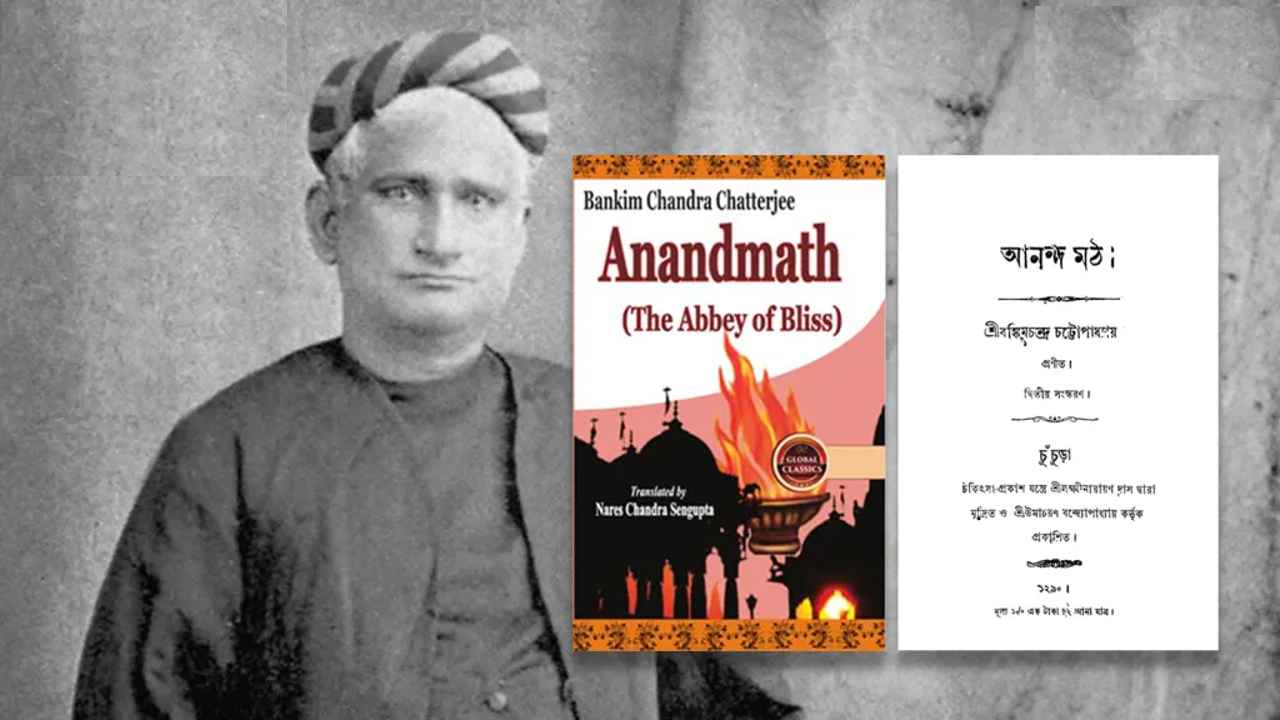
Few works of nineteenth-century Indian literature have acquired as complicated a political afterlife as Bankim Chandra Chattopadhyay’s ‘Anandamath’. Fewer still have produced a symbol as powerful and contested as 'Vande Mataram.” The history of ‘Anandamath’ and “Vande Mataram” cannot be adequately understood through either of two conventional narratives. The first celebrates Bankim as an uncomplicated prophet of Indian nationalism and reads “Vande Mataram” exclusively as the sacred song of the anti - colonial struggle. The second reads Bankim, simply as the precursor of modern Hindu communalism, and treats ‘Anandamath’ as little more than an early manifesto of Hindu nationalism. Both interpretations are inadequate.Bankim was a considerably more complicated intellectual figure. His early literary career was shaped by colonial modernity, Western education, rationalism, social criticism and the emerging Bengali middle class. His later writings, however, increasingly sought the regeneration of Indian society through a reconstruction of Hindu ethical and religious thought. In this transformation, the nation increasingly appeared not merely as a political community, but as a sacred cultural entity.
That transformation is crucial to understand the political career of ‘Anandamath’. It is equally important to distinguish Bankim from those who came later. Bankim did not formulate Savarkar’s doctrine of Hindutva. He did not establish the Hindu Mahasabha or the RSS. He could not have anticipated the political programmes of Savarkar, Hedgewar or Golwalkar. Yet, the intellectual and symbolic vocabulary he developed – Mother India as a sacred mother, the recovery of Hindu civilisational strength, the moral regeneration of society, disciplined self-sacrifice, the fusion of religious imagery with national consciousness and the representation of Hindu history as a source of political regeneration – provided an extraordinarily fertile cultural resource for later Hindu nationalist politics.
The story, therefore, is not one of simple ideological inheritance. It is a story of ‘‘appropriation, transformation and political reinterpretation’’.
2
To understand Bankim’s later nationalism, one must first resist the temptation to read his entire literary career backwards from ‘Anandamath’. Bankim’s early fiction belongs to a very different intellectual world. With ‘Durgeshnandini’ (1865), followed by ‘Kapalkundala’, ‘Mrinalini’, ‘Vishabriksha’, ‘Indira’, ‘Chandrashekhar’, ‘Rajani’ and eventually ‘Krishnakanter Will’ (1878), Bankim helped create the modern Bengali novel. The central concerns of these works were not yet the construction of a Hindu nation. They included love, marriage, sexuality, family, property, social convention, female agency, morality and the conflict between individual desire and social norms. This was the world of a colonial intelligentsia negotiating modernity.
Bankim was deeply influenced by European literature and intellectual thought. He was neither a simple traditionalist nor a defender of an unchanging Hindu social order. He was fascinated by science, rational inquiry and the intellectual resources of the West, even while becoming increasingly dissatisfied with the cultural and moral consequences of colonial domination.
The importance of this early phase becomes particularly evident when we consider ‘Samya’. Published in 1879, ‘Samya’ contained a striking engagement with the question of social inequality. Bankim subsequently withdrew the work from circulation as part of his authorised writings. This decision was significant, although it should not be converted into the simplistic claim that Bankim was once a “socialist” and later became a Hindu nationalist.
The change was subtler. The central question of his intellectual life was shifting. The Earlier Bankim was preoccupied with the problems of ‘‘individual and social reform’’. The Later Bankim increasingly became preoccupied with the ‘‘moral regeneration of a civilisation’’. And in his search for the foundations of that regeneration, he turned increasingly towards Hindu religious thought. By the late 1870s, Bankim was increasingly concerned with the question of why Indian society appeared politically weak and morally disorganised under colonial rule. The answer he increasingly developed was not simply political. ‘India needed a moral reconstruction’. Religion, in this new formulation, was not merely ritual or private faith. It was a source of ethical discipline, social duty and collective strength. This was the intellectual soil from which ‘Anandamath’ emerged. The transformation is particularly important, because Bankim did not merely return to traditional Hinduism. He attempted to ‘‘reconstruct Hinduism through the categories of modernity’’.
He subjected religious traditions to rational examination. He reinterpreted Krishna. He engaged with the Bhagavad Gita. He sought to identify an ethical core within Hindu religion that could produce disciplined, active and morally regenerated human beings. The Later Bankim was, therefore, neither simply orthodox, nor simply modernist. He was attempting to create a modern Hindu moral philosophy. This was the basis of his Later Nationalism.
3
Bankim Chandra Chattopadhyay’s Anandamath is one of those Bengali novels whose influence has extended far beyond the literary sphere, leaving a substantial imprint on society, politics and historical consciousness. Bankim drew some of its materials from a particular chapter of history — the Sannyasi Rebellion. But, he altered those historical materials to such an extent that Anandamath can no longer be regarded simply as a historical novel.
Bankim had already demonstrated his extraordinary ability to blend history and imagination in Rajsingha. He had shown how effectively the historical past could be employed as a backdrop for romance and adventure in Durgeshnandini and Kapalkundala. In Chandrashekhar, he had demonstrated his distinctive skill in placing the moral crises of society and family against a historical background. Again and again, Bankim showed how history could be appropriated and reshaped for different literary purposes.
In Anandamath, however, he used history for a different and more explicitly political purpose. Here, the historical setting becomes the vehicle for articulating a political vision.
At the centre of Anandamath, stands a group known as the Santan community — the “Children.” The real architect and ideological guide of this organisation remains largely in the shadows. Only towards the end, we hear, through the enigmatic physician, the philosophical, historical and political ideas that lie behind the movement.
Throughout most of the novel, the visible leader of the Santan order is Satyananda. His principal associates are Bhavananda, Jibananda, Dhirānanda and other ascetics who have renounced domestic life and dedicated themselves to the worship and service of the Mother. Under the leadership of Satyananda, Bhavananda and Jibananda, the Santan organisation steadily expands.
Their struggle is directed against the existing rulers.
The historical background is the period following the Battle of Plassey and the Battle of Buxar, when the East India Company had acquired the Diwani, or effective economic authority, over Bengal, while formal political sovereignty still nominally remained with the Nawab. After the defeat of Siraj-ud-daulah at Plassey and Mir Qasim at Buxar, the Nawabs of Bengal had effectively become puppets of the East India Company. Mir Jafar and his successors occupied the throne largely in name.
It was during this chaotic period of dual government that the Sannyasis launched their attacks. Again and again, the leaders of the Santan order insist that a ruler who fails to protect his subjects has no legitimate claim to their allegiance.
But, it becomes equally clear that their objective is not merely to overthrow an ineffective or oppressive government. They seek to destroy Muslim rule and establish Hindu rule in its place. According to the Santan leaders, Muslims obstruct the Hindus in the practice of their religion and, therefore, must be weakened and ultimately expelled by whatever means necessary.
One of the most revealing statements occurs when the Santan leaders describe the condition of the country: “Of all the countries—Magadha, Mithila, Kashi, Kanchi, Delhi, Kashmir—where is there such misery? In what country do people eat grass because they have no food? Eat thorns? Eat termites? Eat forest creepers? In what country do people eat jackals and dogs, eat corpses? In what country can people not keep money safely in their chests, cannot sleep peacefully with a Shalagrama on the throne, cannot keep their wives and daughters-in-law safely in their homes? They rip open a woman’s belly to take out her child. With every other king there is a relationship of protection and maintenance with his subjects; but where does our Muslim ruler protect us? Religion is gone, caste is gone, honour is gone, lineage is gone—and now even life itself is disappearing. If these drunken, shaven-heads are not driven out, what remains of Hindu identity?” The political logic is unmistakable. The Santans are not simply rebels against misrule. Their rebellion is increasingly articulated as a project of Hindu political restoration.
The Santan organisation consists, on the one hand, of several thousand men forming a relatively well-organised fighting force and, on the other, of a smaller but ideologically committed leadership. Not all members of the army are religious initiates. Some participate for material rewards. But, the leadership belongs exclusively to those who have accepted the ideological discipline of the order.
Satyananda explains: “The Children are of two kinds—initiated and uninitiated. Those who are uninitiated are householders or beggars. They appear only when there is war, and after receiving their share of the loot or some other reward, they leave. Those who are initiated have renounced everything. They are the leaders of the community. I do not ask you to become an initiated Child; there are plenty of men with sticks and clubs for fighting. Unless you are initiated, you will have no authority in any serious work of the community.”
Thus, Anandamath does not merely present a collection of philosophical rebels. It depicts a movement with an organisational structure, ideological initiation and military discipline. The Sannyasis recruit thousands of volunteers, initiate them into the cult of the Mother and inspire them to sacrifice their lives. They establish weapons workshops, construct fortifications and dig defensive moats around them. Mahendra, a powerful zamindar, becomes an important supporter of these activities. The movement, therefore, possesses the essential characteristics of an organised revolutionary force: recruitment, ideological training, military preparation, financial resources, weapons production and territorial defence.

The political ideology of Anandamath is inseparable from its conception of religion. Satyananda identifies the Santans as Vaishnavas, but immediately makes it clear that their Vaishnavism is radically different from the devotional tradition associated with Chaitanya.
When asked how the Santans can be Vaishnavas when non-violence is regarded as the supreme principle of Vaishnavism, Satyananda responds:
“That is Chaitanya’s Vaishnavism. This is merely the half-religion that arose in imitation of atheistic Buddhism. The true characteristic of Vaishnavism is the suppression of evil and the rescue of the earth. Vishnu is the preserver of the universe. He has taken bodily form ten times to rescue the earth. He himself destroyed the demons Kesi, Hiranyakashipu, Madhu-Kaitabha, Mura and Naraka; the Rakshasas such as Ravana; and kings such as Kamsa and Shishupala. He is the conqueror, the giver of victory, the saviour of the earth, and the chosen deity of the Children.”
Satyananda then draws an explicit distinction between the loving Vishnu of Chaitanya and the powerful Vishnu of the Santans: “Chaitanya’s Vishnu is full of love—but God is not merely full of love; He is infinite in power. Chaitanya’s Vishnu is only loving; the Vishnu of the Children is only powerful. We are both Vaishnavas—but both are only half-Vaishnavas.” This is politically significant. Bankim is reconstructing Vaishnavism as a doctrine of power, discipline, combat and political action. The passive or purely devotional Hindu is rejected. In his place stands the militant religious subject — the warrior who regards the suppression of the enemy as a religious duty. This transformation of religious doctrine is central to the ideological architecture of Anandamath.
Yet, the political trajectory of the Santan movement contains a remarkable contradiction. Satyananda and the other Santans initially wish to move towards confrontation with the English, who are steadily emerging as the new rulers of Bengal. But their hidden leader, the mysterious physician, ultimately rejects that course.
Indeed, the novel's conclusion makes an extraordinary argument: English rule will bring peace, order and welfare; it will put an end to the disorder associated with Muslim rule and, paradoxically, create the conditions necessary for the eventual revival of Sanatana Dharma. Even before the final chapter, the novel repeatedly hints at this distinction between Muslim disorder and English rule.
For example, Bankim writes: “The Kotwal informed the royal government and had the Brahmachari and Mahendra confined in prison. That prison was terrible; almost no one who entered ever came out, because there was no one to administer justice. It was not an English prison — for there was no English administration of justice then. Today is the age of order; then was the age of disorder. Compare the age of order with the age of disorder.”
The contrast is deliberate. The Muslim political order is associated with arbitrary rule; English rule is associated with law, order and institutional governance. The most explicit articulation of this political position comes in the final chapter of the novel.
In the eighth chapter of the fourth part, the hidden protagonist finally emerges and reveals the political logic behind the entire movement. Satyananda and the other Santans wish to continue their struggle not only against the old Muslim regime, but also against the rising power of the English, because they ultimately desire the establishment of the Hindu rule.
The physician tells them otherwise. “The English are not the enemy; they are the allied power.” The exchange deserves close attention. Satyananda asks why, at the very moment when he has defeated the enemy and cleared the path for Sanatana Dharma, he has been ordered to abandon the struggle. The answer is unequivocal: “Your task has been accomplished. The Muslim kingdom has been destroyed. You have no further task. There is no need for further bloodshed.” Satyananda objects: “The Muslim kingdom has been destroyed, but Hindu rule has not been established. The English are still powerful in Calcutta.” The physician replies: “Hindu rule will not be established now. If you remain, there will be needless slaughter. Therefore, come.” Satyananda is devastated. If Hindu rule is not to be established, he asks, who will rule? Will the Muslims return? The answer is: “No. The English will now rule.” The physician then gives the ideological justification: “The English are highly learned in external knowledge and highly skilled in educating people. Therefore we shall make the English rulers. Through English education, the people of this country will become educated in external knowledge and will thereby become capable of understanding inner truth. Then there will be no obstacle to the propagation of Sanatana Dharma.”
This is one of the most politically revealing passages in Anandamath. The novel does not end with a straightforward call for immediate anti-colonial liberation. Instead, its hidden political philosophy proposes that British rule is historically useful, because it can provide the knowledge, education and social discipline necessary for the eventual regeneration of Hindu civilisation. The English, therefore, are not simply enemies. They are temporarily useful instruments of history. The physician goes even further: “As long as the Hindu is not once again knowledgeable, virtuous and strong, English rule will remain unbroken. Under English rule, the people will be happy and will practise their religion without hindrance.”
Satyananda, however, refuses to accept this logic. His emotional commitment remains with the Mother. The physician tells him: “Your vow has succeeded. You have served the welfare of the Mother — you have established English rule.” This is perhaps the greatest irony in the political structure of Anandamath. The Santans believe that they are fighting for the Mother. Yet, according to the novel's hidden ideological authority, their rebellion itself has helped establish the political conditions for British rule. The Sannyasi warrior imagines himself as the liberator of the Mother; the physician tells him that his historical task is to prepare the ground for British rule. Thus, Anandamath contains a striking political paradox: the destruction of Muslim political power is presented as the necessary precondition for Hindu regeneration, while British rule is presented as the temporary historical instrument through which that regeneration can ultimately become possible.
This is where the historical foundations of Anandamath become particularly problematic. The novel draws its inspiration from the Sannyasi Rebellion, which took place intermittently from approximately 1763 to 1800. But, Bankim had to significantly alter the historical record in order to make it fit his narrative. The actual rebellion cannot be reduced to a Hindu struggle against Muslims. It was, in substantial measure, a peasant rebellion in which Hindus and Muslims participated together. Majnu Shah was one of the principal leaders of the movement. Nurul Muhammad was another important leader. Yet, Bankim recasts this historical rebellion through his own ideological perspective and presents it primarily as a struggle against Muslims. This creates a fundamental tension between history and narrative. The historical Sannyasi movement does not fit neatly into Bankim's Hindu nationalist reconstruction of the past. The novel, therefore, transforms history rather than reproduce it. The contradiction becomes particularly striking in the battles described in Anandamath.
In the actual conflicts represented in the novel, the names of English officers — such as Thomas and Edward — are mentioned. Yet, no Muslim military commander is given comparable individual representation. At the same time, the battle cry repeatedly used by the Santans is: “Mar Nere!” — “Kill the Muslims!”. The historical enemy is, therefore, selectively reconstructed.
Bankim takes a complex anti-colonial and agrarian rebellion involving both Hindus and Muslims, and reshapes it into a predominantly Hindu political drama, in which Muslim rule becomes the principal historical antagonist. The result is not history. It is political myth constructed out of history.
Bankim transforms history into political mythology. The Sannyasis are transformed from historical figures into disciplined warrior–ascetics who subordinate personal existence to the cause of the Mother. The most important conceptual innovation of ‘Anandamath’ is, therefore, not its historical setting, but the transformation of the nation into a sacred object. The country is no longer merely land. It becomes ‘‘Mother’’ – and the Mother is progressively visualised through Hindu religious imagery. This is a revolutionary political metaphor.
Modern nationalism generally requires an imagined community that transcends local loyalties. Bankim supplied such a community with an extraordinarily powerful emotional symbol: the motherland as Mother. But, the metaphor contained an unresolved contradiction. If the Mother is simply the land of all Indians, the symbol can potentially embrace everyone. But, if the Mother is represented through specifically Hindu divine forms, the universal political community begins to acquire a particular religious identity. That tension would remain embedded in “Vande Mataram” and would eventually become unavoidable in twentieth-century Indian politics.
(To be continued)