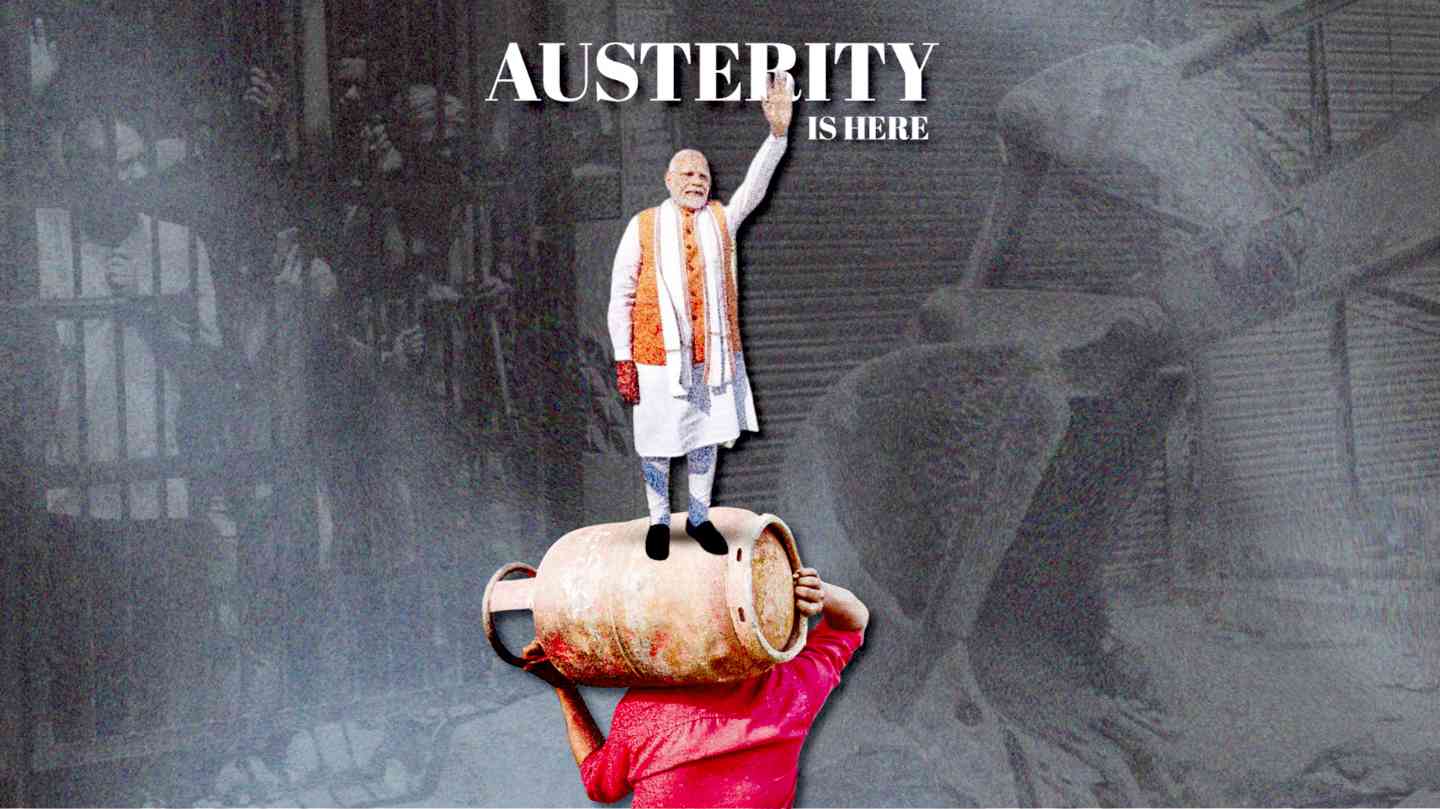
Unable to ignore the crisis any more, Narendra Modi is now asking the people to deal with it by following an austerity package for at least one year. Like demonetisation and Covid period lockdown, this austerity package also appears to have been designed as yet another citizenship drill or patriotic test. For the rich and the powerful, it may be fun to occasionally swap their cavalcade mode of travel with a well publicised metro ride, but how can daily wage earners work from home? Clearly, Modi's 'austerity drive' has different meanings for different classes. For the affluent minority, it is about showcasing their patriotic sacrifice, but for the poor and middle classes it is an enforced imposition of increased hardship.
From prosperity to austerity, from 'achhe din' and 'amrit kaal' to a newly discovered 'decade of disasters' - the economic narrative of the Modi government now suddenly follows a changed script. The government wants us to treat the economic crisis as a sudden accident caused by the US-Israel war on Iran. Narendra Modi is repeatedly invoking memories of the Covid pandemic to make people accept the economic crisis as an unavoidable global reality and not look for its domestic causes and hold the government to account for its policy failures.
This is a complete mockery of facts. There are two popular parameters of the economy which had been widely invoked by the BJP during Modi's 2014 election campaign: the exchange value of the rupee vis-a-vis the US dollar and the price of petrol per litre. Both hovered around Rupees sixty then. The promise was to bring the level back to Rupees fifty, but both had crossed the Rupees ninety mark before the US and Israel attacked Iran on February 28. Since then the rupee has deteriorated further, now it is close to one hundred rupees per dollar. Petrol has crossed the hundred rupee per litre mark in most states.
For much of the Modi era, crude oil prices had been significantly low in the global market. The pandemic and the consequent economic disruption and slowdown had actually triggered a veritable crash in global oil prices. But the benefits of this price drop were never transferred to the ordinary Indian consumer. Even when India was buying cheap crude from Russia before bowing down to Trump's embargo, it was the Ambani group which reaped a hefty windfall by selling the refined petroleum back to the western world which had imposed sanctions on Russia following the Ukraine war. All this while the Modi government continued to collect hefty oil revenue from Indian consumers to balance the sharp reduction in corporate taxes.
Inasmuch as the Iran war is responsible for the escalation of the current economic crisis, the question we must first ask is why did the Modi government side with the US-Israel axis in this patently unjust war on Iran? Why has the Modi government succumbed to American dictates on India's sovereign economic and trade decisions? Is this sacrifice of India's strategic autonomy and economic interests a price that the Modi government has inflicted on India to bail out the Adani Group from punitive action for corporate fraud charges in the US?
Instead of taking responsibility for the crisis resulting from the government’s own policies, especially pro-corporate economic policies and pro-US foreign policy, the regime is busy transferring the burden of the crisis onto the common people. And wherever people are taking to the streets demanding living wages, as witnessed in powerful workers' demonstrations in Noida, Manesar and other places, the state is resorting to mass arrests of protesters and even invocation of the draconian National Security Act against activists. While a bench of the Supreme Court has criticised this repressive response of the government and defended the rights of workers to ask for fair wages, the Chief Justice of India describes India's protesting youth as cockroaches and parasites attacking the system.
As ordinary Indians feel the pinch and cry for relief and justice, the Modi government believes it can coerce the people into silence by invoking the power of manufactured mandates, propaganda blitzkriegs and bulldozer governance. While the Assembly elections were on in Assam, West Bengal, Kerala, Tamil Nadu and Puducherry, the government kept telling us that there were no reasons for worry. Immediately after the poll, we had a massive hike in the price of commercial cylinders of cooking gas followed by continuing serial increase in fuel prices for all consumers. During the poll season we had Modi's 'jhalmuri reel' in West Bengal and after the poll we are witnessing widespread eviction of street vendors across the state.
Meanwhile, having delivered his austerity sermon for fellow Indians, PM Modi was quick to fly off on yet another multi-country trip, this time to Europe. His much publicised visit to Norway, the first visit by an Indian PM in 43 years attracted global attention for how he ran away from the Norwegian media even as analysts point to the hidden Adani agenda. Norway had dropped Adani Green Energy from the investment portfolio of its $1.2 trillion sovereign wealth fund, the world's largest, following corporate fraud charges levied on the group in the US. But with the Adani group having struck a settlement deal with the US Department of Justice and the Trump Administration, Modi's Norway visit is believed to be aimed at getting Adani reinstated.
From the demonetisation drill to the austerity drive and from the 'jhalmuri reel' in West Bengal to the 'Melody toffee moment' with Italian PM Giorgia Meloni, Narendra Modi is recycling a tired repertoire. The BJP Chief Ministers, meanwhile, from Yogi in UP and Himanta Biswa Sarma in Assam to Samrat Choudhary in Bihar and now Suvendu Adhikari in West Bengal, are all busy brandishing their bulldozers and outdoing each other in anti-Muslim hate campaigns. Following the latest round of SIR-engineered electoral victories, the BJP now has its own Chief Ministers in as many as sixteen states with its NDA allies ruling in another five, taking the total to twenty-one or three out of every four. The BJP's capture of West Bengal and the disruption of the settled political pattern in Tamil Nadu mark major challenges for a divided opposition. On top of this, almost all constitutional bodies and the dominant media are now ideologically aligned with the RSS-BJP establishment.
Yet there are new sparks of unexpected popular protests. The order restricting cattle slaughter in West Bengal has run into serious opposition from Hindu cattle traders. Students are up in arms against yet another NEET paper leak, the 89th instance of a paper leak in the last ten years. And the CJI's 'cockroach' remark has ignited unprecedented social media protests propelled by an increasingly vocal, disillusioned and digitally defiant GenZ. India's anti-fascist fighters must urgently pick up all these threads and weave a more energetic and vibrant canvas of resistance.