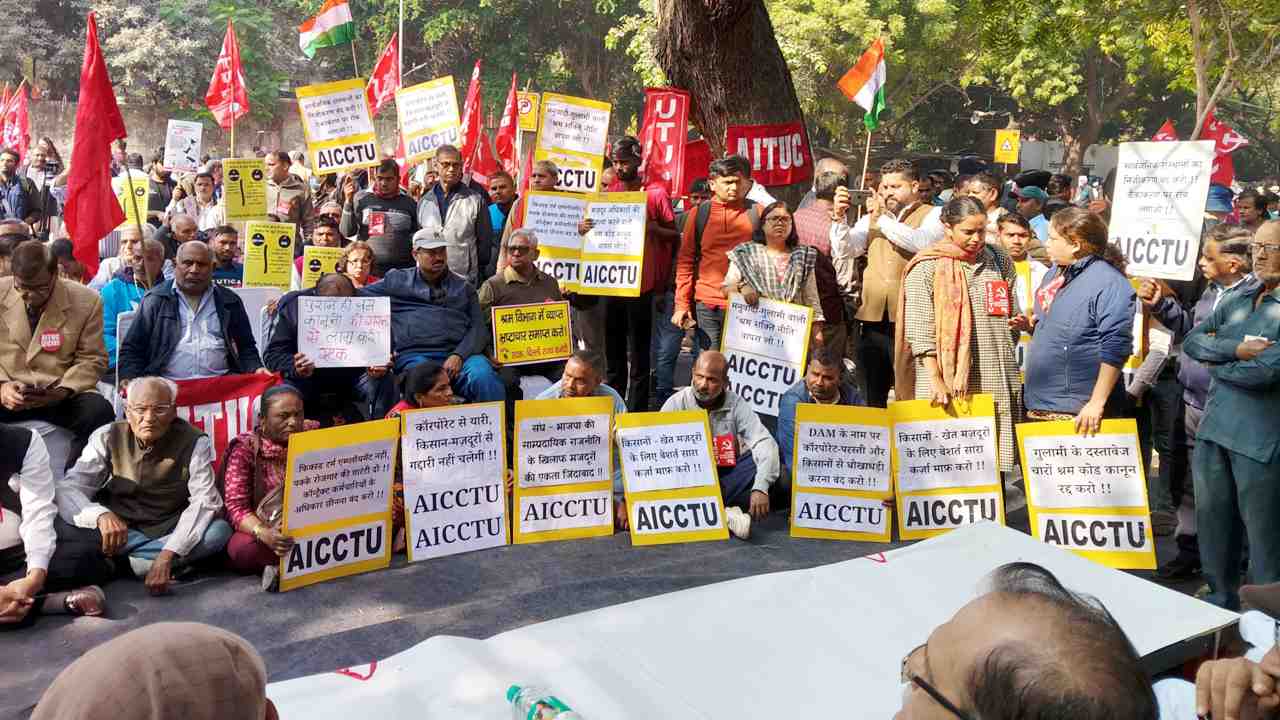
Across India, November 26 witnessed fiery protests. A strong and united demonstration was held at Jantar Mantar in New Delhi, where leaders of the Central Trade Unions and representatives of SKM addressed the gathering. AICCTU General Secretary Rajiv Dimri declared, “This government has handed the working class over to corporate masters. But the working people of India have shown today that these anti-worker Codes will be met with the strongest, united resistance in our history.”
The government’s decision to implement the Code on Wages (2019), the Occupational Safety, Health and Working Conditions Code (2020), the Social Security Code (2020) and the Industrial Relations Code (2020) has drawn strong condemnation. Although branded as “labour reforms,” these Codes dismantle essential rights of workers, dilute industrial safety norms and curtail collective bargaining, ultimately serving corporate profiteering under the banner of Ease of Doing Business. The Codes drastically weaken wage protections and welfare provisions and raise thresholds in favour of employers, leaving vast sections of workers vulnerable to informalisation and near-bondage conditions.
Speaking at the Kolkata demonstration, AICCTU leader Basudev Basu said, “By enforcing these Codes, the Modi regime wants to erase every right earned through workers’ sacrifice. The notification, pushed through without consultation, defies all democratic ethos and undermines the very principles of a welfare state. The workers will resist this slavery with uncompromising determination.”
Jharkhand, Bihar, UP, Rajasthan, Assam, Andhra Pradesh, Odisha and Tamil Nadu saw workers-farmers march and rally, vowing to intensify resistance. In Bangalore, Karnataka and in Rudrapur, Uttarakhand, protestors held mass burnings of the four Labour Codes, symbolising the workers’ rejection of policies that strip away their rights.
The joint platform of ten central trade unions and independent industrial federations has been resisting these draconian Codes since their enactment, starting with nationwide protests after the passage of the Wage Code in 2019. The historic General Strike of January 2020, followed by the September 2020 agitations when the remaining Codes were passed, culminated in the massive joint workers-peasants actions of 26 November 2020 alongside the Delhi Chalo movement of the SKM. The July 9, 2025 General Strike, which saw the participation of over 25 crore workers, once again underlined the depth of public opposition. None of this deterred the government, which ignored demands to convene the Indian Labour Conference both in the November 13 consultation on the draft Shram Shakti Niti 2025 and in the November 20 pre-budget meeting.
November 26 has reaffirmed that India’s working class refuses to surrender its hard-won rights. The united force of workers and farmers has once again demonstrated its resolve to defend democracy, dignity and justice against policies that seek to push the toiling masses into servitude. The struggle will continue with greater strength and unity in the days ahead.
====