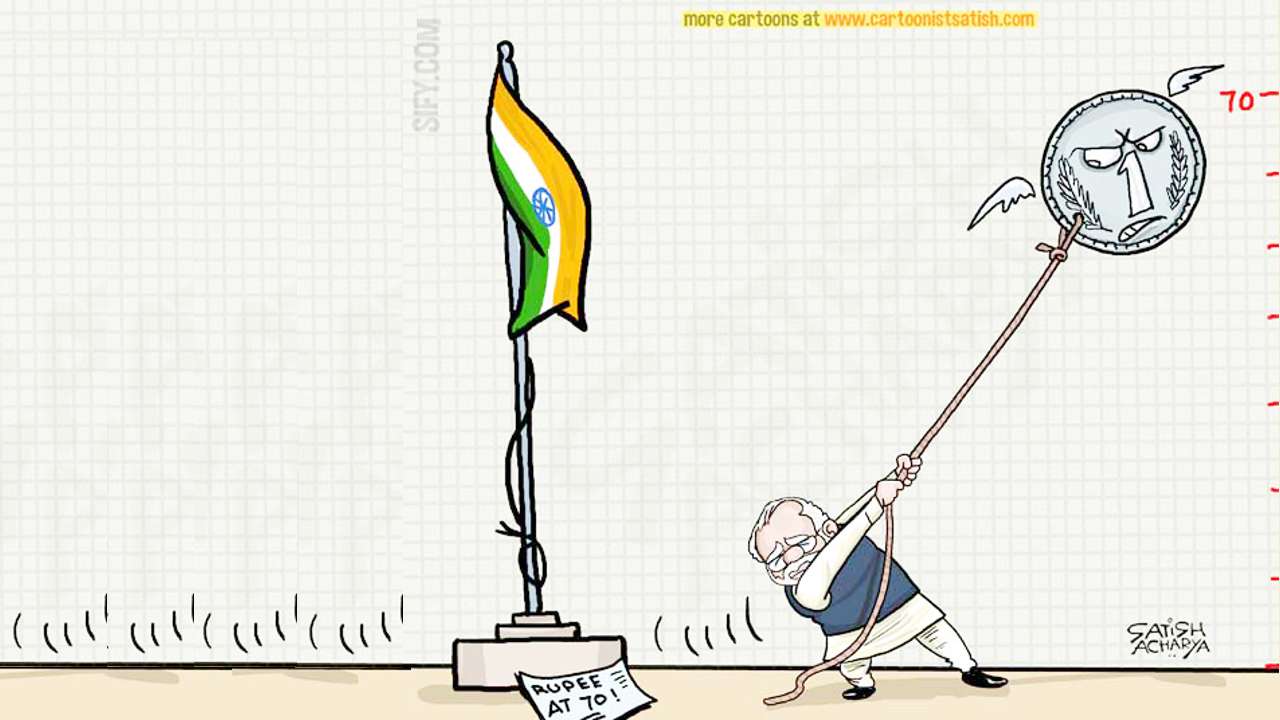
The weakening of the rupee is not merely a consequence of currency adjustments. It reflects India's increasingly insecure external economic position. Persistent import dependence, growing geopolitical instability, declining exports relative to GDP, weaker foreign investment and dependence on the dollar-dominated international financial system have all contributed to increasing pressure on the rupee. The weakening of the rupee must therefore be understood as a symptom of the weakening Indian economy.
In May 2026, the Prime Minister called on Indians to brace for austerity—buy less gold, take fewer foreign vacations, and work from home to reduce fuel consumption. The move towards austerity is not aimed at commodities across the board, and rather is meant to be selectively applied to gold, oil, and foreign expenditure, i.e., consumption that requires foreign currency. These appeals reveal official concern about India's external position. Gold imports, petroleum imports and foreign travel all require foreign exchange. Calls to reduce such expenditures implicitly acknowledge the pressure that rising demand for foreign currency places on the balance of payments.
One of the widely talked about reason for the Prime Minister’s appeal has been the rising costs of petroleum imports due to the war between US-Israel and Iran. The rise in India’s oil expenditure is itself a product of the Modi regime’s several diplomatic failures. Instead of standing for India’s economic sovereignty, the Prime Minister subordinated India’s autonomy in determining from whom India buys oil to the President of the United States.
The Modi regime abandoned Iranian (and Russian in 2025) oil imports under US sanctions despite Iran having been a long time friend and important supplier. The Modi government is culpable in not taking a diplomatic stand against Israel in its genocide in Palestine and its war of aggression on Iran along with the United States, the recent casualties of which have been three Indian civilian seafarers killed by US strikes. This also serves as a lesson to those who often questioned why India should oppose Israel’s actions that are in violation of international law. Not that there aren’t more import reasons to oppose Israel’s actions—such as the genocide in Gaza—the fact remains that actions in another part of the world eventually always affect Indian lives—most recently, through the unavailability of cooking gas, rising fuel prices, and three civilian deaths.
India’s dependence on the dollar is a political choice the Modi government has consistently reaffirmed. Despite frequent rhetoric about strategic autonomy, the government has also not pursued meaningful alternatives to dollar dependence. When the rest of the BRICS countries spoke about the desire to establish a BRICS currency to break the hegemony of the dollar, the Indian External Affairs Minister cowered, and quickly clarified to a complaining US administration that India would not support any efforts towards a BRICS currency or any attempt to break the dollar dominance over international trade. Progress towards trade settlement in regional currencies could have reduced India's exposure to fluctuations in the dollar and lowered some of the pressures arising from dollar-denominated trade.
Oil prices, the war in West Asia, and international financial dependence, however, are not the only drivers of India’ worsening balance of payments and the sliding rupee, which are also a consequence of an unhealthy macroeconomy and an uncompetitive export sector. The biggest source of foreign currency is usually exports. Since India exports goods in world prices, they earn dollars, which are then exchanged for rupees, thus, driving up the price of the rupee. When Manmohan Singh left office in 2014, India’s exports, including both goods and services, stood at 25.4% of the GDP—an all time high. Over the next decade that share had already contracted—instead of growing—to 21.2% in 2024, down to levels prevalent pre-2006. In 2025 and 2026, this number is expected to have fallen sharply due to the tariffs imposed by the United States, impacting several key export sectors such as textiles, fisheries, and leather. Such a large contraction (nearly a fifth) of exports relative to the GDP has imposed considerable constraints on the supply of dollars and thus depreciated the rupee.
Another substantial source of foreign currency is foreign direct investments (FDI). When foreign investors decide to invest in Indian firms or when foreign companies move production to India, they bring with them dollars that are then converted to rupees before being meaningfully invested in India. In 2014, Narendra Modi inherited an economy that generated net FDI inflows at 1.5-2.5% of its GDP. By 2024, FDI inflows had fallen to a mere 0.7% of India’s GDP. The war in West Asia has also worsened portfolio investments globally. For India, this meant more stresses when foreign indirect investments (FII) were already at a low, with both 2023 and 2024 having experienced net FII outflows.
The simultaneous contraction of exports and FDI reveals grave patterns in India’s macroeconomic health. The Modi government has time and again boasted about Make in India, which should have boosted exports, and about improving India’s Ease of Doing Business, which should have brought in more foreign investments. Instead, both exports and FDI have contracted, implying that India’s export sector is unable to grow relative to domestic demand, and foreign investors are more hesitant—for one reason or the other—to invest in India. This is particularly concerning because the only advantage, among many disadvantages, of a depreciating currency is that it makes exports more competitive and FDI more attractive—something Finance Minister Nirmala Sitaraman has used as justification for the falling rupee in the past. Yet the Indian economy appears unable to reap even these limited benefits. Despite a sharply weaker rupee, exports have failed to increase their share of national output and foreign investment has declined relative to GDP. The depreciation of the rupee may therefore be characterized better as a symptom of deeper structural weaknesses than as a mechanism of economic adjustment.
The contraction of the rupee against the dollar has serious implications for ordinary Indians. Currently, imports make up nearly a fourth of the Indian GDP, which means that for every hundred rupees that an average Indian earns, they spend 23.5 rupees on imports. This includes imported goods purchased by consumers, such as automobiles or LPG, but also includes industrial input such as chemicals or petroleum.
Due to dollar’s hegemonic role as the global reserve currency, the rupee weakening against the dollar means the cost of all these imported goods increases. This ultimately hurts households and leading to severe erosion purchasing power directly through oil and gas prices, but also indirectly through inflation, wage stagnation, and unemployment arising due input cost-induced low revenue in firms.
The political economy behind the rupee’s slide cannot be reduced to global headwinds alone. Under the Modi government, it reflects policy choices and economic priorities that consistently treat the lives and livelihoods of ordinary people as secondary.