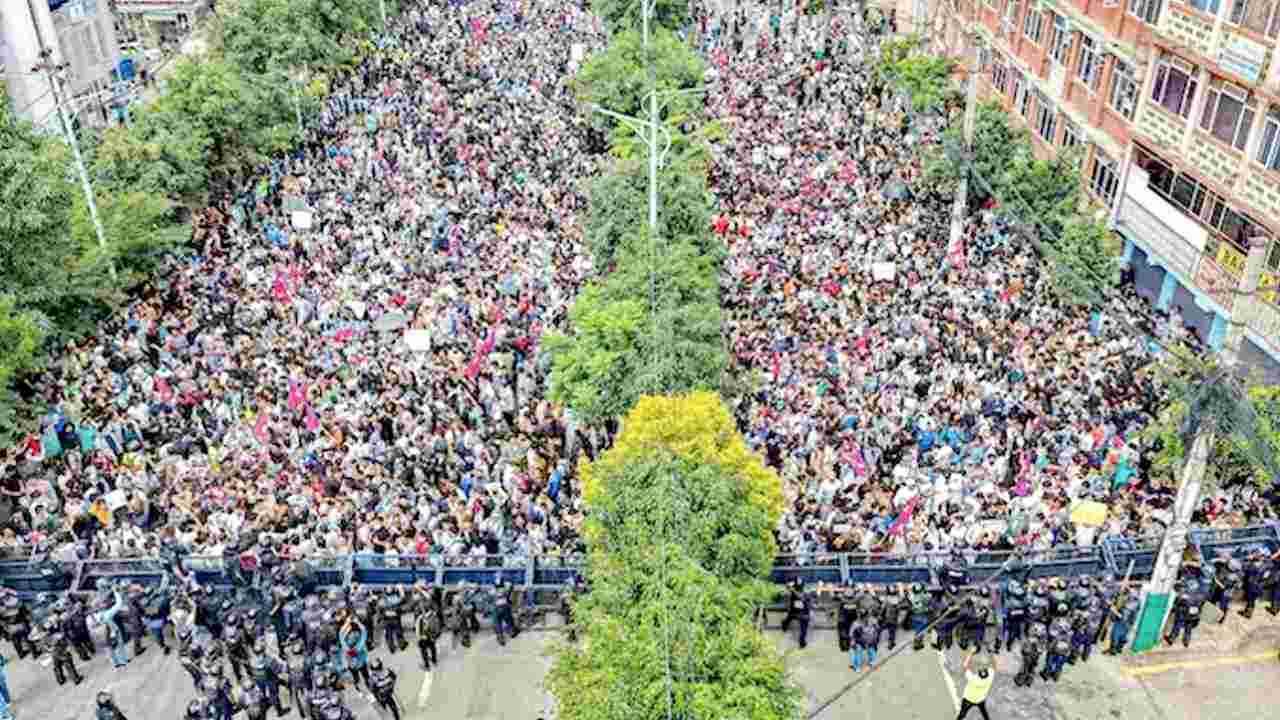
The immediate trigger behind the explosion lay in the Oli government's decision to ban twenty six social media platforms including WhatsApp, Instagram, Facebook, LinkedIn and the like. The ban appeared sudden and drastic, but it resulted from these companies' refusal to comply with the Nepal government's order for mandatory national registration of foreign companies. Popular Chinese social media platform TikTok did not attract this ban because of its compliance with the Nepali registration requirement. Be that as it may, the extensive ban not only curbed social media freedom, it also threatened to cause huge disruption in everyday communication and economy for the overwhelming majority of Nepali people. And when the government sought to suppress the peaceful protests by killing and injuring protesters, the unrest turned into a veritable explosion.
The Gen Z protesters have attributed the widespread vandalism and arson to 'outside agitators'. Indeed, the breaking of jails and attacks on the parliament building, supreme court, and several other state institutions, appear rather well-planned. Equally intriguing is the virtual retreat of the state and the entire political, military and institutional establishment in the face of the post-protest violent attacks. While the disillusionment among the Nepali youth and the simmering anger against corruption in high places and all-pervasive nepotism, the flashy lavish life style of the children of ministers and leaders that made #nepokids viral in social media provided the backdrop to the current unrest, the violent anarchic trajectory and denouement of the unrest remain an enigma.
Since the fall of the monarchy in 2008, the fledgling Himalayan republic of Nepal has been marked by prolonged political instability. In 17 years Nepal has witnessed as many as 14 prime ministers and revolving coalitions with various permutations and combinations. In recent years there has been a growing discernible clamour for the restoration of the monarchy. The RSS, operating in Nepal under its overseas banner Hindu Swayamsevak Sangh (HSS), has been at work trying relentlessly to turn Nepal back into a Hindu kingdom. And then there is the all-pervasive US drive for global hegemony which seeks to use Nepal as a base to serve its game plan of containing China and expanding American influence across South Asia.
The Sangh-BJP establishment's 'Hindu nationalism' in Nepal is however inseparably mixed with its 'Akhand Bharat' expansionism which envisions Nepal not as a free country but as a constituent part of greater India. In fact, commenting on the youth revolt in Nepal the BJP's Bihar Deputy CM Samrat Choudhary openly said that there would have been no anarchy, violence and unemployment in Nepal if the latter were an integral part of India. Many Godi Media reporters had to face the ire of the people of Nepal when in their live coverage from Nepal they tried to describe the present unrest as a movement for restoration of Hindu monarchy in Nepal.
Clearly, the democratic republic of Nepal has to deal with all these internal and external pulls and pressures. For the communist movement of Nepal, which led the country's transition from monarchy to republican democracy, the current juncture poses a crucial challenge. Consolidation of democracy in Nepal demands close ties with the people and a socio-economic model which prioritises people's welfare and Nepal's economic sovereignty. It is surely a matter of great concern if communists too invite allegations of corruption and nepotism like various bourgeois parties. Communists of Nepal will have to work hard to regain the trust of the people and to build a mass movement capable of defeating every design to restore the monarchy, truncate democracy and subvert the sovereignty of Nepal.