

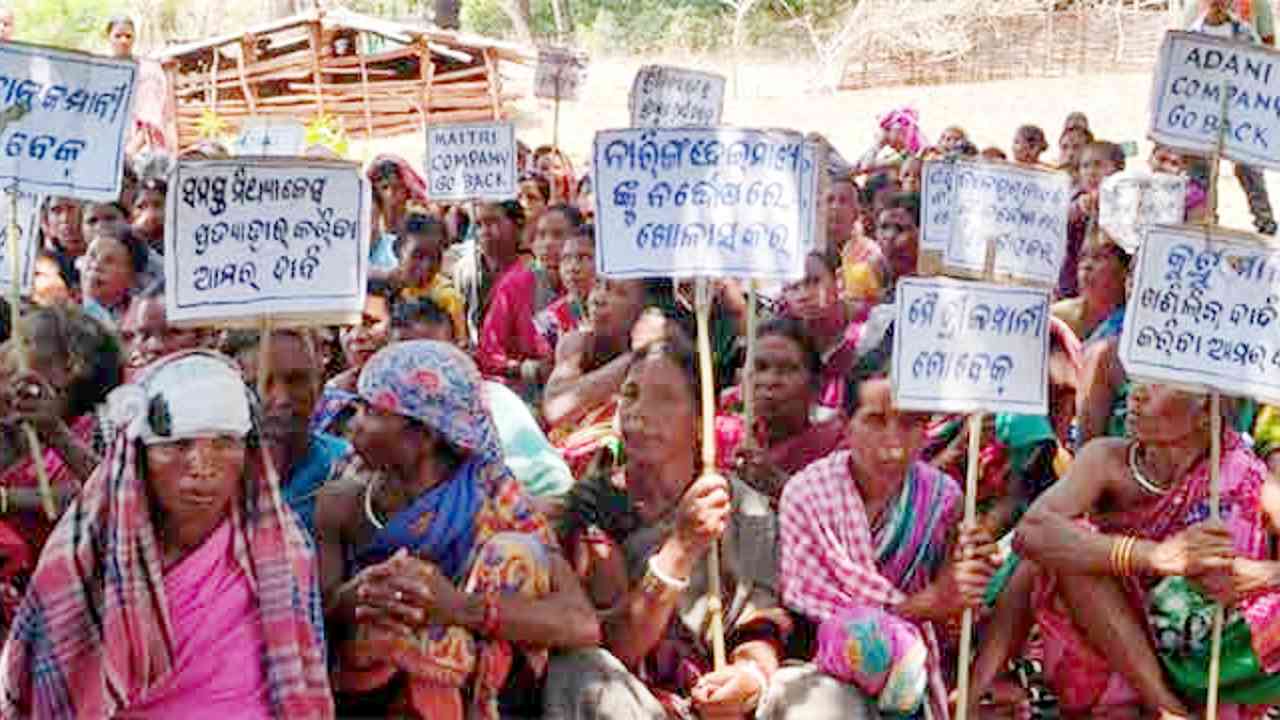
Fear gripped the village in the aftermath. Several injured individuals avoided seeking medical care, apprehensive of arrest. Police authorities stated that the operation was aimed at apprehending a local resident, Subas Singh Manjhi. However, villagers have questioned the scale and timing of the raid, why it was conducted in the dead of night, why homes were forcibly entered, and why force was used so broadly against residents.
The incident did not occur in isolation. In the weeks prior, the District Collector had visited Kantamal to resolve the situation, but he asked villagers to produce land ownership documents. It is a well known fact that such a demand is fundamentally unjust: forest dwellers have lived on the land for generations without formal titles, a condition recognized under laws such as the Forest Rights Act and the Panchayats (Extension to Scheduled Areas) Act. These laws are meant to protect the rights of Adivasi communities in Scheduled Areas, yet administrative actions have ignored these protections.
Kantamal is approximately one of 18 villages facing displacement due to the proposed Sijimali bauxite mining project, awarded to Vedanta Limited in 2023. The project spans roughly 1,549 hectares, including nearly 699 hectares of forest land, and affects predominantly Adivasi and Dalit communities. Despite strong opposition from Gram Sabhas, the project moved forward through initial clearances. Villagers maintain that their consent, legally required, was never genuinely obtained.
The Sijimali region is a biodiverse forest landscape interwoven with rivers and streams that sustain local livelihoods. For generations, Adivasi communities have depended on this ecosystem not only economically, but also culturally and spiritually.
Environmental concerns are significant. Mining activities in similar regions have led to deforestation, soil degradation, and water contamination. In fact, districts such as Kalahandi, Rayagada, and Koraput have reportedly lost over 20% of forest cover in the two decades till 2020 due to extractive projects. Critics warn that Sijimali will further accelerate this trend, damaging river systems and exposing communities to hazardous mineral pollutants.
Pattern of Crackdown and Criminalisation
Residents and activists argue that the Kantamal raid is part of a broader pattern of coercion.
- In late February 2026, around 200 police and paramilitary personnel conducted operations in multiple villages, pasting warrants at the homes of leaders associated with the Ma Mati Mali Suraksha Manch, a grassroots organisation opposing the project since 2023.
- On March 10th, a raid in Tala Ampadar village led to the arrest of 21 people, including women and a pregnant woman.
- On April 3rd, prohibitory orders under Section 163 of the Bharatiya Nagarik Suraksha Sanhita were imposed in the area where road construction for the project is underway.
Villagers continued peaceful protests despite these measures. The Kantamal incident was intended to deter such resistance.
Over the past three years, locals report facing numerous criminal cases, arrests, and detentions, including the use of stringent laws.
A central issue remains the question of consent. The Odisha administration has stated that Gram Sabha approval was obtained in December 2023. Villagers allege that this process involved forged signatures, including those of deceased individuals and minors.
The earlier public hearings of October 2023 reportedly saw strong opposition from residents. Petitions challenging the project have since been filed in the Odisha High Court, where the matter remains under scrutiny.
It has been reported that key clearances are still incomplete. For instance, forest clearance for a 2.98 km access road is still pending, and only preliminary approval (Terms of Reference) has been granted for the mining project.
A delegation from parties including the Communist Party of India (Marxist-Leninist) Liberation, Communist Party of India, Communist Party of India (Marxist), and the All India Forward Bloc visited the area on April 10th to document testimonies of the affected people. They reported that several villages, including Sagabari, Banteji, Bandel, Kantamal, and Tala Ampadar remained under heavy police presence, with continued drone surveillance.
Yuthisthir Mahapatra, CPI(ML) Odisha state secretary, said that the situation in the Sijimali area is extremely alarming due to the proposed mining project, which poses grave human rights concerns. He alleged that local Adivasi communities are living under immense fear and distress, facing intimidation, assaults, and torture with the complicity of the state government.
He further stated that the Sijimali bauxite mining project is located in Scheduled Areas of Rayagada and Kalahandi districts, where the provisions of the Panchayats (Extension to Scheduled Areas) Act, 1996 and the Forest Rights Act, 2006 must be strictly implemented. However, he alleged that Vedanta Limited was granted a lease for approx.. 1,549 hectares (including 699 hectares of forest land), without obtaining key clearances, which is in complete violation of statutory requirements, and also that some of the clearances are pending till date. He added that forest clearance is still awaited for the 2.98 km road under construction, which has become a point of conflict, and that the compliance report is also pending with the Divisional Forest Officer (DFO), Rayagada. Regarding environmental clearance, only the Terms of Reference (ToR) have been granted, while the final clearance is still pending.
The Odisha administration has claimed that Gram Sabha consent was obtained on December 8th, 2023. However, villagers allege that this consent was fabricated through forged signatures, including those of deceased persons and minors. Public hearings held in October 2023 reportedly saw strong opposition from villagers, who, despite facing intimidation and threats during the process, have filed petitions before the Odisha High Court. They maintain that the project is illegal in the absence of genuine Gram Sabha consent.
Left parties have demanded the withdrawal of prohibitory orders imposed under Section 163 of the BNSS, cancellation of Vedanta’s Sijimali mining project, and an immediate halt to all mining and construction activities. They have also called for the removal of police forces and drone surveillance from the area, the unconditional release of those arrested along with withdrawal of cases, urgent medical treatment and compensation for the injured, and a high-level inquiry into the incidents of April 7th. Additionally, they have demanded strict implementation of PESA 1996, FRA 2006, and the Right to Fair Compensation and Transparency in Land Acquisition, Rehabilitation and Resettlement Act, 2013, along with the conduct of fresh Gram Sabha meetings that are impartial and free from fear, coercion, and intimidation.
The situation in Sijimali reflects a deepening crisis in which people’s development, environmental protection, and constitutional rights are at serious risk. For the Adivasi communities of the region, the struggle is not only against displacement, but also for the preservation of a way of life that is intimately tied to their land, forests, and identity. The events in Kantamal raise urgent questions about the human cost of resource extraction and about a government driven by corporate greed. It is a grave irony that the President of India, the Union Tribal Affairs Minister, and the Chief Minister of Odisha all belong to the same tribal community of Odisha, where Sijimali is located.