For half a century, the U.S. has reaped considerable benefits from the post-war economic arrangements it created. Through the dominance of the Dollar in international trade, especially oil trade, and neoliberal structures under globalization, the U.S. has been able to consume more, borrow more, purchase more, and, as a result, exert geopolitical power at low costs. This arrangement did not sustain itself automatically. It was enforced politically and militarily, from the defence of dollar-denominated oil markets to sanctions, coups, and wars. The petrodollar system, globalization on U.S. terms, and American military supremacy functioned together as a single structure of dominance. However, over time, shifts in global trade, finance, and resource diplomacy have begun to challenge the automatic dominance of the U.S. dollar and the economic privileges it conferred.
In 1944, the Bretton Woods system was established, where the U.S. dollar was pegged to gold reserves in the U.S., while other countries’ currencies were valued against the dollar. Due to the Vietnam War and other domestic and foreign expenditures, the U.S. began running large deficits by the late 1960s, flooding international markets with U.S. dollars while U.S. gold reserves stagnated, ultimately leading to the collapse of the Bretton Woods system.
After the collapse of the Bretton Woods gold standard, the U.S. managed to maintain the Dollar’s dominance through oil. By ensuring that crude oil was priced and traded exclusively in Dollars, the U.S. ensured a permanent global demand for the dollar. Any country that wished to purchase oil was forced to earn, borrow, or hold U.S. dollars. This granted the United States extraordinary financial privileges. However, over time, this arrangement has begun to weaken, and oil has been traded at times in the Chinese Yuan, Russian Ruble, and Indian Rupee. Today, while the dollar remains dominant, its role is no longer uncontested.
From the 1980s onward, U.S. dominance was further reinforced through a wave of globalization structured largely on American terms. Enforced trade liberalization, financial deregulation, and the protection of corporate and intellectual property rights allowed U.S. firms to expand globally and extract surplus value from artificially cheapened labour in poor countries. Apart from generating profits for U.S. firms, it subsidized consumption in the U.S. Over time, as developing countries industrialized, the benefits of globalization became less unequally distributed. This reduced the U.S.’s advantage in trade and, thus, its appropriation through unequal exchange. Slower productivity growth at home and rising competition abroad further eroded the material rewards of globalization and the relevance of the U.S. and the dollar in international trade.
As dollar dominance in energy markets faces pressure and globalization yields diminishing returns, large economies have strong incentives to reduce exposure to U.S. financial power, sanctions, and monetary policy. Proposals ranging from expanded local-currency trade to common settlement mechanisms reflect this impulse. This reflects an increasing perception in global markets of the dollar as a risk, rather than a guarantee. The Trump administration’s alarm at talks of a BRICS currency must also be understood in this context.
Faced with these structural pressures, the U.S. response under Donald Trump was to attempt to restore U.S. hegemony in international trade through tariffs as a negotiation tactic that allows the United States to dictate the terms of international trade. The Trump administration had hoped that this would allow the U.S. government to maintain its influence despite reduced profitability through existing trade. However, instead of countries surrendering to the threat of tariffs, as the U.S. had expected, countries began reorganizing trade while the tariffs likely put severe inflationary strains on U.S. firms and consumers. The U.S. government responded by intensifying U.S. imperialism transparently.
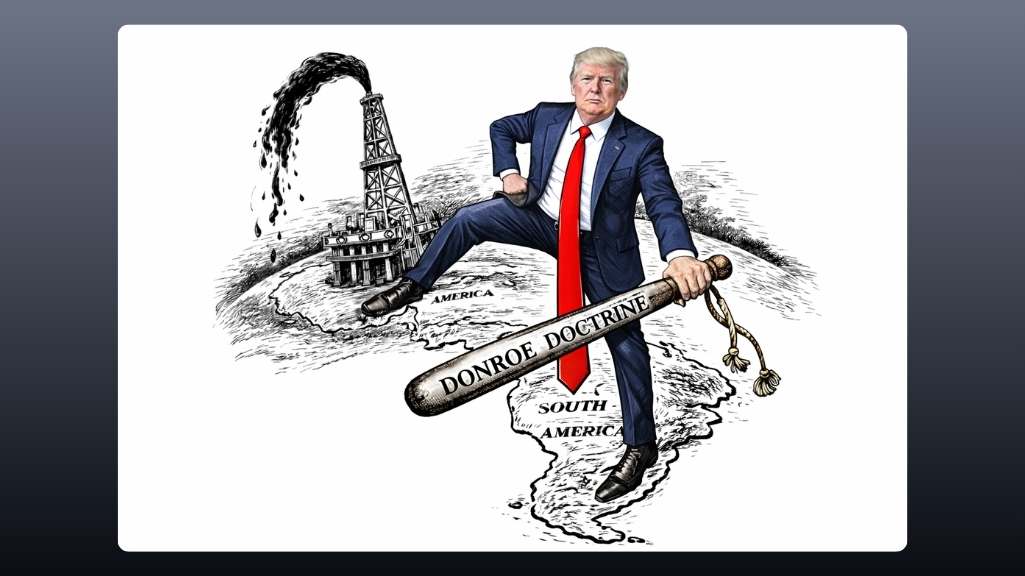
The military intervention in Venezuela must be understood as an attempt to enforce and preserve U.S. hegemony over petroleum resources and the oil trade, in an attempt to resuscitate dollar dominance. Venezuela possesses the world’s largest proven oil reserves (about 17% of the total), and individuals in the U.S. government have made it no secret that oil played a crucial role in motivating the intervention, explicitly arguing the merits of U.S. oil companies in the Venezuelan oil industry. It would seem that the U.S. government hopes that material gains from neocolonial extraction in Venezuela will help remedy some of the damage caused by the failure of the tariffs.
The United States’ assault on Venezuela includes open admissions regarding the pursuit of oil, which is more convenient for the Trump administration, which has refused to implement policies protecting against climate change, and renewed unabashed expansion of fossil fuels, a crucial instrument of U.S. imperial control. The U.S. government’s climate policy itself must be understood as an attempt to prolong resource extraction around the World to support U.S. imperialism at the cost of natural resources and people’s habitats.
Greenland is another, more symbolic, case of Trump’s brand of new U.S. imperialism. Although the United States frames the Greenland issue in terms of security and geopolitical advantage over rivals Russia and China, in reality, Greenland gives the U.S. control over Greenland’s own reserves of fossil fuels and rare earth minerals. However, unlike Venezuela, Greenland is formally a part of Denmark, a long-standing Western ally. The Greenland spectacle demonstrates that the U.S. is willing to subordinate even its allies to imperial ambition, revealing how far coercion has replaced consent in maintaining U.S. dominance.
Taken together, these developments point to an empire no longer able to rely on the institutions that supported its imperialism. The petrodollar system is under strain, globalization no longer delivers effortless gains, tariff wars have backfired, and even limited moves toward alternative currencies provoke outsized reactions. Thus, the projects in Venezuela and Greenland signal insecurity, rather than confidence. Venezuela and Greenland, especially the former, must thus be understood as the newest in a long tradition of U.S. military operations over crude natural resources, especially crude oil reserves.