The Budget 2026-27 underlines the continuing neglect of agriculture and farmers, workers, youth and Women. The majority of the population are forced to live in a highly stressed economic environment with rising inequality marred with low incomes, high unemployment and escalating costs of living a decent life. This was the least to expect some announcements to boost prolonged stagnant incomes. But this budget fails miserably on this count.
Allocations for key social security and poverty alleviation schemes have either been reduced in real terms or left stagnant, failing to keep pace with inflation and rising population needs. The revised estimates (RE) of actual expenditure for FY 2025-26 also shows the trend with RE being less than last year's budget allocation in key sectors of Agriculture and Allied industries, Education, Health, Social Welfare and Rural and Urban development.
The reduction in revised estimates of actual expenditure for FY 2025-26 is dramatic in even flagship schemes of Pradhan Mantri Awas Yojna (PMAY) Urban Rs 7,500 Crore (BE Rs 19,974 Crore), PMAY-Rural Rs 32,500 Crore (BE Rs 54,832 Crore), Swacch Bharat Mission Rs 2,000 Crore (BE Rs 5,000 Crore), Gram Sadak Yojna Rs 11,000 Crore (BE Rs 19,000 Crore), and in Pradhan Mantri Ayushman Bharat Health Infrastructure Mission (PMABHIM) Rs 2,443 Crore (Rs 4,200 Crore). This is irresponsible, and deliberate, on the part of the government to not spend even its own allocated amounts especially in welfare schemes.
While the agriculture sector sustains the country and provides an all-weather support to growth, again the budget completely ignores its need. The core issue of farmers income, MSP, issue of cli-mate change and impact on agriculture, strengthening of storage and food processing facilities etc have no mention in the budget. New peripheral Agri-related schemes like drone intervention, AI in agriculture and focus on high-value agri-sectors are being sold by the government as empowering the agriculture sector. Moreover, fertilizer and food subsidy allocation in the budget for FY 2026-27 is less than that of revised estimates of last year. The agriculture research and education department allocation also witnessed a decrease in fund allocation pointing to complete lack of interest of the government in welfare and strengthening of the agriculture sector in India.
Public healthcare continues to suffer from shortages of doctors, nurses, medicines and infrastructure, while the government promotes a private-sector-led model. Public expenditure on education and health remains grossly inadequate. With the implementation of the VBSA Bill, the private sector is set to gain even greater control over education. This budget has again reiterated the Modi government’s skewed vision, that the Education is not an emancipation project, but a tool for industries and corporates to obtain cheap labour. Universities and colleges are being oriented to train students with skill sets that will make them employable in industries. The proposal for five new educational townships in industrial corridors, and 15,000 schools and 500 universities to have content labs where students will be taught to create content in order to prepare skill sets to feed the labour force required for the gaming industry by 2030.
The budget should have acknowledged the severity of Trump’s tariff war and in order to give some respite to the Indian exporters it was needed to provide them some monetary relief measures. Moreover, no measures have been taken to deal with massive job losses incurred due to Trump’s tariffs on Indian industries. Customs duty exemptions extended at this juncture shows that the talks of Aatamnirbhar Bharat are hollow and that the economy is not tied to domestic realities and necessities.
Crores of women under SHGs are under severe debt trap of microfinance private institutions. This budget goes on with the same policy framework encouraging private companies to exploit more.
The budget gives big tax relief for MNCs and companies that will set up cloud data centres in India till 2047. Worldwide, data centres have become an environmental threat due to massive ground-water depletion, air pollution, and excessive mining to meet the enormous energy requirements for running these centres, along with land conflicts as they require massive tracts of lands.
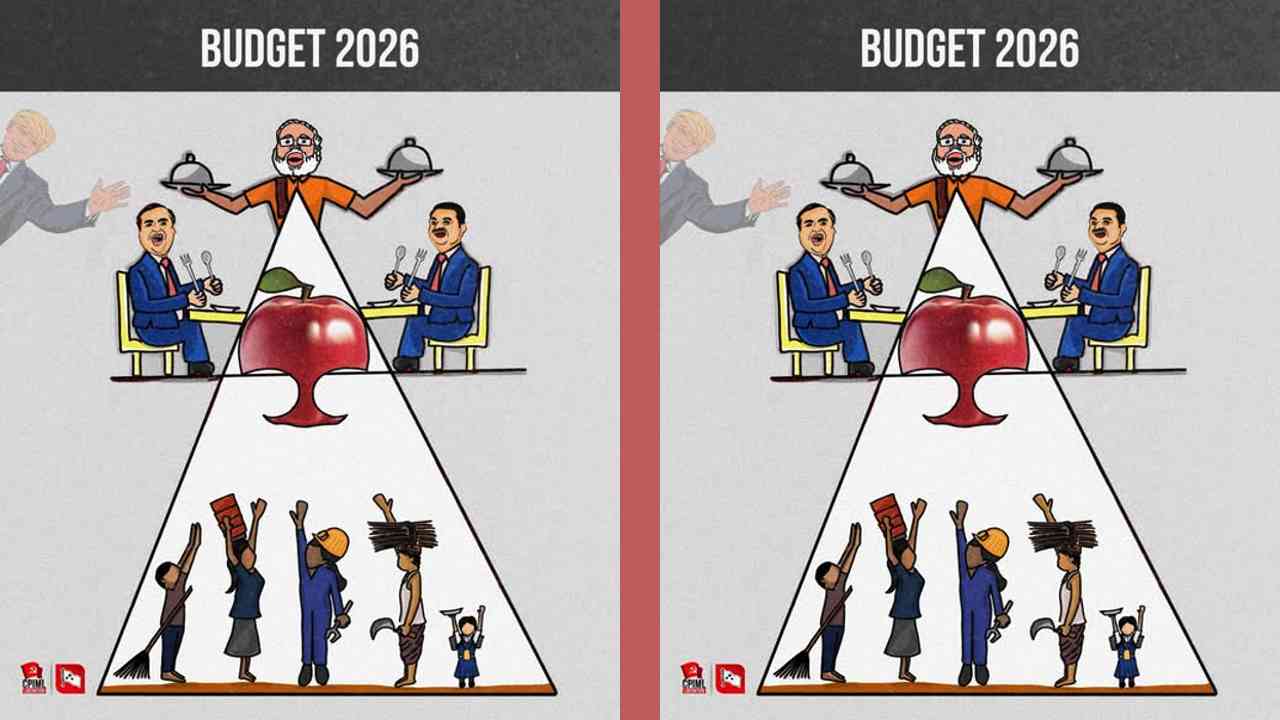
Under the guise of promoting self-reliance, the government has announced mining corridors across mineral-rich states. Freight corridors and expansion of road infrastructure also feature prominently in the budget speech. However, this must be seen alongside the massive disinvestment drive unleashed by the government since its inception. As the public sector is systematically pushed into the background, the real profits from mineral extraction will accrue to Modi’s favoured crony capitalists—Ambani, Adani, Vedanta, and others. This, combined with the dilution of forest rights and workers’ rights, clearly points towards a model of resource extraction designed to maximise private corporate profits at the cost of people and the environment.
MGNREGA, already weakened over the years, has now been replaced by a far more diluted VB-GRAM G. In this budget, allocations have been made under both NREGA and VB-GRAM G heads. However, while NREGA has witnessed a substantial cut, the allocation for VB-GRAM G remains almost unchanged from the previous year. Given that the rollout of VB-GRAM G will take time, the reduction in NREGA funding will have an immediate and devastating impact on the rural poor.
The budget proudly claims the implementation of over 350 reforms, including the labour codes. These labour codes have systematically diluted workers’ legal rights—ranging from wages and working conditions to social security. The budget completely ignores the urgent need to strengthen the right to health, pensions, provident fund, and other forms of social protection. Platform workers, scheme workers, domestic workers, and the vast majority of informal sector workers—who constitute the backbone of the Indian workforce—continue to live without access to any meaningful social security and find no place in this budget.
The under-utilization of budget in the Production Linked Incentive (PLI) scheme, further proves that India is losing manufacturing jobs. The budget gives major tax incentives to the rich, while Start-up India and employment generation projects are ignored and denied major reliefs.
Without addressing the core issue of income inequality of the majority population the aggregate demand can't be raised is common knowledge. But the budget lacked the vision to address this core issue and is not sufficient to push aggregate investment to sustain economic growth.
The government's refusal to raise taxes on corporate profits and incomes of High Networth Individuals (super rich) has reduced space for budget leverage.
The overall expansion of budget size to Rs 53.47 lakh crore is mere 5.6 %, less than even claimed nominal growth in GDP. Out of the overall expenditure one fourth goes to interest payment on past accumulated debt of the government of India.
As the budget follows the pro-liberal policy driven tightrope, fiscal deficit is maintained by cutting allocations and actual expenditure in the core sector of agriculture and rural infrastructure, food security, health, education and housing.
While welfare expenditures are being cut, the budget announces impunity from prosecution for tax evaders and those who have not declared their incomes and properties in the past. Modi came to power with a claim of bringing foreign black money back to the country, but the budget has ironically announced a scheme for voluntary disclosure of foreign income and assets albeit in the name of facilitation for small taxpayers but the 'specified limit' has not been announced raising suspicion!
In essence, Union Budget 2026 continues the Modi government’s consistent betrayal of the people’s most pressing concerns. It reinforces a trajectory marked by corporate loot, erosion of democratic and social rights, and the systematic devaluation of the people’s right to a dignified life.