
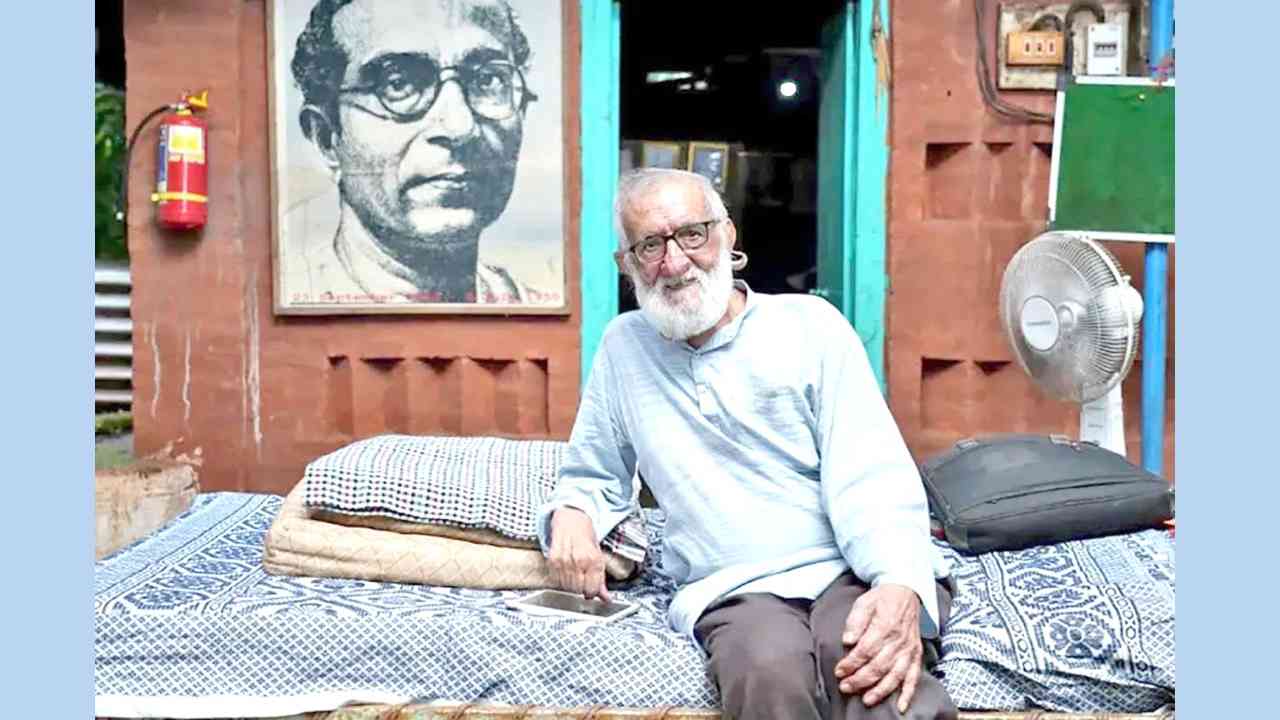
The noise I felt in GG's presence has turned to silence today. The Satyagrahi who fought for our country's freedom, the jail returned who dreamed of what this country would be like after independence, the socialist who experimented with building a society based on the values of the freedom movement, the person who worked tirelessly for the environment with an eye on the future, is no longer with us. An Editor of Janata Weekly, Dr.G.G.Parikh embodies unwavering commitment to justice, equality, and Gandhian values.
Dr. G. G. Parikh, a Socialist, Freedom Fighter, Medical Practitioner, and true Living Gandhian, was born on 30th December 1924 in Surendranagar, Gujarat. Educated in Saurashtra (Rajasthan), Kanpur (Uttar Pradesh) and Mumbai(Maharashtra), he participated in the 1942 Quit India Movement as an 18-year-old cadet inspired by Yusuf Meherally’s fiery speech at St. Xavier’s College. Imprisoned for ten months for his role in the movement, he went on to dedicate his life to socialism and public service—helping found and lead several socialist parties from the Congress Socialist Party to the Janata Dal. As a medical practitioner in Mumbai since the 1950s, he combined healing with activism, establishing the Yusuf Meherally Centre (YMC) in 1961 at Gowalia Tank to foster communal harmony and national integration.
The very first friend I made in the development field is gone. I had a 22-year long friendship with GG. In the past 22 years, I've spent more time with GG than with my own family. When I first met him, I didn't know anyone of his age. There was a 62-year age difference between GG and me. 62 years is like a generation or two. GG never allowed this difference to be felt in any discussions or debates we had or any decisions we made.
Those who have met GG know that he was deeply influenced by Gandhiji and had the courage to fight for the values of the freedom movement, and prided himself on being an uncompromising socialist. After independence, when many of his colleagues sought to change society through power, GG, along with Gandhiji's Antim Aadmi, sought to bring about this change from the ground up. This thought led to the creation of the "Yusuf Meherally Centre." GG's laboratory of socialism and Gandhi's vision of Hind Swaraj, in which the Karta and Vahak are tribals, Dalits, women, and youth. The Yusuf Meherally Centre experimented with the concept of alternative development in the 1960s, sparking debates on environmental conservation, organic farming, water conservation, small dams, and other such issues. He continuously conducted numerous programs through Yusuf Meherally Centre for the last 65 years, on education, health, khadi and village industries, skill development, women's empowerment, and youth camps.
It is not known whether GG was a believer or an atheist, but we never easily heard the line "It is his will or God will take care of it." After the firing on the farmers' protest in Multai in 1998, while he was on his way there, he got off at Murtazapur (Maharashtra) station to get tea and while trying to board a moving train, fell on the railway track. The train ran over him, injuring his leg. But he used to say that even then he did not remember God. I can't say whether GG believed in spirituality, but he considered the "spirit of service" to be a crucial part of transforming humanity.
GG, from 1942 until his death, was associated with socialist ideas, organizations, institutions, parties, and individuals. Throughout his life, he worked with countless associates. He made many socialist initiatives an integral part of his life, including two significant ones: the regular organization of the peace march held by "42 Augusters" on August 9th, August Kranti Din in Mumbai. The second, the management and editing of the socialist magazine "Janata Weekly," published by the socialists since 1946. He was a lifelong admirer of the Rashtra Seva Dal. He served as Chairman of the Yusuf Meherally Centre, Managing Trustee of the Janata Trust, President of the S.M. Joshi Socialist Foundation, the Yusuf Meherally Memorial Education Society, the Vaikunthbhai Mehta Research Centre for Decentralized Industries, and the Mumbai Khadi and Village Industries Association.
We have seen Mumbai through GG's eyes; he was an eyewitness to every event of the freedom movement in Mumbai. There were many stories that he used to tell us while passing through the streets, squares, buildings, and grounds over the years. He was on the streets in the workers' struggles of many trade unions and was a part of the cooperative movement. In the last several decades, seeing the common man leaving Mumbai, he used to say repeatedly, "Whose is Mumbai? Of the common man, and the same man is living 50-60 kilometers away." He would always explain to the middle class that Mumbai's development is happening at the cost of the poor people. He didn't like the current form of Mumbai at all.
GG's specialty was that whoever he met, became one of his own. He used to talk for hours, without any hesitation with people even younger than me. Listening to him, I felt like GG was a part of that "Gen Z" generation. GG had immense patience to listen to everyone; he could listen to his colleagues and workers for hours. I am one of those colleagues who considered GG as their "confession box" to express their views. I could share my daily matters and many secrets with him.
GG was not alone; his family also supported him in his struggle and sacrifice. GG met his wife Mangalaben during the 1942 movement, and both were imprisoned. During the Emergency, GG, Mangalaben, and their daughter, Sonal, were imprisoned. GG registered his marriage on August 9th, took over his only home at Ganesh Prasad on August 9th, started his practice on August 9th, and also opened his clinic on August 9th. Every program or initiative he planned would be held on August 9th. His energy and willpower at the age of 101 is an inspiration to all of us. As the saying goes, when someone does something amazing, the common expression is "What an incredible miracle." In GG, we have witnessed such a miracle with our own eyes. Mumbai will never forget the miracle that was GG.
There is nothing final about GG even in death. There is much to write about him, but I am not in a position to write while the loss is so recent. There will be more write-ups in the future on the innumerable discussions I've had with GG because many of his ideas and views deserve to be documented and shared with a wider audience.