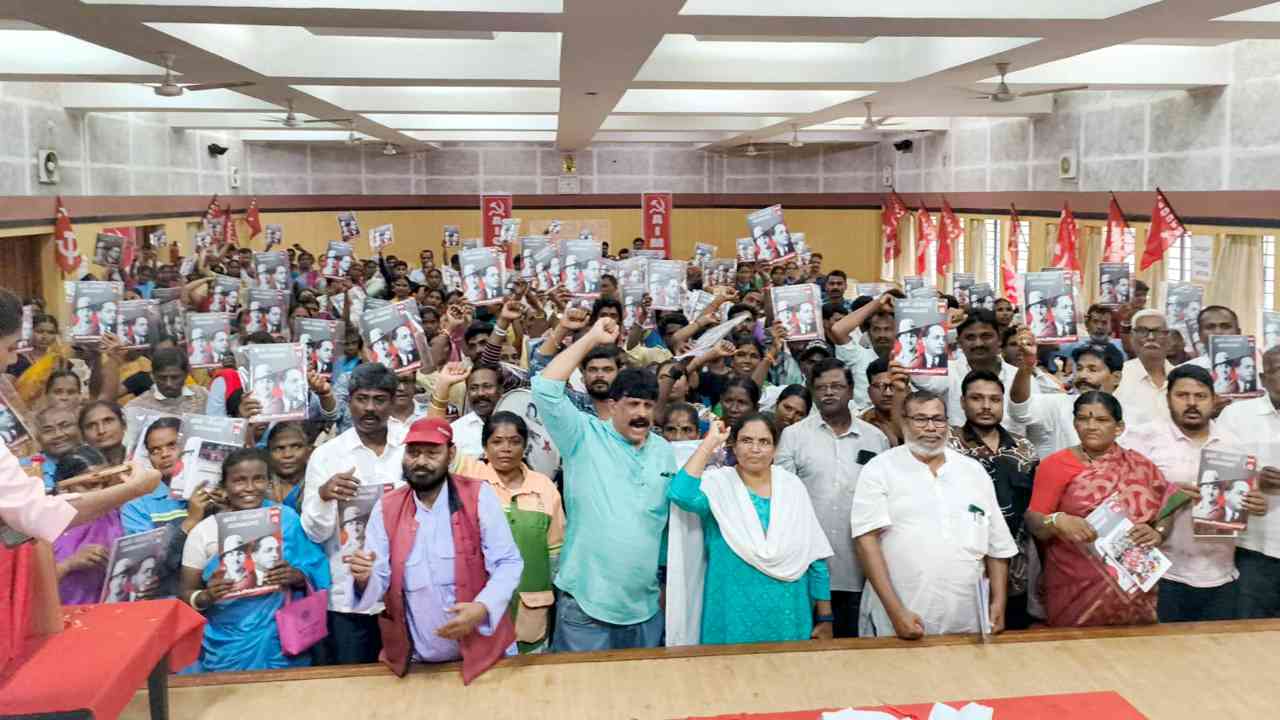
To celebrate this historic victory, a Pourakarmika Victory Conference was organised in Bengaluru on September 7. On this occasion, the All India Municipal and Sanitation Workers Federation (AIMSWF-AICCTU) released a booklet titled “Safaikaramcharis and other Sanitation Workers – The Struggle for Liberation”. The publication documents the struggles and victories of sanitation workers across the country, highlighting their fight for dignity, rights, and liberation.
At the Victory Celebration Conference, Com. Nirmala, President of BBMP Pourakarmikara Sangha, reminded the gathering that this victory was won through unrelenting struggle. Workers once earned only Rs. 2,000– Rs. 5,000 a month, often after months of delay. Today, as regular employees, they earn Rs.41,000 and live with dignity. She underlined that pourakarmikas are largely Dalit and backward community women and that this struggle broke the chains of fear and humiliation inherent in the contract system.
Com. V. Shankar, All India President of AICCTU, said that in many states, sanitation workers have secured victory through courts, including Mumbai, Madurai, etc. Karnataka stands apart, he said, because the sanitation workers' victory came through militant street struggles. The government was forced to concede the demand of regularisation because of consistent, longterm, decade long struggles. He urged that this achievement has now become a beacon for struggles across sectors.
Similarly, the ongoing struggle under our leadership in Chennai, Tamil Nadu against the attempts to bring workers under the contract labour system is also making a bigger political impact. All political parties including the opposition and alliance partners of the ruling party are supporting the struggle and sanitation workers struggle has become a kind of a mass political movement with support from people of all walks of life, including intelligentsia and media. Inspired by women workers struggle in Chennai, sanitation workers of other districts in the state too rise up in struggles.
Com. Uday Bhat, President of AIMSWF, spoke of how the struggle of pourakarmikas is not just about wages or employment security, but is fundamentally an anti-caste struggle. He pointed out that sanitation work has historically been forced upon Dalits by the caste system, dehumanising them and confining entire communities to stigmatised occupations.
Com. Mahendra Parida, General Secretary of AIMSWF, noted that the contract labour system is a mechanism by which governments and employers wash their hands of responsibility, denying workers fair wages, dignity, and security, and the need for all municipal and sanitation workers to come together to expel this exploitative system.
Com. Maniyamma, senior leader of the union, declared: “The government must not stop with us. Regularisation must extend to all workers across sectors in the state.” She recalled how pourakarmikas were once derided as “garbage women” and “garbage men,” treated as less than human. Today, their work commands respect. She spoke of how unionising and collective struggle transformed their lives, and called for unity of all workers across the country to secure permanent status, dignity, and rights.
Com. Clifton, National Vice-President of AICCTU, termed the victory “historic.” He called for abolition of contract labour for drivers and loaders as well, demanding their absorption as permanent employees with direct payment. He also pressed for immediate implementation of pending demands, including housing, education, and the recommendations of the IPD Salappa Committee.
The victory of Karnataka’s pourakarmikas is a landmark in the national struggle against caste and class oppression.