
This dramatic reduction, which brings the Q2FY26 headcount to 593,314 from 613,069 just three months prior, follows an initial announcement in July of plans to lay off approximately 12,200 to 12,261 employees. The gap between the announced layoffs and the final attrition figure hints at a deeper, more systemic churn. The company’s official rationale is one we have become all too familiar with: a "restructuring strategy" to become a "future-ready organization," focused on realignment and heavy investment in technology and Artificial Intelligence (AI). While the business logic may be sound on a balance sheet, it masks a brutal human reality one of shattered lives, precarious futures, and a reckless corporate cycle of hire-and-fire that treats people as disposable assets.
The Anatomy of a Workforce Reduction
To understand the scale of what has transpired at TCS, one must look beyond the headline number. A reduction of nearly 20,000 employees in a single quarter is not mere attrition; it is a strategic purge. The initial announcement of 12,200 layoffs, roughly 2% of the workforce, was likely just the publicly disclosed, involuntary part of the equation. The remaining thousands likely departed through a combination of forced resignations, performance improvement plans (PIPs) used as a pretext for termination, and a freeze on hiring that naturally amplified attrition.
What makes this round of layoffs particularly alarming is the profile of those affected. Reports and internal sources indicate that a significant portion of the employees let go were moderate to senior-level techies. These are not fresh recruits who failed to onboard effectively; these are experienced professionals with a decade or more of expertise. Their exit reveals the true, dual-edged nature of the "restructuring." While it is framed as an investment in the future (AI and automation), it is simultaneously a brutal cost-cutting exercise. Senior employees command higher salaries, and in the cold calculus of corporate finance, replacing them with a smaller number of junior AI-specialized engineers or leveraging automation to handle their workload is a straightforward path to fatter profit margins. The guise of being "future-ready" provides a convenient smokescreen for what is, at its core, a financial decision aimed at pleasing shareholders.
A Symptom of a Larger Sickness: The Reckless Boom and Bust Cycle
The TCS layoffs are not an isolated incident but a symptom of a profound sickness within the global IT sector. This is the culmination of a perilous cycle of aggressive, often reckless, hiring followed by equally aggressive and reckless firing.
During the pandemic-induced digital gold rush, IT companies went on a hiring spree. Believing the hyper-growth would continue indefinitely, they onboarded tens of thousands of new graduates, offering inflated packages and creating a bloated workforce. TCS itself saw its employee numbers swell dramatically during this period. This hiring was not always driven by sustainable, long-term project pipelines but by FOMO (Fear Of Missing Out) and the need to show growth to the market.
However, the market is a ruthless corrector. As global economic headwinds gathered strength, client budgets tightened, and the initial surge in digital transformation projects began to normalize. Concurrently, the very technologies these companies are now betting on AI and advanced automation began to mature. Tools that can auto-generate code, manage cloud infrastructure, and test software are now capable of displacing the very roles that were so aggressively filled just a few years prior.
The result is the current, painful reset. Companies that hired with short-term optimism are now firing with short-term panic. The human resource is treated with the same disposability as outdated hardware acquired en masse during a boom and discarded during a bust. This cycle demonstrates a fundamental lack of strategic foresight and a callous disregard for the societal and human capital that these companies so heavily depend on.
The Human Fallout: Lives Left in Limbo
Behind the sterile corporate jargon of "workforce optimization" and "strategic realignment" lie thousands of individual stories of anxiety, disruption, and despair. The human cost of these layoffs is immense and multifaceted.
1. The Psychological and Financial Limbo: For an employee, a layoff is not just the loss of a job; it is a profound personal crisis. The sudden severance of a stable income plunges individuals and families into immediate financial insecurity. Mortgages, children's school fees, medical expenses, and daily living costs become sources of crushing anxiety. The job market for experienced tech professionals is currently saturated, meaning the search for a new role is long, demoralizing, and often comes with a significant pay cut. The term "limbo" is apt a state of suspended animation where future plans are put on hold, and the present is dominated by uncertainty.
2. The Great Displacement: The IT sector in India is concentrated in specific hubs like Bengaluru, Pune, Hyderabad, and the National Capital Region. Many employees relocate to these cities, often with their families, investing in homes and building communities. A sudden layoff forces a brutal choice. Do they stay in an expensive city without an income, hoping to find another local job? Or do they uproot their family, pull their children out of school, and return to their hometowns, often where tech opportunities are scarce? This "reverse migration" is a deeply disruptive process, tearing apart social networks and imposing significant emotional strain on entire families.
3. The Erosion of Trust and Morale: For the employees who remain at TCS and other companies engaging in mass layoffs, the impact is also severe. The psychological contract—the unwritten agreement of loyalty and job security in exchange for hard work—is shattered. Morale plummets. Employees become risk-averse, less innovative, and constantly fearful of being the next target. This "survivor's guilt" and pervasive anxiety can cripple productivity and creativity, ironically hampering the very "future-ready" transformation the company claims to be pursuing.
4. The Devaluation of Experience: The targeting of moderate and senior-level employees sends a dangerous message: experience is a liability. This devalues the very institutional knowledge that is critical for mentoring junior staff, navigating complex client relationships, and architecting robust, large-scale systems. A company cannot become "future-ready" by discarding the wisdom that built its present.
Beyond the Balance Sheet: A Call for Ethical Responsibility
The fundamental failure exposed by the TCS layoffs is the myopic view that decisions can be made based solely on balance sheets, with human consequences treated as an externality. Corporate leadership and investors cheer cost-cutting measures, and stock prices may see a temporary bump, but the long-term damage is profound.
There is a pressing need for a more ethical and sustainable approach to corporate restructuring. This includes:
Transparent and Compassionate Communication: Instead of sudden, brutal layoffs, companies should offer longer notice periods, substantial severance packages, robust outplacement services, and career counseling to help transition employees.
Upskilling as a Default, Not an Exception: A "future-ready" strategy should prioritize retraining existing employees for new roles in AI and automation. Investing in human capital is a more sustainable, and ultimately more loyal, path than disposal and re-hiring.
Government and Regulatory Oversight: Policymakers must examine the social impact of these large-scale layoffs and consider stronger worker protection laws, ensuring that corporate "restructuring" does not become a euphemism for social irresponsibility.
The 19,755 employees who left TCS in the last quarter are more than a line item in a financial report. They are parents, partners, and providers. They are individuals who placed their trust in a corporate titan, only to be cast adrift in the name of progress. The story of TCS’s restructuring is a cautionary tale for the entire IT industry. A company’s worth is not measured by its stock price alone, but by the well-being of the people who build it. Until that balance is restored, the pursuit of a "future-ready" organization will continue to leave a trail of broken presents in its wake.
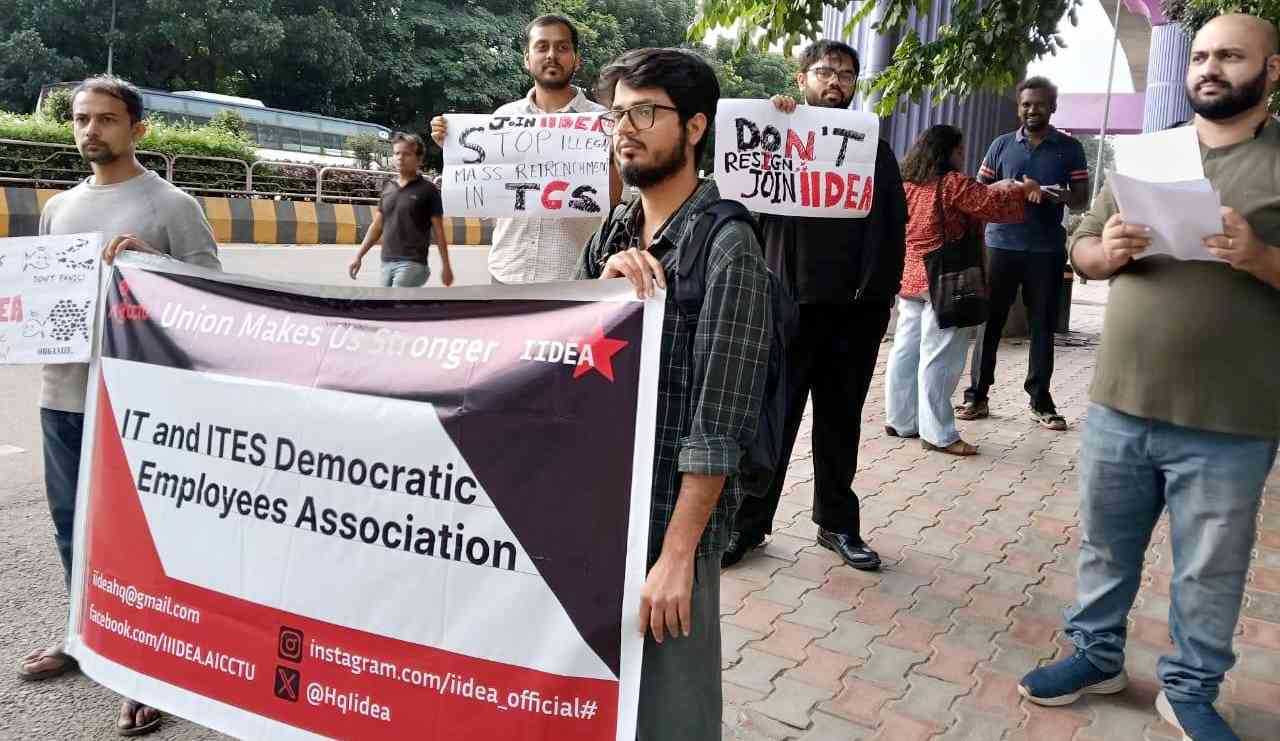
The author is a member of the Convening Body of the IT and ITeS Democratic Employees Association (IIDEA), affiliated with the All India Central Council of Trade Unions (AICCTU). Article Credit: Workers Resistance.