By embedding the labour policy within this framework, it is a clear attempt at institutionalising aspects of Manu Smriti in violation of the Constitution. Such an approach constitutes nothing short of a direct attack on the Constitution. While the Constitution envisions dismantling centuries of social and economic subjugation, this policy is an attempt to institutionalize caste-based hierarchies and reinforce social and economic subordination, thereby undermining the very principles of justice, liberty, equality, and fraternity that the Constitution stands for.
The Central trade union further noted that the policy has been released only in English, and not in any of the other Indian languages. This, in itself, reflects a serious exclusionary approach. How can workers from across the country, who come from diverse linguistic, cultural, and regional backgrounds, be expected to understand, engage with, or respond meaningfully to a policy that is available only in English? India is a nation characterized by its rich linguistic diversity, with the Eighth Schedule to the Constitution recognizing 22 distinct languages, and many more widely spoken across the country. By restricting the policy document to English alone, the government effectively denies the majority of workers, particularly those from marginalized and non-English-speaking backgrounds, the opportunity to participate in the process of policymaking.
AICCTU also noted that the policy proposes a type of new Employment Exchange in a sense, where AI would be used to link workers with job opportunities through the Ministry. The Ministry would also engage itself in resume generation and credential verification as per the policy. It is pertinent to note that the Employment Exchanges (Compulsory Notification of Vacancies) Act, 1959 is still in force, though effectively defunct. The proposal for “AI-driven labour-governance capacity in all States” in the policy does not appear to be well thought out. At a time when lakhs of workers are losing jobs across the globe due to influx of AI, and AI is being used to increase surveillance, AI must not be integrated into core regulatory mechanisms.
The union also slammed various misleading terms in the policy, where dubious promises and commitments are made, but the spirit and intent of the policy is to subjugate and exploit the workers. Regarding welfare of workers, no tangible outcome has been envisioned in the policy and all the promises are an eyewash.
Further under the Ease of compliance and formalisation, the policy seeks to further the dismantling of the inspection system and allow managements ample leeway to violate the law without regulation. It is a fact that even today the most basic statutory right of minimum wages is routinely violated with impunity. Lakhs of workers across sectors are forced to work for less than the legally prescribed minimum wages, while enforcement authorities remain grossly inadequate and inactive. In such a context, the idea of self-certification is nothing short of a cruel mockery of justice.
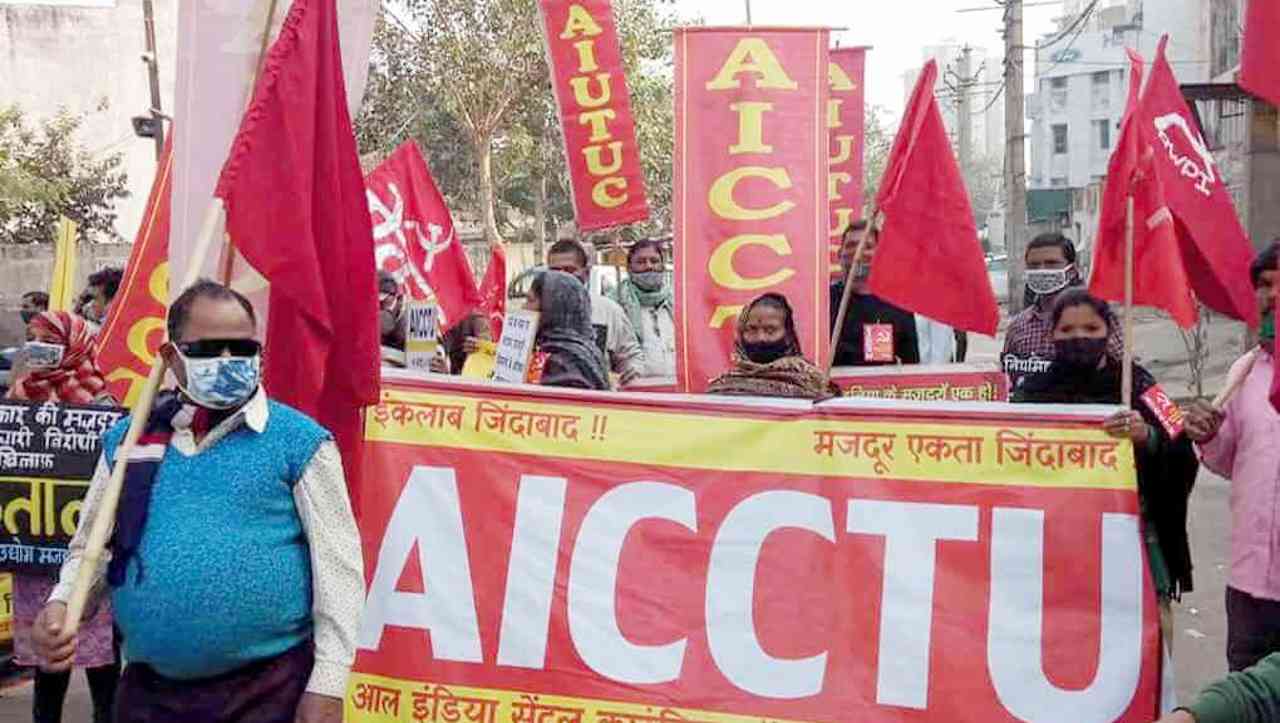
Rejecting the Shram Shakti Niti, AICCTU demanded that the policy be immediately withdrawn, labour codes be scrapped and that any labour and employment framework be re-envisioned in a manner that genuinely upholds the Constitution’s transformative vision, ensuring equality, dignity, security, and justice for all workers. It is also necessary that such labour policy should be discussed and evolved only through the Indian Labour Conference. AICCTU has called for immediate convening of ILC.