
To cement the emerging cracks within NATO and address the growing anxieties and anger of Europe over Trump's aggressive tariff war and renewed hegemonic claim over the entire western hemisphere through a revived Monroe Doctrine (termed Donroe Doctrine by the Trump Administration), Rubio invokes the colonial era nostalgia and calls for a return to the unity of Christian faith and Western Civilization by recovering the erosion caused by 'godless communist revolutions and anti-colonial uprisings'. In other words, an open bid for a collusive and aggressive imperialist alliance against the rise of the Global South.
For most of the Global South, imperialism has never ended. It continues in the form of income deflation, military invasions, debt traps, surplus transfers, and forms of imperial-monopoly rents. Rubio is blind to these mechanisms. In his speech, he mentioned the need to go back to earlier forms of imperialism. He believes that Western imperialism served as the cradle of civilisation and marked an epoch of glorious economic and cultural triumph. Nothing else could be farther from the truth. The rise of Western imperialism, which officially began with the Portuguese capture of Ceuta in 1415, has been a history of violence, wanton loot, murder, slavery, war and genocide. The first major form of loot that enabled the West to purchase Asian goods was bullion looted from the Americas by the Portuguese and the Spanish. Bullion from the Americas was distributed by the Portuguese, Dutch, English, and French to Asia via the ‘Cape of Storms’, as the Muslims had long called it, but which was renamed as the ‘Cape of Good Hope’ by the Iberians after 1498, as it began to provide economic hope to feudal empires. The mining of bullion in huge quantities was made possible by the ruthless exploitation of Amerindian labour and later African slaves. Before Christopher Columbus arrived in 1492, the Americas hosted a native population of 60 million people. Europe’s population at the time was 70-88 million spread over less than half the area. Within a century of European colonisation, 56 million Amerindians perished. On the corpses of the natives, the huge edifice of the ‘first global economy’ was built. 75 per cent of the English East India Company’s (EEIC) total exports between 1660 and 1760 were in American bullion, while the equivalent figure for the Dutch Vereenigde Oost-Indische Compagnie (VOC) was 87 per cent (1660–1720). Between 1699 and 1751, more than 90 per cent of British exports to China were in silver.
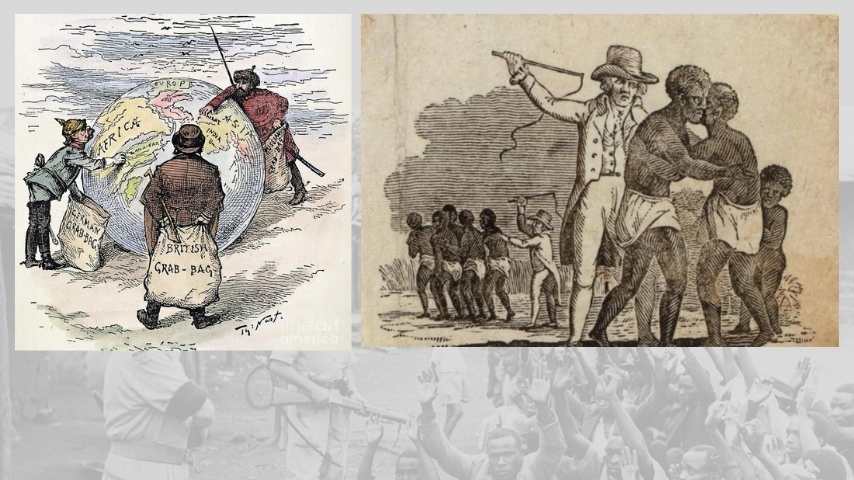
The next great tragedy that was caused by Western ‘civilisation’ was slavery. Slavery pre-dated western slave trade. The pre-Western slave system was less malign than the Atlantic system, and, moreover, the slaves were often treated no differently from peasant cultivators, as they were, in fact, the functional equivalent of free tenants and hired workers in Europe. Under the Western trans-Atlantic slavery, racialization of Africans became the core norm of dehumanization which continues to exist even today. Between 1500 and 1900, some eighteen million slaves were transported from Africa. The labour of these slaves built the most commercially successful plantations in the Americas and the Caribbean. For example, in the mid-eighteenth century, the French colonial slave plantation in Martinique became one of the largest suppliers of coffee and sugar to Europe. In 1740, Martinique dispatched 6.5 million lb of coffee to Europe and began to drive the Arabian and Moroccan product from the markets of Western and Northern Europe. In 1743, 97.3 per cent of the West Indian coffee arriving at Bordeaux was dispatched from Martinique. Unlike other larger colonial slave plantations like Saint Domingue, whose size was 10,714 sq. miles, Martinique stood at 425 sq. miles. The great productivity of Martinique was made possible by tightening the leash of slavery and making sure that the slaves ‘productivity’ matched the industrial scale.
The third major gift of Western civilisation was the building of formal colonial empires. By the end of the 19th century and the beginning of the 20th century, the world was partitioned among a handful of states, with about one-quarter of the globe's land surface distributed or redistributed as colonies among a half-dozen states. Britain increased its territories by some 4 million square miles; France by some 3.5 million; Germany by more than 1 million; Belgium and Italy by just under 1 million each. The worst was Belgian imperialism in Congo. King Leopold II of Belgium claimed Congo as his private property and imposed a harsh labour regime that killed 5 to 8 million Congolese between 1890 and 1910 and left countless others maimed and disabled. The Belgian colonisation of Congo was also racialised to an extreme degree. The word ‘macaque’ (a species of monkey) was used by Belgians (and even children) as an epithet for the native Congolese.
The British Raj in India was equally ruthless in the age of Western imperialism. After scooping away 45 trillion dollars from India between 1765 and 1938, in 1943, Churchill created a man-made famine in Bengal that led to the death of over 3 million people. Even before the famine, the treatment of Bengal was particularly vicious. An official report written by Dr Bentley, director of the Public Health Department in Bengal for the year 1927-28, was unsparing in its details. A million and a half Bengalis were dying every year from malnutrition, curable diseases, and lack of health facilities. These included 750,000 children under fifteen years of age. A report read: It was a diet on which even rats could not live for more than about five weeks. Their vitality is now so undermined by an inadequate diet that they cannot stand the infection of foul diseases. Last year, 120,000 people died from cholera, 350,000 from malaria, 350,000 from tuberculosis … On an average 55,000 newborn infants die every year of tetanus.’’
The impact of the glorious Western civilisation (read colonialism) on India was, in human terms, too traumatic and ghastly. At independence, the average life expectancy was barely 30 years. The poor obviously died much younger. India faced acute food shortages, leading to near-famine conditions across many regions. Between 1946 and 1953, about 14 million tons of food grains worth Rs.10 billion had to be imported, seriously affecting India’s planned development after independence. In 1951, 84 per cent of the Indian people, and 92 per cent of women, were illiterate. The legacy of colonialism was described by Rabindranath Tagore shortly before his death in 1941, in the following words:
The wheels of fate will someday compel the English to give up their Indian Empire. What kind of India will they leave behind, what stark misery? When the stream of their centuries’ administration runs dry at last, what a waste of mud and filth they will leave behind them!
After the formal empires ended in the middle of the 20th century, American imperialism has steamrolled the countries in the Global South. Post 9/11, almost a million people were directly killed by US imperialism in Iraq, Afghanistan, Syria, Yemen, and Pakistan between 2001 and 2023. Of these, more than 432,000 were civilians. The number of people wounded or ill as a result of the conflicts is far higher, as is the number of civilians who died “indirectly” from wars’ destruction of economies, healthcare systems, infrastructure and the environment. An estimated 3.6-3.8 million people died indirectly in post-9/11 war zones, bringing the total death toll to at least 4.5-4.7 million and counting.
Rubio’s imperialist fantasies are an attempt to turn Trump’s gangster imperialism more palatable for the European Lilliputs. Rubio must be resisted; his fantasies should be nipped in the bud.