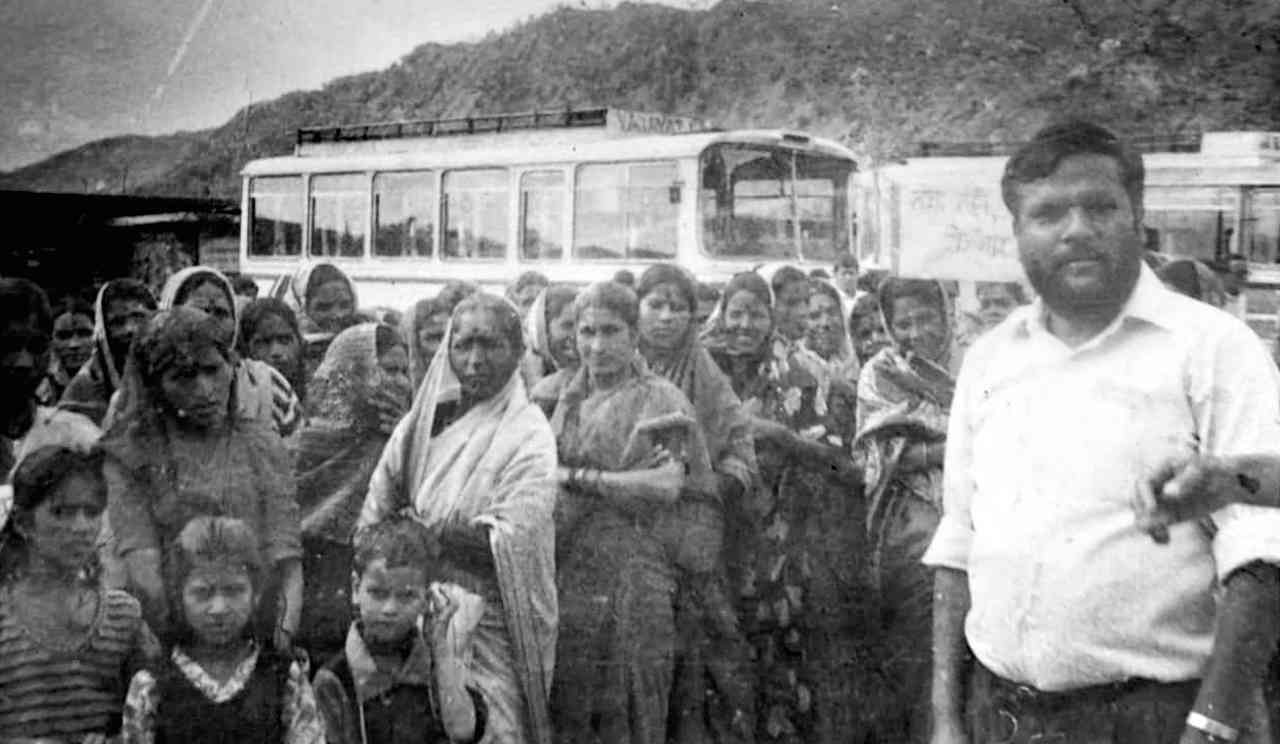
Born in Nainital, Rajeshwar Prasad Bahuguna or Raja Bhai as he was fondly called began his political life as a young Congress activist and was soon seen as a promising leader within the party. His father worked in the postal department. The year 1977 proved decisive in his political evolution. Disillusioned with the Congress and influenced by the JP movement during the final phase of the Emergency, Raja Bhai plunged wholeheartedly into the Janata Party campaign. However, his disenchantment with the Janata Party followed soon after it came to power.
As popular anger mounted against the auctioning and plunder of forests, Raja Bhai emerged as a key organiser of resistance. Under the banner of the Parvatiya Yuva Morcha, a campaign against forest loot was launched, culminating in the historic Nainital Club incident. The movement succeeded and expanded. Soon, there was the formation of the Uttarakhand Sangharsh Vahini, of which Raja Bhai was a founding member. He later played an active role in the Chanchridhar and Dhyari movements in Almora district.
Between 1980 and 1981, Raja Bhai came into close contact with the communist movement. Alongside comrades Bahadur Singh Jangi, Man Singh Pal, Bhuvan Joshi and others, he became a central force in building the historic Bindukhatta peasant struggle. With efforts underway to form the Indian People’s Front (IPF), the Uttarakhand Sangharsh Vahini became its constituent unit after the IPF’s formation in April 1982. During this period, Raja Bhai’s primary field of work was the Terai region.
In 1984, the “Nasha Nahin, Rozgar Do” movement against alcohol and for employment was launched from Chaukhutiya and soon spread across Kumaon. Raja Bhai played a leading role in this agitation and later spent extended periods in Almora jail along with leaders of the Uttarakhand Sangharsh Vahini and the Uttarakhand Kranti Dal.
The IPF’s second conference was held in Kolkata. Internal differences weakened the Sangharsh Vahini, after which the IPF began functioning independently. During this phase, the Terai Kisan Sabha was formed, covering areas from Nainital district (including present-day Udham Singh Nagar) to Lakhimpur Kheri. Raja Bhai drafted its founding document in Nainital. A regional committee combining the hill and Terai regions of Uttar Pradesh was formed under the Party Central Committee’s supervision, with Raja Bhai acting as a vital link between the two regions.
In Almora district, Raja Bhai helped build the Mazdoor Kisan Sabha in the Takula, Someshwar and Dhauladevi blocks along with comrades Chandrashekhar Bhatt, Khadak Da and others. Several large-scale mass mobilisations were organised during this period. The organisation later evolved into the Mazdoor Kisan Jan Sabha, expanding its work to Bhikiyasain and attempting to extend it to the Gauchar region of Chamoli. Raja Bhai also played a decisive role in organising a major conference of Lisa workers in Someshwar and sustaining their movement.
In Nainital, Raja Bhai was instrumental in organising the boatmen’s movement. Many of these boatsmen hailed from regions of Almora which had an impact on the forest conservation movement. He also initiated the Marxist Study Forum in the city, bringing together university teachers, cultural activists, students and workers, thereby laying an organisational foundation for Party work. During this time, he expanded political contacts in Srinagar and Pauri as well. The Progressive Students Organization (PSO) was in the process of its formation in Srinagar.
Elected to the Party’s Uttar Pradesh State Committee at the 1987 Gonda conference, Raja Bhai worked under the leadership of state secretary Comrade Ramjatan Sharma, for whom he always expressed deep respect. His responsibilities within the IPF steadily expanded.
The Mahtosh Mor movement of 1988–89 against violence against women became one of the largest agitations in the then Nainital district, which included the present-day Udham Singh Nagar. Led by Raja Bhai, the movement spread widely despite severe repression, prolonged imprisonment and harsh winter conditions. In the 1989 Lok Sabha elections, Raja Bhai contested from Nainital as IPF candidate— marking the organisation’s first major electoral intervention in Uttarrakhand. The campaign, conducted alongside Comrade Bahadur Singh Jangi’s assembly election campaign from Haldwani, was marked by remarkable energy and mass outreach. Raja Bhai also contested the Nainital Lok Sabha seat in the 1998 and 1999 elections.
Raja Bhai served as IPF’s Uttar Pradesh President and later as the National General Secretary until 1993, when IPF was dissolved. He played an important role during the turbulent period surrounding the demolition of the Babri Masjid. After the Party’s Fifth Congress in Kolkata in 1992, open Party functioning began, and the IPF was gradually wound up. A separate party committee for Uttarakhand was formed by the Central Committee.
Comrade Raja Bahuguna played an important role in the Uttarakhand statehood movement, and he mobilised a huge rally in Nainital in 1992. When the Uttarakhand movement was at its peak in 1994, he wrote a booklet highlighting the future framework for a separate state and also launched the Uttarakhand People’s Front in 1993-94, a platform to give voice to democratic sentiments for the separate statehood. Raja Bhai assumed an increasingly active role in the statehood movement. After the resolution of a separate state movement, ill health forced him to spend some time in Lucknow, where he remained closely associated with the Party office. He was part of the leadership team that organised the Party’s Sixth Congress in Varanasi in 1997 and was elected to the Central Committee.
After Uttarakhand’s formation in 2000, Raja Bhai remained actively engaged in addressing emerging political challenges. At that time, AISA was a prominent students organization in Uttarakhand. Several AISA leaders contested in Assembly Elections as CPIML candidates. Raja Bhai shared a close and enduring bond with student activists, particularly Comrade Yogesh Pandey. After the formation of the state, initiatives in the form of protests, conventions and seminars were undertaken in Dehradun. He continued to play an active role in movements across Bindukhatta, Nainital and Udham Singh Nagar.
From preparing a booklet on the Kedarnath disaster to serving as National Vice President of AICCTU and later as Chairman of the Central Control Commission of the Party, Raja Bhai remained politically active until his final days.
Known for his simplicity, clarity, moral courage and deep commitment to justice, Raja Bhai connected effortlessly with people across generations. He spoke truth to power, raised his opinions boldly at party forums, mentored young activists, and worked consistently to transform movement participants into organised political forces. Not only was he an agitator par excellence, he saw to it that emerging elements were organized into local units. Grooming young comrades by close interaction with them was an integral part of his workstyle.
He carried out tasks such as building movements, intervening within ongoing struggles, and setting the focus of movement with remarkable ease. Once the direction and issues are decided, his discussions would remain firmly centred on it. Whether in internal meetings or joint forums, he was always clear about what needed to be emphasised.
He had a natural ability to strike up conversations with people on the move and to turn those interactions into friendships. In our politics, it is not easy to bring one’s own family and relatives firmly into one’s circle of support, but Raja Bhai succeeded in doing this to a great extent— a fact that became evident in his final days.
Spontaneity and an uncompromising refusal to tolerate injustice lay at the core of his personality. Whether it was the near-fatal attack by hired goons during his college days in Nainital, when he confronted the college administration over irregularities in fee waivers, or the physical assault he suffered in Someshwar, Almora, while trying to stop people attacking a member of a minority community with communal abuse, these incidents show that a deep commitment to justice lay at the heart of his character. It was this commitment that transformed Rajeshwar into the revolutionary communist leader Raja Bahuguna.