India’s overall environmental & climate crisis despite not being at the forefront of the national political agenda has time and again proved to be one of the most rampant subjects concerning some of the core issues of the citizens, especially the most under-privileged groups, with the air-pollution crisis as one of the most quintessential of the examples. According to the State of Global Air Report 2024, air pollution now claims over 21 lakh lives annually in India, with another report stating one in seven deaths in NCR is related to this.
The hardest impact remains on the working class and vulnerable communities, driven by their occupations, economic conditions, and living environments. Outdoor workers such as construction laborers, migrant workers and agricultural workers face constant exposure to toxic air, heightening the risk of severe diseases. Those from lower-income groups often live in densely polluted areas with minimal access and awareness to protection or healthcare, making air pollution both a public health crisis and a social justice issue.
Beyond the scientific and policy level dissection of the current pollution conundrum, what essentially comes across is the absolute negligence of the present government and their priorities which puts people's concerns at last. This is evident from the fact that as the capital of world’s largest democracy with the self-assumed title of ‘vishwa-guru’, maintained its not-so-lofty title of ‘most polluted capital’ for the seventh straight year, whereas the / institutional and governance response remained ironic but devastating. This year’s action or rather the in-action of the triple-engine BJP government is tantamount to telling the Delhiites that, we and our future generations can die without breath but neither can we protest nor anyone is going to listen and solve. All of this happens as the tenders for ordering air purifiers worth 15 lakhs are floated for the Delhi state government, and the campaign by the Chief Minister to ask people to ‘Thank You Modiji’ makes its rounds. We wonder who we should thank for taking away almost ten years of our lives, as breathing Delhi’s air can reduce our life expectancy by the same.
India’s pollution crisis has a pattern of overt negligence and lack of effort over the past several years, as beyond Delhi NCR region, this also is a national crisis. India’s National Clean Air Program is the primary policy in place since 2019 to address this paramount challenge, covering 131 cities in India, however it leaves over 200 cities which also are dealing with this massive concern.
Despite the past several government’s failure to appropriately address this crisis in Delhi NCR, the response of the Rekha-Modi duo has set abysmally low standards in this current year. This was the first time in several years the elected government went out of its way to approach the courts to legalize cracker bursting in Delhi NCR. The so-called ‘green crackers’ which were allowed not only had implementation challenges but were also warned against by several experts & media about the serious consequences and they created disastrous outcomes.
This political move of wooing Hindu majoritarian enthusiasts led to a four-year high pollution on the day next to Diwali, and since then the region’s air quality has not recovered. What remains even more ghastly is that rather than taking any accountability, and coming up with concrete policy measures, the state has engaged in false solutions like cloud seeding, which have historically proved to be ineffective. And when all else failed, a political twist was given to scapegoat the past government which turned into a political-blame game and even attempts were made to fudge the data from air quality monitoring systems.
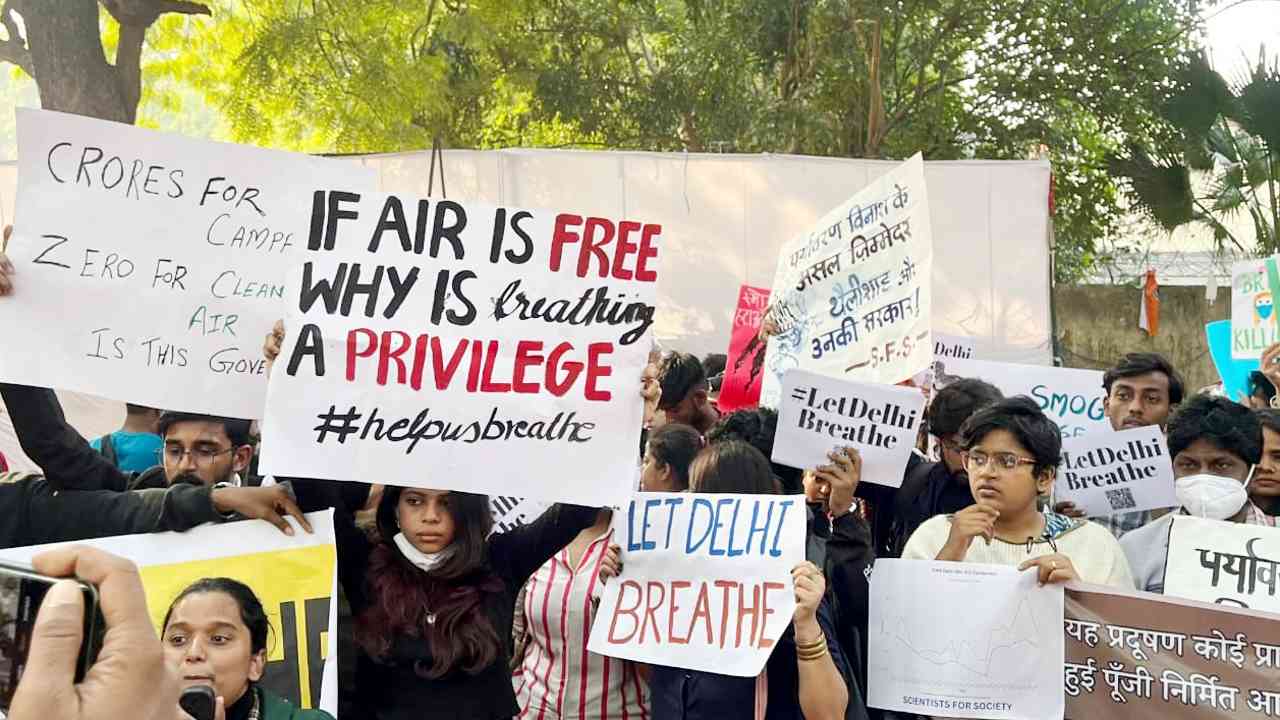
Delhi NCR’s air pollution challenge has shown that resistance and protest can only be the way forward, by people fighting for their own rights and coercing this regime out of its way. The desperation of covering up their failures was clearly shown in arbitrary detention of senior citizens, children and students on the protest call concerning this disastrous state of life in Delhi at the India gate. Nevertheless, the people of Delhi have not backed down, several organizations, activists, students, researchers & experts and concerned citizens have joined hands to keep mobilizing to ask for accountability and demand actions from the state. Research and science show several key low hanging measures which can be taken to actively reduce the dangerous air quality levels such as increasing public transportations, introducing rapid bus transit & restricting private vehicles, restricting constructions or polluting business and ensuring compensatory wages to workers.
However, in reality, this government is taking no steadfast steps as its priorities are with the capitalist groups who will fail to benefit with such active measures in place. The way forward remains clear, Delhi’s environmental challenge is now a year-round concern, with killer toxic fumes in winters to heat extremes in summer. The people must stand together to fight and ask for comprehensive long-term action such as air-shed management practices, heavy investments in public health infrastructure, affordable long-term public transport by keeping Delhi’s ordinary and working-class citizens in the center. This environmental concern challenges the very livability in this city and people need to fight to take down any such regimes who are against their interests and fight to keep for their rights.
=====

Delhi: Students and Citizens Protest Against Dangerous Delhi Pollution
On
18th November, hundreds of residents of Delhi joined protest call at
Jantar Mantar tormented by the severe AQI in Delhi. Protesters gathered
in huge numbers and raised slogans demanding immediate action from the
government.
JNUSU President Aditi said at the
public meeting, "people are suffering and this government is not even
ready to acknowledge the crisis. However, they have installed ₹6 lakh
worth of air purifiers in government buildings to save themselves from
the venomous air. The people demand immediate and long-term action
against the poison in Delhi's air."
AISA
Delhi State President, Saiyed Ishfaq said, "we are asserting that
pollution is a socio-political issue, and its answer lies in the intent
of those who we choose as decision makers. But right now, we see our
Chief Minister is not ready to step up. The venomous air needs immediate
catering as well and lasting solutions. We demand a people centric
policy for industrial and vehicular pollution, which does not exclude
the already marginalised."
The protest called for urgent measures that the government must implement to confront Delhi’s air emergency:
- Strengthen affordable public transport by increasing DTC buses and metro coaches and provide free travel during peak-pollution periods to discourage private vehicle use.
- Impose a moratorium on construction activities and guarantee compensation and job protection for affected workers.
- Strictly enforce industrial pollution norms and penalize violators without exception.
- Launch a special medical care and support drive for children, the elderly, and those with respiratory illnesses.
- Ensure transparent, real-time AQI monitoring and proper functioning of all air quality stations.
Earlier on 9th November, the protest against Delhi’s pollution at India Gate was met with a police crackdown. Despite regular police intimidation, the protest continued and ended with a resolve to carry forward the fight for clean air.