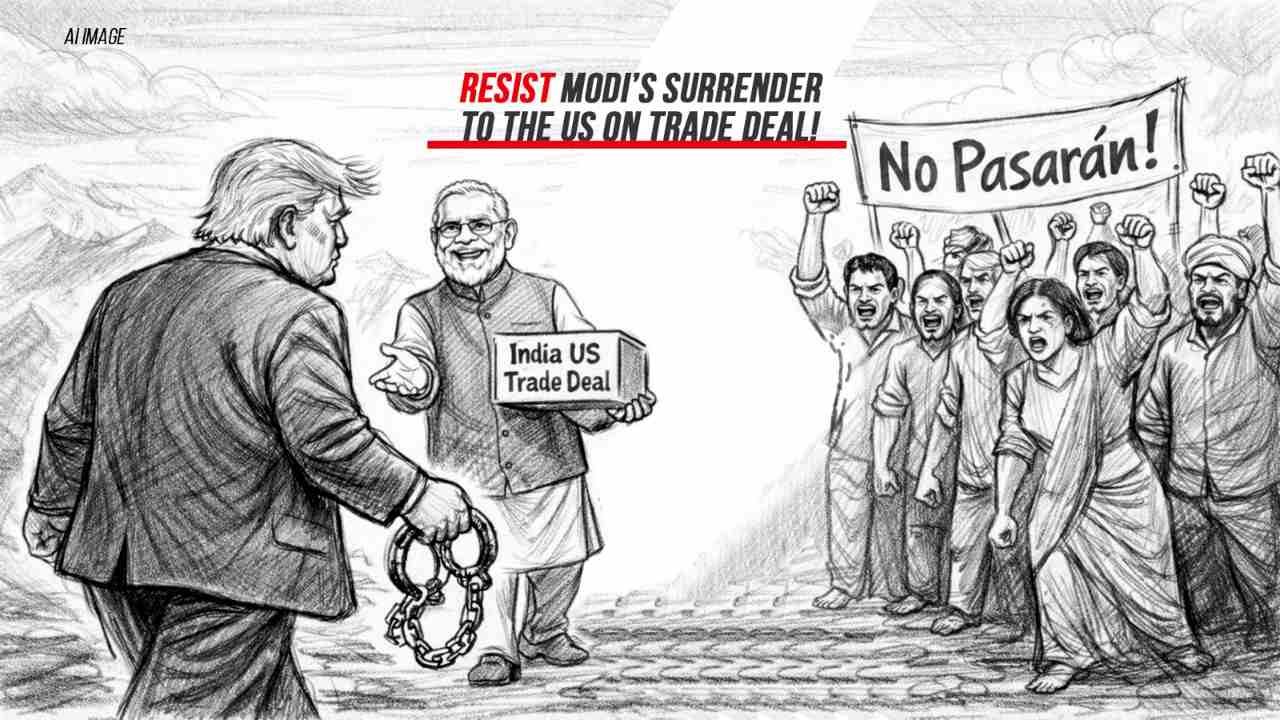
Let us first look at the basics that are being sought to be camouflaged by the Modi government's propaganda machinery. India will be required to pay an increased average of 18% tariff on Indian exports to the US, up from 3% till recently before Trump started waging the tariff war. Modi government however shows it as a decline from the threatened penal level of 50% tariff, but as mentioned in Trump's executive order, this decline is conditional on a US-monitored certificate of India not purchasing any oil from Russia!
India, on the other hand, used to charge more than 50% tariff on most American imports, which will now come down to Zero. And this includes the hitherto protected agriculture sector which is now being opened up to American agri imports in howsoever calibrated a manner. In other words, the crisis-ridden agriculture sector of India which is still predominantly small-scale and accounts for the livelihood of half of Indian population is being exposed to a disastrous competition with the highly mechanised and heavily subsidised gigantic American farming involving only around 1% US population.
Then there is also the issue of non-tariff barriers or NTBs. As of now India applies less than 500 NTBs as against 6000 NTBs applied by the US. Yet it is only India which is being pushed to lift the NTBs without any reciprocal relaxation from the American side. India's commerce minister dodges the issue of Russian oil purchase by passing the buck to the External Affairs Minister while the latter passes it back to the Commerce Ministry. The Commerce Minister also evades the issue by talking about oil companies deciding the details. Meanwhile, the Finance Minister draws false comfort by comparing India's 18% tariff level with the 19% tariff level for Bangladesh. But now we know that Bangladesh has got zero reciprocal tariff on certain textile and apparel items, and shares of Indian textile exporters have already begun to tumble.
The claims of “India’s calibrated opening of agriculture safeguarding farmers” and “no sensitive agricultural sector included” peddled by Modi regime are also being exposed with Trump and the White House spilling the beans on a regular basis. The fact sheet issued by the White House now includes zero or reduced tariffs on “certain pulses”, a detail hidden from the people in the initial framework agreement issued on February 7. Though, the very next the fact-sheet was updated to remove “certain pulses” after an uproar. We now know that the phrase “additional agricultural products” with reduced or zero tariff is the real devil in the details that will undo decades of effort to protect Indian farmers, the overwhelming majority of whom are small and marginal cultivators.
Historically, India has defended tariffs and non-tariff measures such as subsidies, procurement and import quotas for decades at the WTO and in bilateral trade agreements, despite immense pressure from Western countries. This is because our history, and the history of the entire Global South, has taught us the bitter lessons of colonial and unequal trade relationships — which continue to dominate international trade — in which rich countries engulf and control the markets of developing nations, destroying domestic production and livelihoods.
The dangers are itched everywhere in global history. In Mexico after NAFTA (1994), heavily subsidised U.S. corn entered duty-free and undercut millions of small maize farmers who could not compete with mechanised American agribusiness backed by federal support. Between 1994 and the early 2000s, U.S. corn exports to Mexico more than tripled. Rural incomes fell, agrarian communities were destabilised, and large-scale migration became a structural feature of the economy. In Haiti, tariff cuts in the 1990s, under pressure from international financial institutions and the US, opened the floodgates to heavily subsidised U.S. rice, devastating domestic producers and turning the country from largely self-sufficient into structurally import-dependent for a basic staple.
In this deal, while India gets some crumbs, Modi has laid out the entire platter before the US. It promises eliminating or reducing tariffs on all US industrial goods and a wide range of US food and agricultural products including dried distillers’ grains, red sorghum, nuts, fresh and processed fruits, certain pulses, soybean oil, wine and spirits and additional products. Distillers dried grains with solubles, soyoil, cotton and various fruits and nuts mentioned in the agreement are bound to destabilise domestic agricultural markets already in deep crisis. The same government that claims to promote oilseeds and pulses is granting concessions for US pulses and soyoil to enter at reduced or zero tariffs. Indian cotton farmers struggling for remunerative prices will be devastated by entry of subsidised US cotton. Apple growers in Kashmir and Himachal, already facing climate stress and market volatility, will be pushed further into distress with the entry of cheaper American fruits.
Indian dairy and poultry farmers have traditionally been using oilmeals (the remaining part of oilseed after oil extraction) and coarse grains (like sorghum, jowar) in animal feed. India has expanded ethanol production under the E20 programme (Ethanol-Fuel Mix) and increased corn cultivation, leading to rising domestic DDGS production. This is also expected that along with more poultry and dairy industry expansion, DDGs production will also increase. Industry experts indicate that current production is not fully absorbed domestically. In such a scenario, opening the market to US DDGS is nothing but knowingly inflicting self-harm.
Similarly, duty free red sorghum imports (which earlier had customs and duties @ 60-65%) will directly threaten millions of farmers in rain fed regions of Maharashtra, Karnataka and the Deccan plateau. Existing Sorghum tariffs are high because this crop serves as staple coarse cereal as well as animal feed traditionally in the region. Sorghum is part of the Shree Anna basket promoted by the government itself. Yet the same government is exposing it to cheaper subsidised imports.
The Modi government is also silent on GM crop products while US farmers cultivate genetically modified corn and soybean, and there is danger of genetic contamination with DDGs (from GM corn) as well as soyoil that will introduce invasive species threatening native crops.
Currently the US exports agricultural products to India worth approximately ₹17,000 to ₹19,000 crore annually, facing weighted average tariffs of 60 to 65 percent. If this framework translates into zero or minimal tariffs, not only will Indian farmers face devastation, the country will also lose an estimated ₹10,000 to ₹12,000 crore annually in tariff revenue based on existing import volumes. The result will be agrarian devastation combined with fiscal erosion.
For Indian industry, there is little beyond selective tariff adjustments on a few identified products and vague promises of reciprocal arrangements. Even these remain far higher than pre Trump levels. In contrast, India is offering zero or minimal tariffs on US industrial goods across a wide range.
The language surrounding pharmaceuticals reveals a deeply asymmetric structure. India’s treatment on pharmaceuticals and pharmaceutical ingredients will be “contingent on the findings” of a US Section 232 national security investigation. Indian generic companies supply nearly half of all generic medicines consumed in the United States. Indian generic companies supply nearly half of all generic medicines consumed in the United States. However, a significant share of the active pharmaceutical ingredients (APIs) used by Indian generic manufacturers, the core raw materials of medicines, are sourced from China. With the Section 232 investigation framed within a China focused national security narrative, the Indian generic industry could face tariffs, quotas or pressure to relocate manufacturing to the US in order to retain market access. The real objective appears to be to force Indian generic manufacturers to shift towards more expensive, US approved API supply chains. This will not only weaken India’s export competitiveness but also increase medicine prices domestically, directly impacting public healthcare and access to affordable drugs.
Significantly, under the Section 232 investigations, key industrial products such as steel and aluminium remain excluded from the so-called reciprocal tariffs, meaning Indian exporters in these crucial sectors will continue to face high US duties, severely limiting their competitiveness in the American market.
Further, Modi has committed (later changed to “intended” in the fact-sheet) to purchase over 500 billion dollars of US goods over five years, translating into roughly 100 billion dollars annually, approximately ₹9 lakh crore. Such a commitment will strain foreign exchange reserves and create serious fiscal pressures. At present, weighted average tariff rates are around 13.5 percent. Under a zero tariff regime, India could forgo roughly 13.5 billion dollars annually in customs revenue. At a time when public expenditure on health, education and rural development is constrained, who will bear this revenue shock?
The deal also reflects India’s growing subordination to US geopolitical interests. The US share in India’s oil imports has already nearly doubled over the past year. It is therefore alarming that the Indian government would commit to purchasing oil from the US or Venezuela or to refraining from buying oil from Russia or Iran, at the behest of the United States. Any decision to buy oil from Venezuela—or not to buy from other countries—is a bilateral matter between sovereign nations, and not a prerogative of Donald Trump or the US government.
Switching from discounted Russian crude to more expensive US supplies could impose additional annual costs estimated at 25 to 30 billion dollars, apart from higher shipping and logistics expenses. They will be passed on through higher fuel prices, raising costs across agriculture, transport and industry. Inflationary pressure will deepen, and ordinary citizens will bear the burden.
The framework for the interim agreement explicitly includes negotiations on “intellectual property, labour, environment, government procurement, and trade-distorting or unfair practices of state-owned enterprises”. In plain language, this omnibus clause subjects India’s entire regulatory architecture to Trump's diktats. From MSP and fertiliser subsidies to labour protections and public sector enterprises that anchor national infrastructure, every policy instrument designed to protect domestic interests is being placed on the negotiating table.
The farmers, workers and all the toiling masses of India must unite to resist this new colonial blueprint of the US Imperialism that Trump is inflicting on India emboldened by the Modi government's policy of total capitulation. We have seen how the Modi government remained a mute spectator while Trump handcuffed, shackled, and deported Indians. Now, it is preparing to shackle the entire country itself.
No Pasarán! They shall not pass! India shall resist and defeat the neocolonial expedition of the Trump Administration and US Imperialism.