The legal picture adds to the urgency. The Supreme Court of India is still hearing the matter and has not ruled on SIR's legality. Yet the ECI has not paused. The Court itself has noted that the ECI's position before it has been shifting and inconsistent, and has intervened directly to oversee SIR's implementation in West Bengal - even before the case is decided - which does not fare well for democracy and its practice in India. In one pointed observation, the SC noted that if the winning margin in a constituency is 2% and more than 15% of the electorate could not vote, the constitutional and political damage is self-evident. In West Bengal, a state where the BJP has demonstrated it will pursue power at any cost, that damage is already done.
A Campaign Takes Shape
Against this backdrop of national mass disenfranchisement and state abdication, civil society organisations in Karnataka resolved to act. The trigger was an early meeting convened by the Chief Electoral Officer of Karnataka (CEO-K) with all political parties, including CPI(ML) Liberation. The CEO made clear he saw himself as a conduit for the ECI rather than a guardian of voters' rights, and that SIR would be implemented regardless. The announcement that SIR would be carried out in Karnataka came at a time when five municipal corporation elections in the Greater Bengaluru Authority area were imminent and the state government's socio-economic survey was already underway.
The response was to convene a broader gathering - Muslim, Dalit, women's, slum, student, and progressive organisations - to collectively plan for what was coming. That meeting gave rise to a round-table conference, attended by representatives of the farmers' and workers' movements, where a resolution was passed to resist SIR in Karnataka. The coalition adopted a name: the 'My Vote, My Right' campaign. Its dual mandate was to press the Congress-led state government to pass an anti-SIR resolution in the assembly, and to prepare legally for a fight if it came to that.
Mapping the Ground and the Gaps
The campaign's first phase focused on understanding what SIR actually meant in practice. Members met with Booth-Level Officers (BLOs) to hear directly about the difficulties they and voters were encountering in the field. Complaints were compiled and filed with the CEO-K. No response came. Repeated requests for a meeting with the CEO-K went unanswered. Across the state, protests went up demanding that SIR be stopped.
Parallel to this, mapping of voters was progressing at pace. Media reports indicated 73.2% completion. When the CEO-K eventually released figures, he claimed that 4.46 crore of Karnataka's 5.57 crore voters had been mapped. But buried in that same data was a revealing detail: only 19.13 lakh voters had actually been 'System and BLO verified.' The accuracy of the remaining mapped voters was left an open question — one the campaign was determined to raise.
The State Government: Promising Much, Delivering Little
The campaign engaged Karnataka's political leadership at several levels. A meeting with Karnataka Pradesh Congress Committee Honorary President GC Chandrashekhar revealed that the party was running its own voter verification exercise - spurred by Rahul Gandhi's concerns about 'vote chori' - with BLA-2 agents working at booth level. Trainings were underway. Yet when campaign representatives attended one such session, it became apparent that the Congress's energy was directed primarily toward preparing for the upcoming municipal corporation elections, which are expected to be held only after SIR concludes.
Efforts to meet Chief Minister Siddaramaiah and Deputy Chief Minister DK Shivakumar were not successful. The budget session, and the duo's internal contradictions, kept those meetings from happening. At a cabinet meeting, the Department of Law was tasked with studying the national picture and submitting recommendations within 15 days. Campaign representatives met with HK Patil, Minister of Law and Parliamentary Affairs, who heard the campaign's concerns and promised a stakeholder consultation before any report was submitted. That consultation has not been called. The report has not been submitted. The state government has yet to take a formal position.
The Communities Most at Risk
While the political negotiations continued, the campaign turned its attention to the communities that SIR would hit hardest. In Kodagu district, the campaign spoke to the Paniyerava Adivasi community and found a situation of near-total exclusion. These families have moved between plantations over the decades and cannot trace where their names appeared in the 2002 voter rolls — the document that SIR treats as its baseline. They do not possess the records that would prove their 2002 address, nor can many recall where their parents or grandparents were registered. A BLO working in the area was unambiguous: it had proven impossible to locate even one person's name in the 2002 voter list. A survey was carried out to collate the community's electoral data and documentation, and a formal complaint was filed with the CEO-K. The situation, the campaign found, was not unique to one settlement - it reflected the condition of the Paniyerava community across Adivasi areas and plantation line-houses throughout the district.
A similar survey is underway for the transgender community across Karnataka. Preliminary discussions brought to the surface significant barriers: community members estranged from their families face difficulty obtaining their parents' voter details, while name and gender changes create further complications that SIR's rigid document requirements are ill-equipped to accommodate.
Awareness work has also been initiated among migrant workers in Bengaluru - people who have come for their livelihoods from districts in North and Kalyan Karnataka and now face uncertainty about their electoral status. The campaign has also attempted to reach Devadasi women, who, having been disowned by their families through generations of a brutal and exploitative practice, cannot furnish the family documents SIR demands. Their children face the same impossibility.
On the Ground: Workshops, Helpdesks, and Complaints
Awareness workshops have been held in Kodagu, Dakshin Kannada, Udupi, Chikmagalur, Mysore, Davangere, Uttara Kannada, and several other districts. In Bengaluru, workshops have been organised with slum organisations, domestic workers' unions, women's organisations, transgender community groups, trade unions, and Dalit groups.
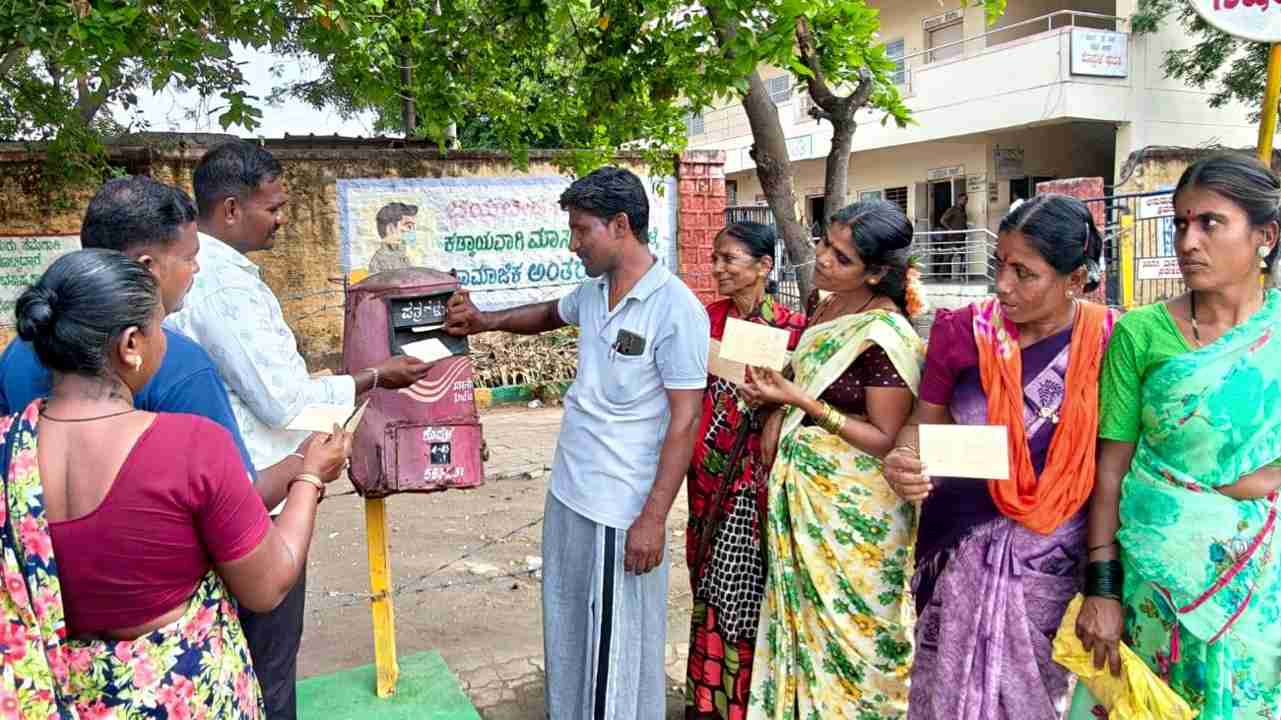
The campaign has also trained youth volunteers to run helpdesks across the city, assisting voters in locating their 2002 mapping details and preparing their documentation before SIR formally begins. The problems surfacing at these helpdesks are varied and telling: discrepancies in names and addresses, changed addresses, relatives' names that don't match records, an inability to recall 2002 registration details, names that were deleted from the 2002 rolls altogether. For each case, individual complaints are being filed with the CEO-K.
What This Fight Is About
The My Vote, My Right campaign is working on three fronts at once: raising public awareness about what SIR means in practice, providing direct assistance to voters who risk being excluded, and pressing the Congress-led state government to take a clear, formal stand in defence of Karnataka's voters. The state government has so far responded with process - commissioning reports, promising consultations — without producing any of it, showing their lack of seriousness.
What is at stake is not procedural and administrative. It is the right to vote - the foundational right of the Constitution, the one through which every other political claim is made. To allow SIR to proceed unchallenged, with its demand for 2002 documents that millions of Karnataka's most marginalised citizens simply do not have, is to write those citizens out of democracy.