True to its nature, the Modi government seeks to camouflage this dismantling of the employment guarantee framework as a 'benefit' for rural job seekers by presenting it as an increase in the scope of persondays from 100 to 125 per year. The reality is labourers have hardly been getting 50 days of work per year. Behind the veil of imaginary increase of workdays, the new bill actually erodes whatever right and guarantee job-seekers enjoyed under the previous arrangement. The operation of the Act will from now on remain suspended for a period of sixty days during the main agricultural season. States will have to bear a bigger burden of the wage bill, and panchayats will hardly have any say in the bureaucratically administered scheme of things. There will be no increase in wages or guaranteed payment of minimum wages. A demand-driven rights-oriented legislation will thus be replaced by another centrally manipulated supply-limited cash transfer programme subjected to the vagaries of the digital delivery system.
The government would like us to believe that the new arrangement of pausing the operation of the Act during busy agriculture season is beneficial to both farmers and labourers. Actually farmers across India have been demanding a closer integration or linkage between rural employment guarantee and agriculture. The money the government distributes in the name of 'Kisan Samman' or honouring India's farmers does little to ease the burden of agrarian crisis and ever escalating cost of agriculture. Closer linkage between the employment guarantee act and agriculture would amount to an effective subsidy from the farners' point of view while ensuring regular employment and minimum wages for agricultural labourers. The Modi government has chosen exactly the opposite route of divorcing the employment guarantee act from agriculture.
Renowned development activist and one of the key architects of NREGA in 2005 Jean Dreze has rightly described the VB-GRAMG Bill as not mere renaming of the old act and removal of the name of Mahatma Gandhi, but as outright assassination of the Act akin to the assassination of Gandhi himself. At a time when the country has been yearning for a stronger rural employment guarantee act with an equivalent extension in urban areas to address the issue of acute urban poverty and unemployment, the Modi government has come out with this combo package of Labour Codes and VB-GRAMG sounding the death knell for employment guarantee and labour rights.
For the Modi government this is a long awaited surgical strike on a UPA-era signature legislation. From NREGA (later renamed MGNREGA) and RTI to Forest Rights Act and the Land Acquisition Act 2013 (Right to Fair Compensation and Transparency in Land Acquisition, Rehabilitation and Resettlement Act), the UPA period had witnessed a set of legislations which were all products of protracted struggles and dedicated public interest research and activism. The Modi era began with the attempt to kill the Land Acquisition Act with an Ordinance, but the farmers' movement and the opposition succeeded in foiling the move. Wiser from the defeat of that bid, the Modi government chose the path of subverting the legislations by sinister amendments. Now emboldened by the successful hijack of the Bihar elections, the government has chosen the moment to kill the MGNREGA through a summary execution without any public consultation or parliamentary debate. It is now for India's agricultual and other rural labourers, workers and farmers to forge broad-based unity and wage a sustained movement against the disastrous combo package of Labour Codes and VB-GRAMG Act with the kind of tenacity, strength and determination that enabled India's farmers to win their historic victory over the now repealed farm laws.

Protest Against Modi Govt’s Attack on MGNREGA
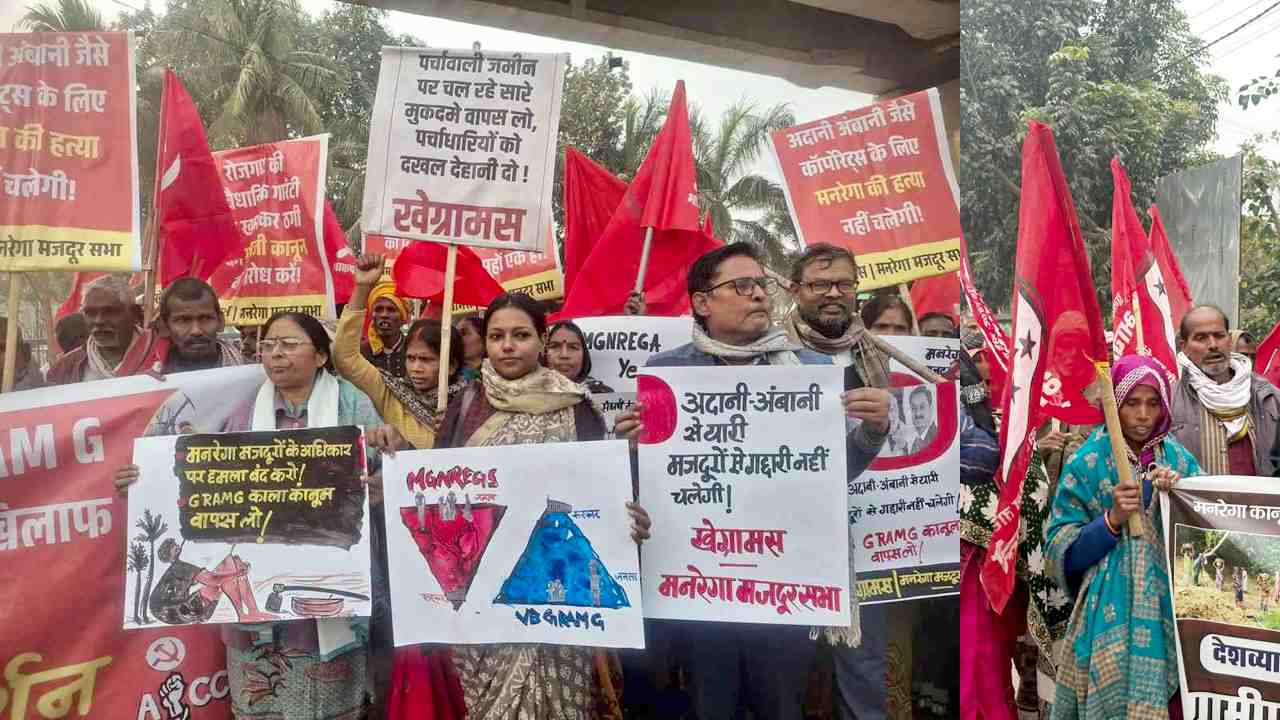
As part of the All India Protest Day on December 22, CPI(ML) Liberation, AIARLA, MNREGA Mazdoor Sabha, AICCTU and other Left organisations led militant protests across Bihar, Odisha, Andhra Pradesh, Punjab and other states against the Modi-led BJP government’s assault on MNREGA and the right to guaranteed rural employment.
The protests condemned the BJP regime for destroying MNREGA, advancing corporate-driven policies, and reducing workers to modern-day slaves of corporates. Protesters strongly opposed the stealthy introduction of the VB GRAM G Act and demanded its immediate withdrawal, expansion of MNREGA to 200 days of work, a minimum wage of Rs. 600 per day, and increased budgetary allocations.