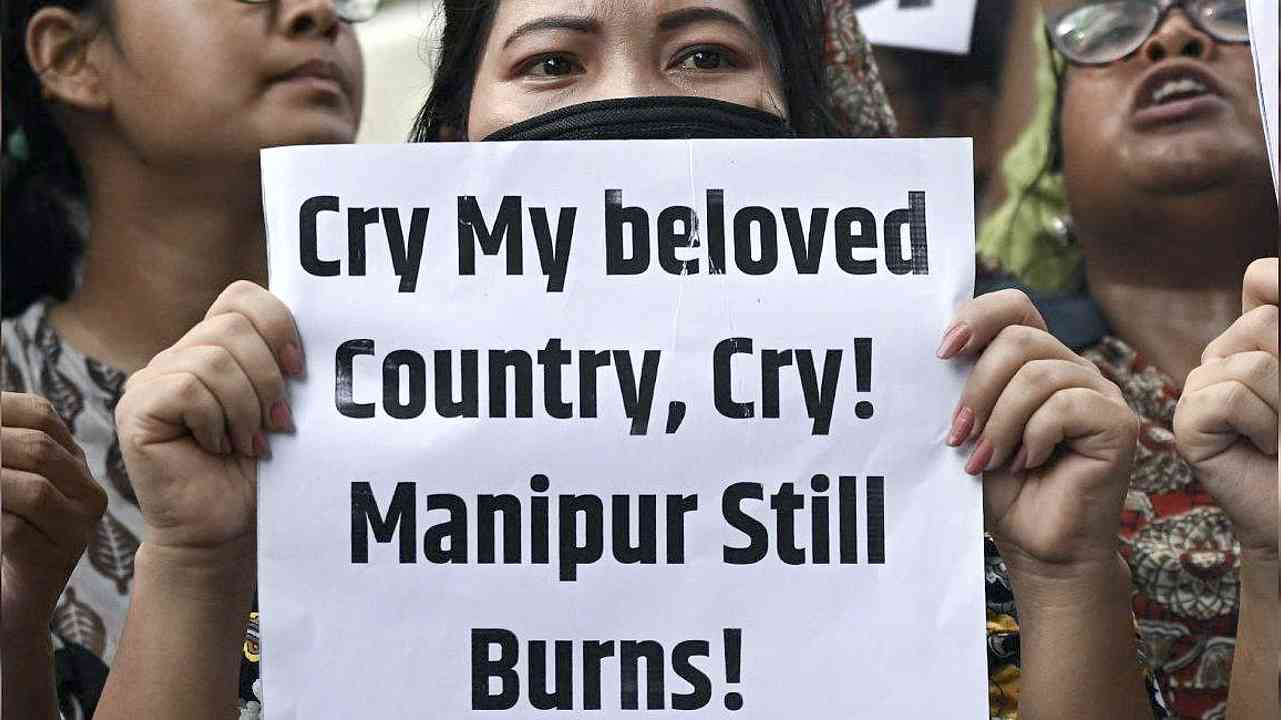
For nearly three years, i.e., since May 2023, Manipur has remained trapped in a deep and devastating crisis. A state of barely 3.2 million people has been torn apart by sustained ethnic violence between the dominant Meitei community in the Imphal Valley and the Kuki-Zo tribes in the surrounding hills. More than 300 lives have been lost, while over 60,000 people continue to live as displaced persons in segregated relief camps, cut off from any semblance of normal life. Even when the scale of violence appeared to reduce, peace never truly returned. What emerged was not peace but a fragile and militarised stalemate enforced by armed deployments, curfews, internet shutdowns, and buffer zones. The relative decline in violence owed less to any meaningful political solution and more to mutual exhaustion among the affected communities, combined with central security force deployments. The events in Bishnupur have once again exposed the bankruptcy of a governance model that substitutes security management for political resolution.
It goes without saying that the violence and segregation that have raged for more than 3 years now, are the outcome of the actions — and inaction - of the BJP government. Even as the then BJP Chief Minister Biren Singh displayed utter incompetence and a disturbing reluctance to end the bloodshed, Prime Minister Narendra Modi chose to prioritise foreign visits over the burning reality of Manipur. The dismal responses of both the Prime Minister and the Home Minister in Parliament only laid bare their political bankruptcy and their complete inability to offer any meaningful, comprehensive solution to the crisis. The resignation of Biren Singh on February 9th, 2025 and the subsequent imposition of President’s Rule for a year brought the state under direct Union control. Yet even this extraordinary intervention could not restore normalcy. Despite intensified disarmament drives and expanded humanitarian relief, fatal clashes continued.
Prime Minister Modi’s long-awaited visit to Manipur on September 13th, 2025 more than 28 months after the outbreak of ethnic conflict, where he delivered public addresses at Imphal and Churachandpur focused extensively on infrastructure projects and investments in the State, while the ongoing conflict found only incidental mention, reduced to an appeal for peace so that development would not be hindered. A rather transactional approach exemplifying the limited political imagination of the BJP seeking to substitute justice and reconciliation with promises of development.
The restoration of an elected government in February 2026 under Chief Minister Yumnam Khemchand Singh was projected as a turning point. His coalition, with Kuki and Naga representation, and the reconvening of the Assembly were presented as steps toward reconciliation. But symbolic gestures alone cannot heal a society fractured by years of violence, mistrust, and displacement. Tens of thousands continue to live in relief camps, economic life remains severely disrupted, and even inter-district movement is tentative. The condition of the camps remains a stain on the conscience of the nation, with basic services grossly inadequate and essential relief arrangements insufficient. A state cannot claim normalcy while its citizens are reduced to surviving in camps, dispossessed of home, livelihood, and dignity.
On the other hand, a civil society approach that is trapped in simplistic binaries reduces the crisis to a straightforward Hindu right versus minority conflict, which ignores the complex political realities of the state. In the last Lok Sabha elections, the Congress won both parliamentary seats in Manipur against the BJP, despite widespread fears of money power, force, and booth capture, puncturing the logic of the Meitei population being firmly in the grip of the Hindu right. Equally, the claim that the Hindu right works exclusively with the Meiteis to marginalise tribal groups is complicated by the fact that there are seven BJP legislators from the Kuki-Chin community, including a Deputy Chief Minister from the community. There is no neat communal binary; what obtains is a complex fragmented political terrain marked by shifting alliances and competing social interests. Scholars have long argued that the protracted conflict in the state is inseparable from India’s security and policing approach to the region, an approach that continues to carry the imprint of colonial logic. Borrowing from Bimol Akoijam, the “postcolonial” itself becomes an oxymoron in the context of Manipur, where the state’s relationship with the region continues to be mediated through force, surveillance, and exceptionalism.
What we are witnessing in Manipur is nothing short of a historic betrayal. Never before in independent India has a government presided over such a complete rupture of the social fabric that entire communities within a single state have been driven into ethnic enclaves, separated by fear, violence, and militarised boundaries. This did not emerge in a vacuum. It is the direct political consequence of a double-engine BJP government that has manufactured division in a state which, despite its history of conflict, had repeatedly found ways to reconcile and live together.
What we are witnessing in Manipur is not merely a law-and-order problem, but a profound democratic failure. Until the political roots of the conflict are confronted - including the failures of governance, the distortions of centre-driven security policy, and the fractured social compact within the state - every claim of peace will remain hollow, and every fresh death will stand as a reminder of that failure.