Microfinance was introduced into the lives of poor women with the promise of empowerment, yet the burden of high interest rates quickly transformed it into a coercive and exploitative trap. Their perceived reliability as clients stems not from empowerment but from their socio-cultural vulnerability. Coercive repayment practices rely on social violence and public humiliation, which anthropologist Lamia Karim terms a “local economy of shame”, ultimately reinforcing patriarchal dominance.
In Bihar, testimonies from women in Jeevika at the Sammelan revealed that loans are largely used for consumption smoothing, such as covering medical expenses, school fees, or marriage costs. Women borrowers frequently report harassment from recovery agents. Coercive recovery practices by MFI agents are widespread and deeply violate the dignity and safety of women borrowers. Multiple women reported instances of intimidation and harassment, including agents visiting the borrower’s house and staying outside until midnight, confiscating household items such as gas cylinders or ceiling fans, locking women and families out of their homes and denying access to basic utilities, and intimidating family members or threatening to block Aadhaar cards and access to government schemes. There were also multiple reports of suicide and forced migration of families to escape loan repayment.
Microfinance Story
India’s microfinance system evolved from informal moneylending to early World Bank-supported Self-Help Groups (SHGs), later incorporating Grameen Bank-inspired models for women through joint liability groups, and eventually expanding through Non-Banking Financial Companies (NBFCs), with Bihar’s Jeevika project (2007 onward) formalising SHGs and linking them to livelihoods and microloans.
Mohammad Yunus started Grameen Bank in 1983 to help poor women gain freedom from exploitation by moneylenders. He believed that through low-interest micro-credit, poor women could slowly come out of the trap of local moneylending feudals. The Grameen Bank model was a success because it met the huge demand for microcredit due to low interest rates. Poor women lacked collateral and were unable to access loans from formal sources. The Grameen Bank’s solidarity circle or joint liability group acted as “social collateral”, resulting in a high repayment rate and making them bankable for the first time.
It soon gained the support of the international development community, and microfinance was promoted in the 1980s and 1990s as a way to empower poor women and stimulate grassroots entrepreneurship.
Over time, Grameen Bank transformed into a profit-driven financial institution. The bank was highly dependent on government subsidies and external sources. It struggled to keep interest rates low, and with the rise of neoliberalism since the 1970s, there was increasing pressure for financial self-sustainability. Gradually, commercialisation occurred, and microfinance became a place to invest and earn under the guise of philanthropy. Interest rates rose sharply to maximise profit. The goal shifted from poverty reduction to providing financial services, creating frantic competition and a drive to obtain new clients and retain old ones, leading to “hard-selling” practices. Poor clients were encouraged to take more loans, pushing them into deeper and permanent micro-debt.
Several arguments are built in favour of microfinance that keep it relevant today. Microfinance is said to support income-generating activities, which would eventually help the poor escape poverty. However, evidence shows that microfinance does not sustainably reduce poverty, although it may provide a short-term financial cushion. Income is mostly absorbed in meeting consumption needs and does not generate enough for surplus. This pushes borrowers to take additional loans to continue meeting basic needs. Microfinance is also said to empower women by enabling access to markets through self-employment. Governments and NGOs, including the World Bank, promote self-employment and introduce microcredit to support income-generating activities. However, a Grameen Bank study in the mid-1990s found that 70% of loans were used for non-income-generating activities. The notion of self-employment as a development approach is problematic, as it romanticises survivalist struggles, informalises work, and weakens rights-based institutions like trade unions. Poor households focused on day-to-day survival have little time, energy, or knowledge to engage in collective efforts.
While the non-governmental sector has promoted microfinance through Grameen Bank-style models and private companies, the state has advanced its own version through Self-Help Groups under the State Rural Livelihood Missions (SRLM). Rather than strengthening women’s cooperatives or investing in agro-based industries, state policy has shifted toward the mass disbursal of microloans. Recently, Jeevika launched “Jeevika Banks”, offering loans of up to Rs. 3 lakhs at 12% interest, equivalent to commercial rates.
Freedom From Debt Conference
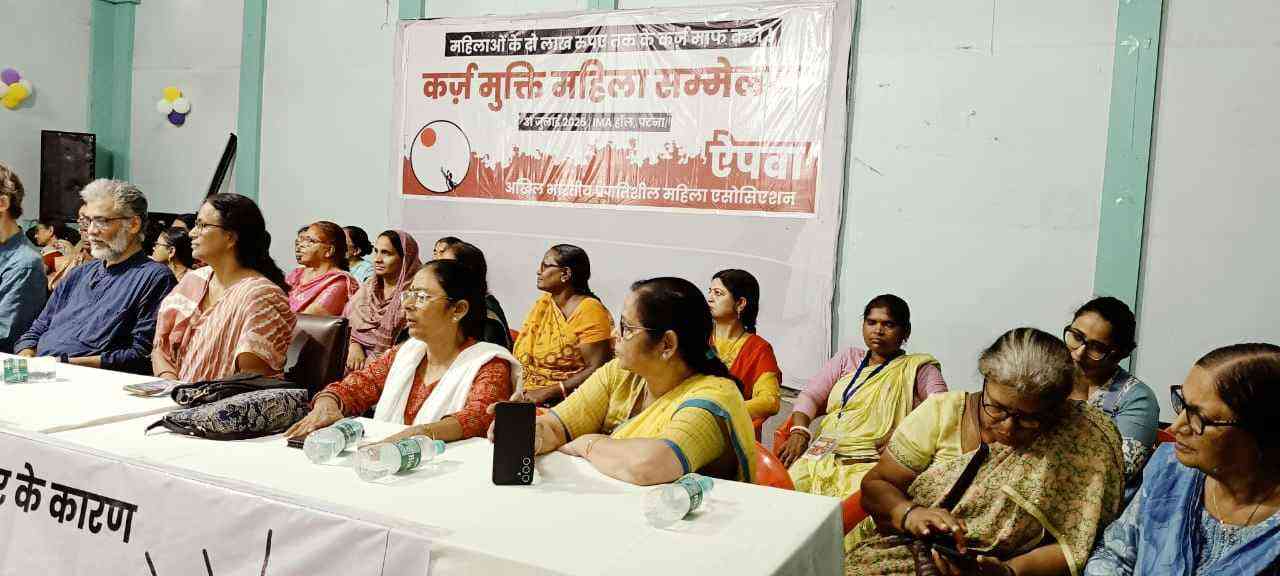
On the occasion of the birth anniversary of renowned Hindi writer Munshi Premchand, a Karza Mukti Mahila Conference (Women’s Freedom from Debt Conference) was organised at IMA Hall, Patna on July 31. The event witnessed the participation of a large number of women grappling with mounting debt burdens. The women shared their pain, anger, and determination to resist what they described as systemic exploitation.
The conference witnessed a strong turnout of women from 20 districts of Bihar, many of whom shared personal accounts of being trapped in mounting microfinance debt. Opening the proceedings, Vandana Prabha reflected on the enduring relevance of Premchand’s novels, noting how his portrayals of rural life captured the crushing impact of indebtedness on ordinary households, particularly women. She emphasized that the current debt crisis must be understood as part of this historical continuum of exploitation. The session also included the screening of a documentary on debt produced by Priti Prabha, AIPWA. The film shows video testimonies collected from across Bihar highlighting the plight of women under microfinance debt. First session set the tone for a broader discussion on the structural nature of the debt trap and the urgent need for regulatory and policy interventions.
Highlights from speakers:
Jean Drèze, Development economist, highlighted that microfinance companies are charging interest rates of 35–40% with compound interest. Testimonies revealed harassment by recovery agents, humiliation, and even suicide in Bihar as well as Jharkhand. He also highlighted that many microfinance companies operate under fake names, beyond the reach of even RTI queries, while governments remain silent spectators. ‘People have been taking loans on high interest rates to fulfil their basic needs.’ Unable to repay the interest on the principal amount, the companies are charging interest even on the interest that gets accumulated, which, in turn, has been pushing them into debt traps’.
Kalpana Wilson of the South Asia Solidarity Group added that women need policies guaranteeing dignified employment and fair wages, not suffocating loans. She also shared similar microfinance debt crisis faced by women of Punjab. She shared ‘A strong movement by women emerged to collectively fight against this form of oppression. In the initial meeting at district level attracted 3,000-5,000 women. It soon increased to 20,000 – 30,000. The decision was taken to boycott repayments resulting in not allowing the recovery agents to enter the village.’
Meena Tiwari, AIPWA, pointed out that microfinance portfolios ballooned from Rs. 6,000 crore (2020) to Rs. 49,500 crore (2023). This explosion coincided with shrinking state support for healthcare, education, and rural employment, pushing women to rely on predatory private credit.
Dipankar Bhattacharya, CPI(ML) General Secretary said that current policies are designed to push ordinary people into debt traps while the government remains absorbed in rituals and spectacles. “This is a cruel joke. While people are dying by suicide, struggling for jobs and food, the government is busy with disenfranchising exercises. Debt must now become the biggest issue in the upcoming Bihar Assembly elections,” he said, calling for a campaign under the slogan: “Sood khoro, Bihar chhodo! Chunav chor, gaddi chhodo!” (Moneylenders Quit Bihar! Vote Thieves Quit Power!)
The conference concluded with the adoption of demand charter for further action;
- Immediate demand for Regulatory framework for microfinance companies as strict state law.
- Compensation of Rs. 20 lakhs to families affected by debt-related suicides, and relief to those forced to flee villages due to coercive recovery by microfinance agents.
- Low-interest loans at 2% annual rate through public sector banks for women.
- Guarantees for Jeevika women including and market support and government procurement of their products.
- Independent social audits of Jeevika at the gram panchayat level, with public disclosure of findings.
Powerful testimonies with policy demands, the Karza Mukti Mahila Conference highlighted the urgency of addressing the debt crisis facing women in Bihar. AIPWA pledged to organise women at village and panchayat level on the issue to build a movement against the new ‘corporate mahajani.’