
The question is, why JNU's union elections inspire such a violent, coordinated attack from the ruling nexus. The answer lies in the university's unique democratic structure.
The student-run system at JNU, which the ABVP sought to dismantle, stands as a powerful exception to the national trend of democratic erosion. What distinguishes JNUSU elections is that students themselves elect the Election Committee that conducts their union elections. Unlike universities where administrations control electoral machinery, JNU's system ensures that those who oversee elections answer only to the student body, not to administrative authority or external political pressure.
The process begins with outgoing JNUSU calling for General Body Meetings (GBMs) across JNU's various schools. These GBMs are the first step toward union elections, spaces of direct democracy where every student can participate and vote.
These GBMs became primary targets of violent assault.
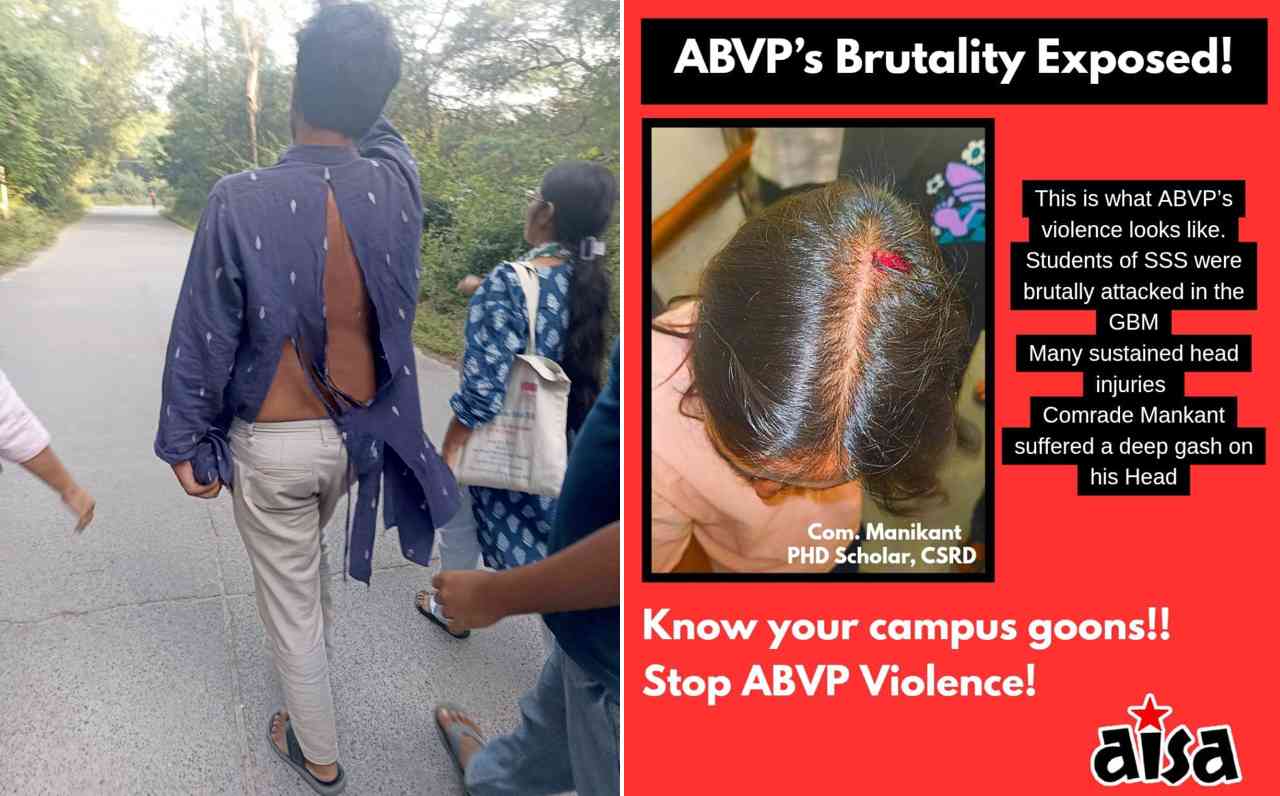
The assault began on October 14 at the SIS GBM, where ABVP heckling and physical obstruction rendered the democratic proceedings impossible, forcing an adjournment. The violence escalated on October 15 at the SSS GBM. For an entire night, ABVP orchestrated a spectacle of hatred, physically attacking the JNUSU President and holding him and other office-bearers hostage for ten hours. Multiple students were beaten, and female students were groped and sexually assaulted. This was accompanied by a torrent of targeted casteist, queerphobic, and Islamophobic abuse, all while JNU security and police officials watched in silence.
Consequently, the SSS GBM also failed to elect an EC. On October 16, ABVP replicated these tactics at the SL GBM, but students stood firm and successfully elected an independent EC. This success proved pivotal. On October 17, the SSS and SIS GBMs were recalled. Despite the preceding days of extreme violence, the student body's collective resistance prevailed, and they successfully elected their independent EC.
Following the campus violence, JNUSU called for a march to Vasant Kunj police station to file an FIR against the perpetrators, as Delhi Police had refused to register complaints. As soon as the march exited the university gate, police immediately attacked the students without provocation. The police, dressed in plain clothes to obscure accountability, assaulted students, resulting in serious injuries.
Twenty-eight students, including women, were detained and held in police custody throughout the night. In response, hundreds of students marched to the police station, demanding our comrades' release. The detained students were finally released after fourteen hours, at 9 AM the following morning.
In a bitter inversion of justice, six students had FIRs filed against them. The police filed FIRs against the victims of ABVP’s assault—the very students who had sought justice—while ABVP members faced no consequences for their violence.
Time and again, JNU administration along with the police has acted as a silent partner in ABVP’s communal project by normalising the impunity given to them. If those responsible for campus safety watch ABVP’s rampage unfold in silence, then why must we not see them as complicit in this violence?
The convergence of interests between JNU Admin and ABVP is transparent. ABVP seeks to prevent democratic elections through violence. The administration benefits from the absence of an elected union that stands for students’ rights. Both share a common investment in turning JNU's democratic structures inoperative. The result is a campus where authority operates without accountability.
The state has ensured that there is no legal recourse, no neutral arbiter, no space outside the BJP-RSS dispensation’s control. Therefore, law enforcement serves not as protector but as enforcer of BJP-RSS-ABVP’s dominance.
This open complicity on campus is a symptom of a much larger national disease: the top-down capture of every institution meant to guarantee fair play and protect civic rights.
This grim national backdrop is what makes the struggle of the JNU students so significant. While democracy is being dismantled from the top down, JNU demonstrated how to successfully defend it from the ground up.
Despite days of systematic violence—casteist and misogynist abuse, serious physical injuries, sexual assault, numerous hostage situations, and police brutality—JNU students successfully elected an independent student Election Committee.
What ABVP feared was not the procedural act of electing representatives but what that act symbolized—that JNU's democratic culture possesses resilience stronger than the violence aimed against it.
A JNU made of Dalit, Bahujan, Adivasi, Muslim, women, and queer students shatters ABVP's Brahmanical fantasies because it demonstrates the possibility of egalitarian politics in practice. ABVP's politics requires the maintenance of traditional hierarchies—caste supremacy, patriarchal authority, Hindu communal dominance—as the natural order of social organization. Therefore, in targeting students at JNU, ABVP is not merely attacking individuals. Following the line of their RSS-BJP masters, they are attacking a plural, inclusive, and egalitarian student movement that the students of JNU have built through decades of resilience.
What is happening in JNU exemplifies what defending democracy during a time of fascist assault actually requires. When democratic norms are systematically destroyed, one can no longer adhere to them. When institutions become captured or complicit, they forfeit all trust. When the state shields the violent and prosecutes the just, legal appeals are pointless. Defending democracy, therefore, requires a collective refusal to allow democratic space to be eliminated by violence, no matter what.
What the students of JNU defend is not merely their own union elections but also the very existence of democratic space and the right to dissent in a nation where both are under attack.

Protest in Delhi Against Exploitation of JNU Workers
On
9 October, contractual workers of Jawaharlal Nehru University (JNU) and
other institutions staged a protest demonstration at Shrameva Jayate
Bhawan in Delhi, the office of the Deputy Central Labour Commissioner,
demanding an end to the theft of workers' bonus, extortion, and
fraudulent salary practices. The protest was led by All India General
Kaamgat (AICCTU) and several organisation joined in solidarity.
The
protest highlighted that contractualisation has become a tool to deny
workers their basic rights. Under the Payment of Bonus Act, 1965, every
worker is entitled to a bonus of 8.33 percent of their salary. Despite
assurances from the JNU administration last year, contractual workers
have yet to receive the legally mandated bonus.
Protesters
also exposed widespread extortion and corruption. Several officials,
including the sanitation inspector of JNU and staff of Rakshak Securitas
Pvt Ltd, allegedly demanded bribes ranging from Rs 50,000 to Rs 70,000
to secure employment. Economically marginalised Dalit workers have been
particularly targeted. Complaints have been filed with the police and
JNU administration, but no inquiry or action has been taken. The protest
further condemned the misuse of the Biometric Attendance System, which
has resulted in illegitimate reductions in attendance and salaries of
workers.
The protest called for immediate enforcement of workers’ rights, accountability of corrupt officials, and rollback of fraudulent attendance systems.