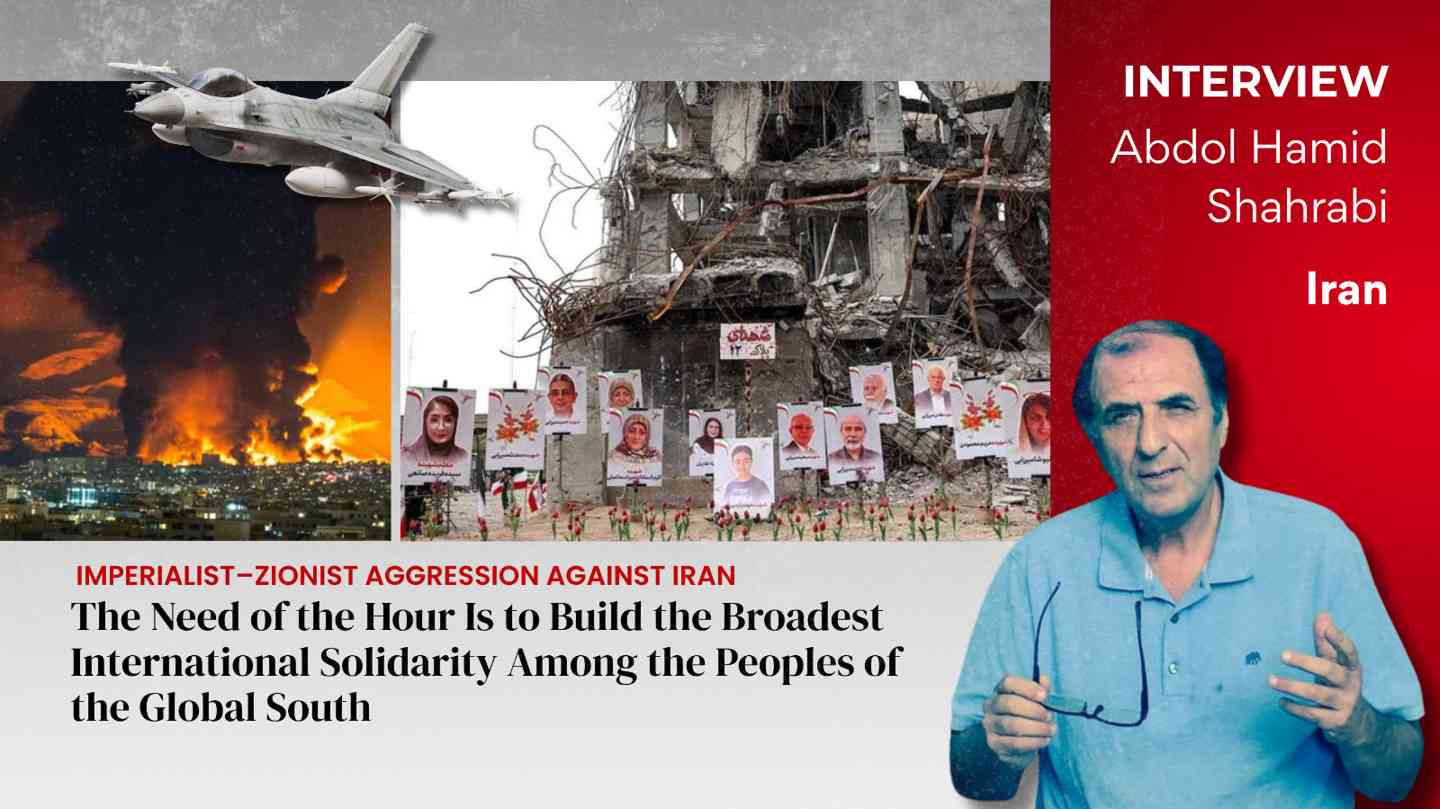
Following the US–Israeli aggression against Iran, what is the everyday situation like where you live since this aggression began?
Hamid Shahrabi: The war imposed on Iran by one of the most powerful militaries in history has been devastating. Before the so-called ceasefire, in Tehran, as in many other cities across Iran, there was a constant uncertainty about who might be the next target of US or Israeli bombs. Will it be your neighbour, a family member, or even yourself?
Initially, they claimed they would only target military commanders and government officials. However, when they ruthlessly killed 168 children in Minab, the world witnessed their lies and deception.
In such a dire situation, one might assume that fear and panic would grip the entire nation. While there is certainly a level of fear and anxiety among the people, it is not the only sentiment. Above all, there is a profound sense of hatred toward the aggressors and a strong desire for revenge against those who have killed our supreme leader, high-ranking military commanders, brilliant scientists, and innocent children.
When discussing public reactions to the war, it’s essential to distinguish between ordinary working people—who make up the majority of the population—and the wealthy capitalists, who represent a privileged minority. These two groups have vastly different perspectives on the conflict. The former views it as a threat to their homeland and sovereignty, something worth sacrificing their lives for. In contrast, the big capitalists see this imperialist war as an opportunity to extract more concessions from the state and bolster their positions within the Islamic Republic. In fact, they often act as agents of foreign capital, contributing to instability in the country.
Additionally, there exists a sizable middle class that aligns itself with one of these two major camps. Among this group, the poorer segments tend to side with the working class and resistance movement, while the wealthier members often support the aggressors or vacillate between opposing sides.
However, what best illustrates the people's response to this imperialist-Zionist war is the mass gatherings in the squares and streets of Iranian cities since the conflict began. This phenomenon is remarkable and unprecedented. Hundreds of thousands of people have taken to the streets at night to chant slogans of resistance, condemning the killing of the supreme leader, show support for young Khamenei, and denounce those who seek to compromise Iran's sovereignty through humiliating deals with imperialists. As of May 16, these rallies have continued uninterrupted for 78 nights!
This marks a significant change and a growing consciousness among the people, signalling a shift toward a more radical stance against imperialism.
What are your thoughts on ongoing fragile ceasefire and continued threats by Trump?
Hamid Shahrabi: The so-called ceasefire is tenuous and has been repeatedly violated by the US since its inception. A clear example of this is the naval blockade imposed on Iran by the US. Their interpretation of ceasefire seems to be that US adversaries must stop attacking while they prepare for their next round of military aggression. And in reality, they have been doing just that—deploying more troops and military equipment to the battlefield during this so-called ceasefire. They even sent a nuclear submarine close to Iran while Trump threatened that "one big glow will come out of Iran!"
However, rather than demonstrating strength, such language reveals desperation. Despite their assertions of having destroyed Iran's military capabilities, those who are aware of the realities on the ground—including military experts in the United States—acknowledge that mighty US imperialism has faced significant setbacks. They will tell you that this war has not only failed to achieve the objectives of the US and Israel in bringing about regime change in Iran, but it has also resulted in an opposite outcome: the Islamic Republic of Iran now enjoys greater support among the Iranian populace than it did when the conflict began.
A man [Trump] now known as the butcher of Iranian children is claiming to act in our best interest!
What Iranian people think about Trump’s justifications for war against Iran, including claims about Iran developing nuclear weapons and the need to support the Iranian people for “freedom”?
Hamid Shahrabi: Both claims are unfounded, and we should not need to provide extensive arguments to refute their validity. Regarding the development of nuclear weapons, the entire US intelligence community has repeatedly testified that there is no evidence to suggest that Iran is pursuing such plans. However, in light of the ongoing US and Israeli military attacks on Iran, there is now a growing demand among the Iranian people for the country to acquire nuclear weapons as a deterrent against future aggressions. Let us not forget that we are discussing the United States and Israel, both of which possess nuclear arsenals, with one having a documented history of using such bombs.
As for Trump's assertion that he wishes to support the freedom of Iranians, do we really need to respond to such an absurd claim! A man now known as the butcher of Iranian children is claiming to act in our best interest! Does anyone take that claim seriously?
Amid the ongoing aggression, there are claims that Iran has launched attacks against neighbouring countries?
Hamid Shahrabi: Iran has not attacked any of its neighbouring countries. This position has been clearly articulated by Iranian officials. It is important to note that the United States maintains military bases in several countries surrounding Iran, and these bases have been used to launch attacks against Iran. In response to such aggression, Iran has targeted these bases as a defensive measure, which is entirely legitimate. If Iran aims to defend itself, which it has done, it had no choice but to respond to the sources of these aggressions.
In light of the global energy crisis, how do you analyse the situation in Strait of Hormuz?
Hamid Shahrabi: We must consider international law regarding waterways, which stipulates that both international and territorial waters should not be used by any nation to infringe upon the sovereignty and territorial integrity of another. How can it be justified for the United States to deploy its naval fleets and nuclear submarines in waters near Iran while threatening the Iranian people with a "return to the Stone Age," and then expect the Islamic Republic to remain silent in the face of such aggression? What is happening in the Strait of Hormuz is Iran's defence of its sovereignty—nothing more, nothing less.
The essence of the Iranian people's struggle over the past two centuries has been centered around three intertwined principles: freedom, independence, and social justice.

Photo: Hamid Shahrabi at a protest in Tehran against U.S.-Israeli aggression.
How do you assess current status of the Left movement in Iran, and analyse the situation in the context of imperialist aggression alongside the rising voices for liberty within Iran?
Hamid Shahrabi: The essence of the Iranian people's struggle over the past two centuries has been centered around three intertwined principles: freedom, independence, and social justice. These elements form a singular movement that has manifested through various significant events, such as the protest against the tobacco concession with Britain in 1890, the Constitutional Revolution of 1905, the widespread campaign for oil nationalization in 1951, and the successful revolution of February 1979. Each of these pivotal moments, along with the current national resistance against U.S. and Israeli aggression, has been rooted in these fundamental demands.
It would be both a mistake and a failure to appreciate the dynamics of the Iranian struggle to believe one can advocate for one of these three core principles while disregarding the others. Doing so would be a grave error—one that has had dire consequences in the past. For instance, consider the protests that erupted in Iran earlier this January in response to the drastic devaluation of the Rial, Iran's national currency, and the subsequent rise in consumer prices. Initially, this movement was driven by a legitimate cause. However, it was soon hijacked and distorted by counter-revolutionary forces.
It has even been acknowledged by Israeli intelligence that Mossad played a direct role in instigating the violent protests in January. This "movement," ultimately set the stage for a military attack on Iran just two months later, in March.
While discussing various movements within Iran, I would like to highlight a crucial point regarding certain leftist perspectives on the relationship between national movements and class struggles—not only in Iran but also more broadly in the Global South, where many nations are striving against imperialist dominance. One cannot advocate for liberty and social justice without an anti-imperialist orientation. This is precisely what some leftist political factions overlook when assessing different movements in these countries. By neglecting this critical aspect, they risk blurring the lines between their supposedly progressive and revolutionary positions and those of imperialism, which has a long history of suppressing national liberation movements under the false pretence of defending "democracy" and "human rights."
A genuine leftist perspective acknowledges the critical importance of advocating for freedom of expression, political rights, and civil liberties. However, it also recognizes that imperialism has historically been a primary force depriving nations of their liberty. Therefore, it is essential to confront imperialism while simultaneously striving for people's democracy.
This principle applies equally to the struggles of the working class. Workers in the Global South cannot effectively pursue their class demands without clearly distinguishing themselves from imperialist influences. A compelling example of this can be seen in Iran, where the leadership of the South Pars gas field workers has successfully mobilized thousands of workers on two fronts: defending the nation against imperialist aggression and fighting for workers' rights, including fair wages and job security.
How do you understand this aggression in the context of the Palestinian cause, especially given that people in Iran have often been at the forefront of expressing solidarity with Gaza?
Hamid Shahrabi: This is fundamentally the same struggle, united by a common cause and a shared enemy. The rhetoric surrounding Iran's nuclear program serves to obscure the truth: Iran's unwavering commitment to defending the right to self-determination for Palestine. At its core, this is about more than just sovereignty; Iran has emerged as a source of inspiration for liberation movements globally, and particularly in West Asia.
We are witnessing what many describe as an attempt by the Trump–Netanyahu axis to impose a new colonial global order—from Palestine to Venezuela and now Iran. What impact do you think this will have across the world, especially on the Global South?
There should be no doubt that imperialism aims to impose a new colonial order on the countries of the Global South. This is not merely our assessment; they openly declare their intentions, even announcing plans to revive the Monroe Doctrine. However, it is essential to recognize that they seek to implement this agenda at a time when they are increasingly weakened. While they have perpetrated horrific acts of genocide in Gaza and demonstrated some military strength in Venezuela, they have also faced significant setbacks.
Yes, they assassinated numerous Hezbollah commanders in Lebanon, as well as key figures in Iran's military leadership. Yet, despite these actions, we must ask: have they succeeded in restoring a unipolar world order? When we examine the other side of this conflict, we see the limitations of imperialism. Russia and China's rise as a major global power, the emergence of BRICS, and the ongoing resistance movements in Palestine and Lebanon all illustrate that resistance remains vibrant. We also witness the heroic actions of the Houthis in Yemen and Iran's steadfast resistance, which plays a crucial role in undermining American hegemony.
As an Iranian, what message do you have for people and progressive forces around the world?
Hamid Shahrabi: The message is straightforward and clear: Iran is fighting not only for its own sovereignty but also for the broader cause of liberty shared by all freedom-loving people worldwide. Iran stands in solidarity with all countries in the Global South that aspire to live free from imperialist dominance. Everyone has a stake in this struggle, and we call for the broadest international solidarity—especially from working people in the U.S. and other imperialist nations who can play a decisive role in bringing this cruel war to an end.