
K.M. Subramanian, President of the Tiruppur Exporters Association (TEA), said: “Nearly 60% of knitwear exports come from Tiruppur. Last year, our exports were worth Rs. 45,000 crore. With the new tariff, business worth Rs. 12,000 crore is immediately at risk. We urgently need the Union government to intervene with the US and provide financial support to exporters and manufacturers.”
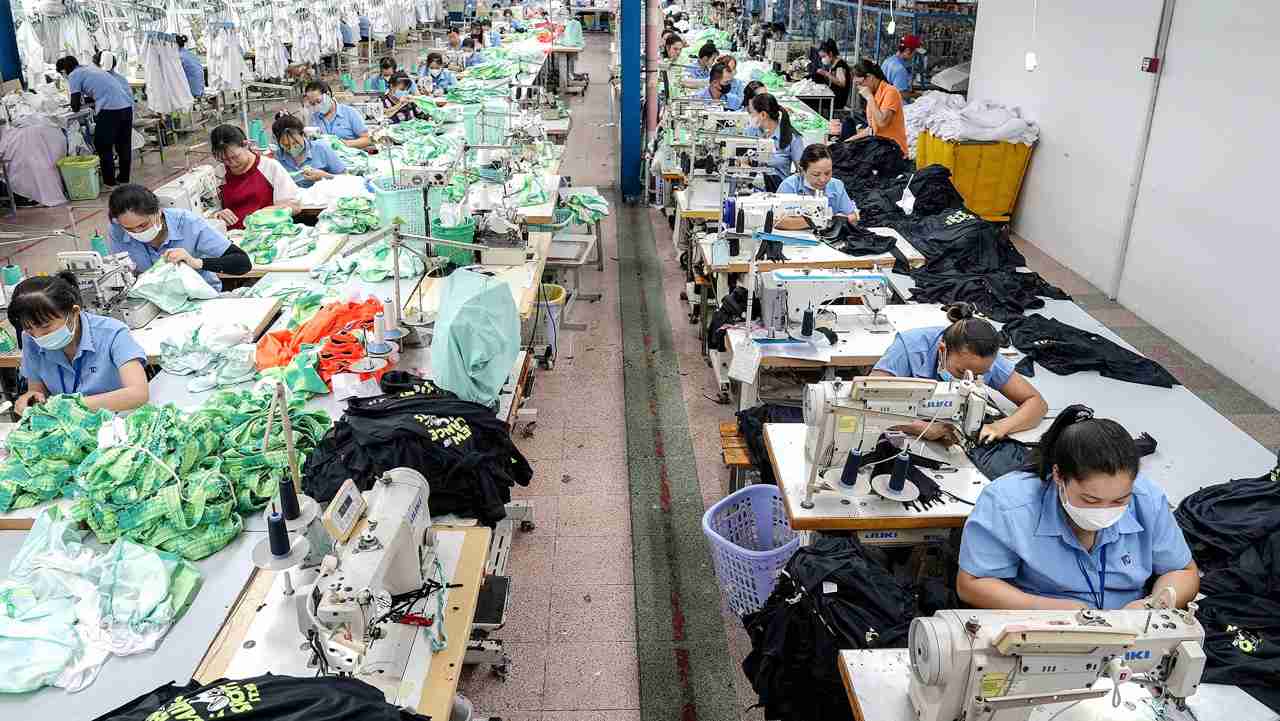
Tiruppur employs over 8–9 lakh people across 2,500 factories in the district, more than 60% of whom are women. India has set a target of $100 billion in textile and apparel exports by 2030. But exporters and trade experts are sceptical. With India’s current exports at $37 billion, the additional 50% tariff makes the target difficult to achieve in the next five years. Some estimates suggest the tariff could impact 28–40% of India’s overall textile business with the US.
The Confederation of Indian Textile Industry has demanded a moratorium on the payment of principal and interest on loans for up to one year, credit support, and other relief measures. The Free Trade Agreement with the UK, recently signed, is welcomed by industrial bodies. While these measures may help the industry, they cannot compensate for the loss of employment and livelihoods of workers.
A worker, Rajini Sankar, said that Best Garments, one of the export companies, closed down two of its units, leading to job losses for more than 1,000 workers. Arora Garments closed down, affecting the lives of 200 workers. “These are only some examples,” he said.
Another migrant worker, Ganesh, said they have no option but to go back home if their company shuts down. More than 8–9 lakh people work in 2,500 knitwear and garment factories in Tiruppur, with migrant workers from Bihar and other northern states forming a sizeable majority.
Another tailor, Kumar, said that workers’ wages have decreased significantly. The first round of wage reductions occurred during COVID-19, but the Trump tariff has had the worst impact. Even those still employed are unable to lead a decent life. “We are not even paid statutory minimum wages. With the piece-rate system and reduced overseas orders, we are unable to earn enough to meet even our bare minimum necessities,” he said.
Muthu Krishnan, Tiruppur District Secretary of AICCTU, said that the overwhelming majority of companies have already shifted from time-rate to piece-rate systems. With stoppages and reduced production, workers no longer achieve the number of pieces they used to, and consequently, their wages have drastically reduced. Even before the full impact of the Trump tariff is felt by most workers, companies have already started reducing their workforce, particularly in American export-oriented jobs.
He added that companies are looking to the Modi government to renegotiate the trade deal and hope, against hope, that the shock and crisis may be short-lived. As more than 33% of the textile industry in Tiruppur depends on exports to the US, workers’ employment and wages are the worst casualties. Job losses and wage reductions are the biggest impacts of the Trump tariff on workers.
He also mentioned that the cotton and ginning industries in the Coimbatore–Tiruppur belt are facing a ripple effect, with production falling drastically. He said that the recent reduction of an 11% import tax offers no real relief to the industry, as it is limited to only 40 days.
Ravindran, the president of Coimbatore Compressor Industries Association (COCIA) said that the Trump tariff should be necessarily opposed because it is an imperialist dictate and a reciprocal action against India for buying oil from Russia.
Textile is the worst affected industry in India, particularly Tiruppur and Coimbatore based companies which are export-dependent, in addition to industries like sea food, gems, leather and others. India should work more towards generating domestic demand for apparel and textile industries. We are only seeing the direct impact of the Trump tariff now, but its potential ripple effect on other industries could be substantial in the near future.
Many workers said that the impact of the American tariff is the worst economic challenge they have faced in their lifetimes, surpassing the 2008 global economic depression, the 2016 demonetisation, the rollout of GST, and COVID-19.