"Now do you understand why people were protesting Trump, Israel, or the wars?” a man in his 50s asks his friend aboard a bus from Pathanamthitta to Kottayam as they discuss the LPG crisis. He adds, “The struggles of people across the world are interconnected."
The ripples of US-Israeli aggression against Iran have now reached even the Indian kitchen and domestic sectors. The International Energy Agency (IEA) has called the impact on the global energy sector the worst in history, surpassing even the turbulent 1970s.
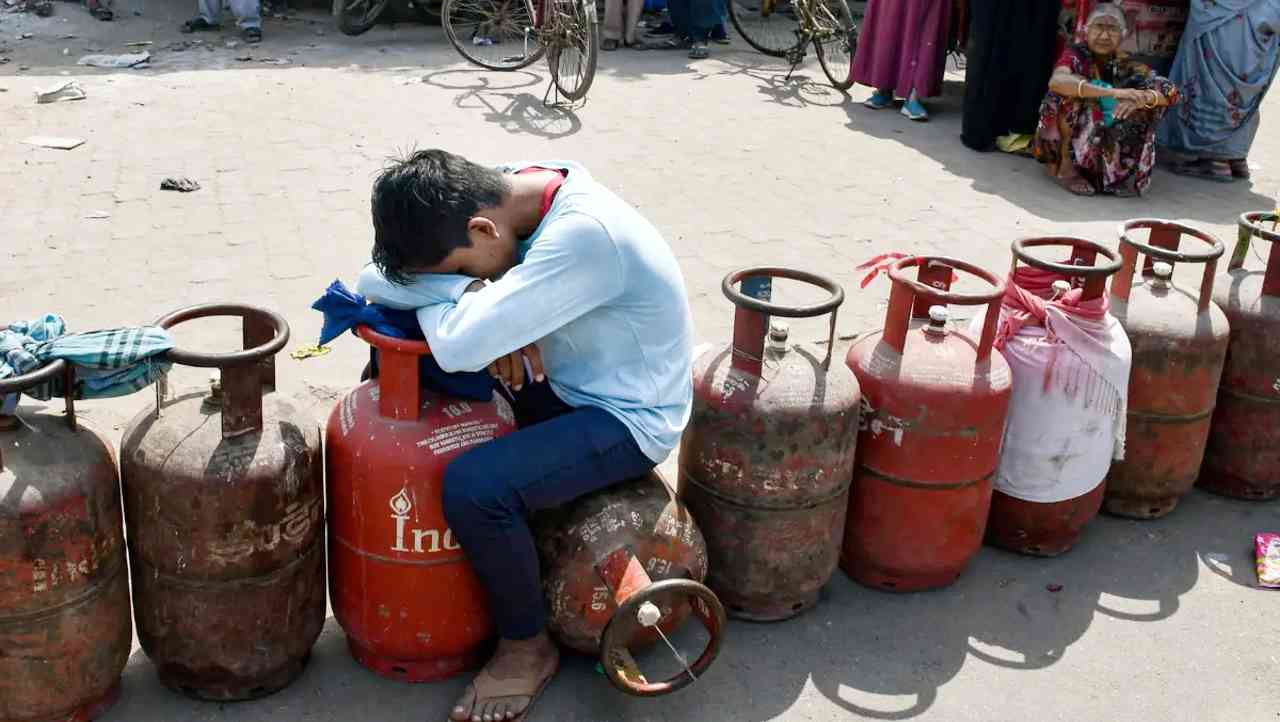
Liberation correspondents spoke to small street vendors, restaurant owners, and migrant workers across Kerala, Karnataka, and Delhi, where the impact of the LPG shortage is clearly visible. Many restaurants have shifted to using wood or other primitive fuels, while reducing their menus. Those with no alternative have been forced to shut down. A roadside tea shop vendor said he now sells only lime juice due to the shortage. Most small vendors had similar stories. A well-known tea shop in Bengaluru reported that it now prepares tea only once a day and stores it in a thermos due to limited gas supply. In areas where enforcement is weak and corruption is rampant, some manage to obtain cylinders on the black market, but at prices ranging from Rs. 3000 to 4000 per cylinder for non-commercial use.
India, like crude oil, is highly dependent on imports for LPG, which is a mix of butane and propane, and Liquefied Natural Gas, LNG, which is methane. These imports largely come from West Asia, especially Qatar, and pass through the Strait of Hormuz. Nearly 60 percent of India’s LPG consumption, around 30 to 32 million tonnes annually, is met through imports, with about 90 percent sourced from Gulf countries such as Qatar, the UAE, and Saudi Arabia. Similarly, about 45 to 50 percent of India’s natural gas demand is met through LNG imports, with Qatar alone accounting for over 40 percent of supplies. More than 80 percent of LPG and over 50 percent of LNG imports pass through Hormuz.
The impact is visible in the data as well. State LPG company figures show that gas sales fell to about 1.15 million tonnes in early March, marking a 17 percent year-on-year decline and over 26 percent drop from the previous month.
While the Modi government, which abandoned Iranian and Russian fuel supply chains under pressure from the US during the Trump regime, continues to assure that there is no shortage of LPG, the ground reality across the country tells a different story.
Migrant workers are once again the first to bear the brunt. A recent report by the Indian Express highlighted the plight of thousands forced to return home due to lack of LPG, rising prices, and hunger. The BBC Hindi has reported similar stories from Delhi, where migrant workers face a stark and uncertain future while the government continues its denial.
Why No One Believes the Assurances Anymore
The lack of trust in the Modi government’s assurances is visible nationwide. People have not forgotten the impact of demonetisation and the COVID lockdown. Just days before the nationwide lockdown, the government had claimed that COVID was not an emergency. Soon after, millions faced hunger and chaos, and migrant workers were forced to walk thousands of kilometres to return home. Similarly, the 8 pm demonetisation announcement by PM Modi in 2016 turned into a nationwide crisis despite assurances that people would not suffer.
Unlike crude oil, where India maintains a dedicated Strategic Petroleum Reserve (SPR), there is no equivalent strategic reserve for gas. The country relies only on storage terminals meant for day-to-day operational supply. These terminals hold around 1.9 million tonnes, which provides a buffer of barely 20 to 22 days of consumption. While the physical properties of Liquefied Petroleum Gas (LPG) make long-term storage more complex, this cannot be used as an excuse. The absence of any serious move towards building strategic gas reserves reflects a clear apathy of the government towards the basic energy needs of millions of people. Technologies ranging from salt caverns to refrigerated storage tanks exist, yet India has failed to invest in them at the required scale, despite widespread dependence on LPG for everyday survival. Even efforts to increase domestic production remain minimal and structurally limited. LPG is produced only as a by-product of crude oil refining in small quantities, or extracted from limited natural gas basins. These measures are grossly inadequate, and the crisis will only deepen if the war continues.
Diversification of supply is also weak and poorly planned. For example, imports from the United States (US), the world’s largest producer, take 40 to 45 days to reach Indian ports, compared to less than a week from the Gulf, and are more expensive.
From Fuel Crisis to Food Crisis
With no end in sight to the Trump-Netanyahu war on Iran, the disruption of energy supplies is no longer confined to kitchens and transport. It is now seeping into one of the most critical sectors, agriculture, with serious implications for India’s food security.
India’s most widely used fertiliser, urea, is heavily dependent on imported gas, that is Liquefied Natural Gas (LNG). Nearly 85 percent of the natural gas used in fertiliser production is imported, and the sector itself consumes a substantial share of the country’s total gas imports, making it highly vulnerable to supply disruptions. Amid the gas crisis, supplies to fertiliser plants have been cut to around 70 percent of their requirement, forcing several units to scale down operations or shut temporarily. The import of fertilisers, including urea, around 25 to 30 percent imported, and Di-Ammonium Phosphate (DAP), around 50 to 60 percent imported, from regions affected by the war is also witnessing severe disruption and rising prices.
This crisis is set to intensify in the coming weeks as the Kharif sowing season begins, sharply increasing demand for fertilisers. Any shortage will put immense pressure on the agricultural sector and inevitably push up food prices.
A Foreign Policy Adrift
Despite this, the Modi government and the Godi media (lapdog media) continue to push propaganda to downplay the situation. The arrival of a few LPG tankers is projected as a major achievement, even though it is insignificant compared to national demand – with a single tanker catering to less than two days of total consumption. Similarly, ships passing through Hormuz are portrayed as foreign policy success, when in reality this access granted is rooted in India’s long-standing foreign policy of non-allignment, which has now been abandoned by Modi government.
Reports indicate that Iran has raised the issue of three of its “US sanctioned” tankers seized by India under Trump’s pressure and has demanded their release to ensure secure access through Hormuz. This exposes the extent to which India’s sovereignty in decision-making has been compromised under external pressure. Shockingly, the government even had to wait for US approval to purchase already loaded Russian oil after the outbreak of war.
While the current crisis stems from US-Israeli aggression, the Modi government’s alignment with these imperialist interests has deepened India’s vulnerability. The abandonment of fuel supply arrangements from Russia, along with the Modi government’s exit from its partnership in Iran’s Chabahar port, has further eroded the country’s strategic position. The government’s refusal to condemn the war on Iran, despite Iran being a BRICS member and India holding its current chairmanship, its failure to call out the aggressors, and its continued silence on the genocide in Gaza have further eroded India’s standing among Global South countries.
With a directionless and compromised foreign policy, the Modi government, has not only distanced India from its neighbours but has also decimated the country’s strategic bargaining power, pushing the country into deep uncertainty and towards the brink of a larger crisis.
============
Government Claims on LPG Cylinder Availability Unrealistic
On March 12, CPI(ML) MPs Raja Ram Singh and Sudama Prasad joined INDIA bloc protests at Parliament against the government's failure to ensure the availability of LPG and fuels for common people amid escalating US–Israeli aggression against Iran and the uncertainty at the Strait of Hormuz. The MPs said that while the government continues to claim that there is no shortage of LPG, the ground reality tells a different story. Across the country, small restaurants and street vendors are on the verge of shutting down due to lack of LPG availability, while reports of hoarding are widespread.
The silence of the Modi government on the rising fuel prices and the non-availability of LPG cylinders, shows a complete abdication of responsibility by the government.
Meanwhile, in Uttar Pradesh, the CPI(ML) State Committee criticised state government’s claims on LPG cylinder availability terming it unrealistic, pointing to a widening gap between official statements and the situation on the ground.
UP State Committee said that while ministers and officials continue to deny any shortage and label reports of scarcity as rumours, consumers are facing long waiting periods and queues at gas agencies. It added that disruption in supply has forced several small food establishments to shut operations.
The CPIML statement drew parallels with the Demonetisation, stating that similar scenes of hardship are being witnessed, with people standing in prolonged queues for essential commodities.
Referring to a recent incident in Farrukhabad district’s Lal Sarai area, CPI(ML) said a 75-year-old man died after falling ill while waiting in line at a gas agency warehouse to collect a cylinder, raising concerns over the human cost of the shortage.