
After years of policies that eroded people’s purchasing power, the Prime Minister now wants citizens to celebrate savings. The new two-slab GST regime comes soon after fresh tariffs and trade measures imposed on India by none other than Modi’s “dear friend” US President Donald Trump.
While the nature of growth of Indian economy, despite tall claims of growth of GDP numbers over substantial period of time, was already considered by many as unable to provide dignified employment to majority of youth entering job market in crores every year with opposition raising the battle cry that promise of 2 Crore Jobs per year of Modi has become a Jumla.
 Increased unemployment and stagnant income have pushed inequalities of income to a level where aggregate demand in economy was taking a hit. According to Piketty and colleagues’ data by 2022–23, the top 1% captured 22.6% of national income and a staggering 40.1% of national wealth, the levels unprecedented in Indian history. It was about 10% share of national income for top 1% in 1991 and top 10% share increased from 35% to 59% while the bottom 50% which had 20% share of national income in 1991 declined to 13% of income and 3% of wealth. NSSO data shows that in rural areas, only the top decile saw meaningful consumption growth, while lower deciles stagnated despite rapid GDP growth. In urban areas too the top decile far outpaced all other groups, while the bottom 20% barely saw any increase.
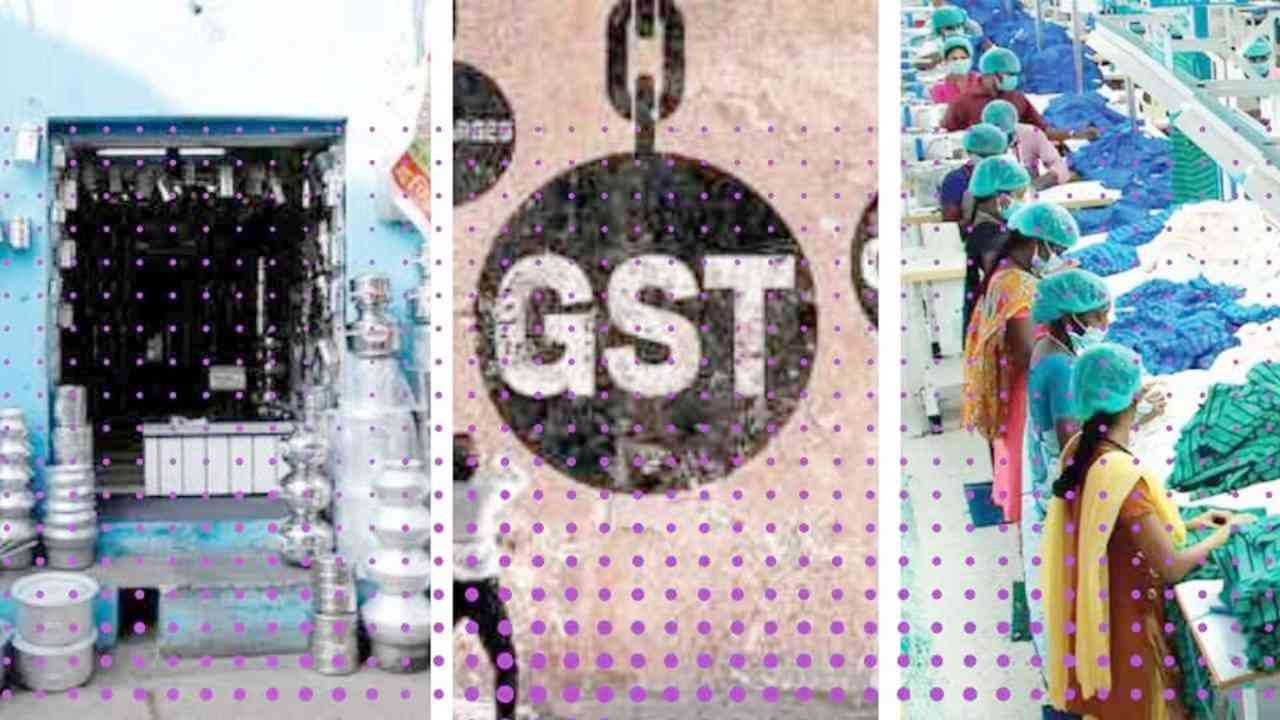
In his speech, Modi shifted the responsibility of building an “Atmanirbhar Bharat” onto Micro, Small and Medium Enterprises (MSMEs). Yet, it was demonetisation in 2016 and the flawed GST rollout in 2017 that devastated MSMEs. Government data show that small industries fell from 6.25 crore units in 2016 to 3.25 crore units in 2024, a decline of 48%. The 2024–25 period even witnessed closures doubling.
But the question is can the new GST regime mitigate the damage done?
GST Reform, but Where Is the Income?
Indirect taxes such as GST are inherently regressive, meaning they take a larger proportion of income from the poor than the rich. A small cut in GST rates may marginally benefit consumers, but for low-income households facing stagnant wages and rising costs of living, the relief is negligible. By contrast, the affluent classes, who already have higher purchasing power, capture more of the benefit. Lowering tax rates may reduce the price of goods, but demand is ultimately a function of disposable income.
If incomes remain low, even cheaper goods will not boost consumption. The problem is not only the price level but also the distribution of income between labour and capital, urban and rural households, and across regions and classes. Since the wealthy spend a smaller proportion of their income on consumption compared to the poor, this skewed distribution reduces overall demand in the economy. Businesses invest when they expect demand to grow. If consumers do not have the purchasing power to buy goods and services, even lower tax rates cannot convince investors to expand capacity. Without stronger domestic demand, India risks falling into a low-investment trap.
The government itself admits that GST 2.0 relief is only Rs. 93,000 crore. Even ignoring Rs 45,000 crore recouped through higher GST on luxury and sin goods, the net concession is just 3.16% of total indirect tax collections of Rs. 29.48 lakh crore in 2024–25. These collections include both GST and taxes on the Petroleum sector, since most petroleum products are still taxed separately. This meagre relief, though celebrated loudly, can hardly boost people’s purchasing power.
Reviving Demand
To genuinely revive demand, the government must move beyond token GST cuts. Tackling inequality is central. This requires raising household incomes and wages, improving social security, and ensuring affordable essential services, including healthcare, education, transportation, and basic utilities.
In a country where half the working people are still employed in agricultural sectors, farmers remain vulnerable to price fluctuations. Expanding procurement systems, ensuring remunerative minimum support prices (MSP), and reducing dependence on exploitative intermediaries can stabilize rural incomes. Push towards encouraging crop diversification, agro-processing industries, and better supply chains will not only raise farmer incomes but also reduce rural underemployment. More public investments for better irrigation, storage facilities, and rural connectivity can reduce wastage and improve farm profitability.
Calling the new GST rates a “festival of savings” is a cruel joke. Token tax cuts cannot revive demand or protect livelihoods. Unless the government raises wages, strengthens social security, generates dignified employment, increases corporate taxes, and implements wealth and inheritance taxes on the super-rich, India risks a prolonged slowdown that will hit the majority of its citizens while the wealthy continue to prosper.