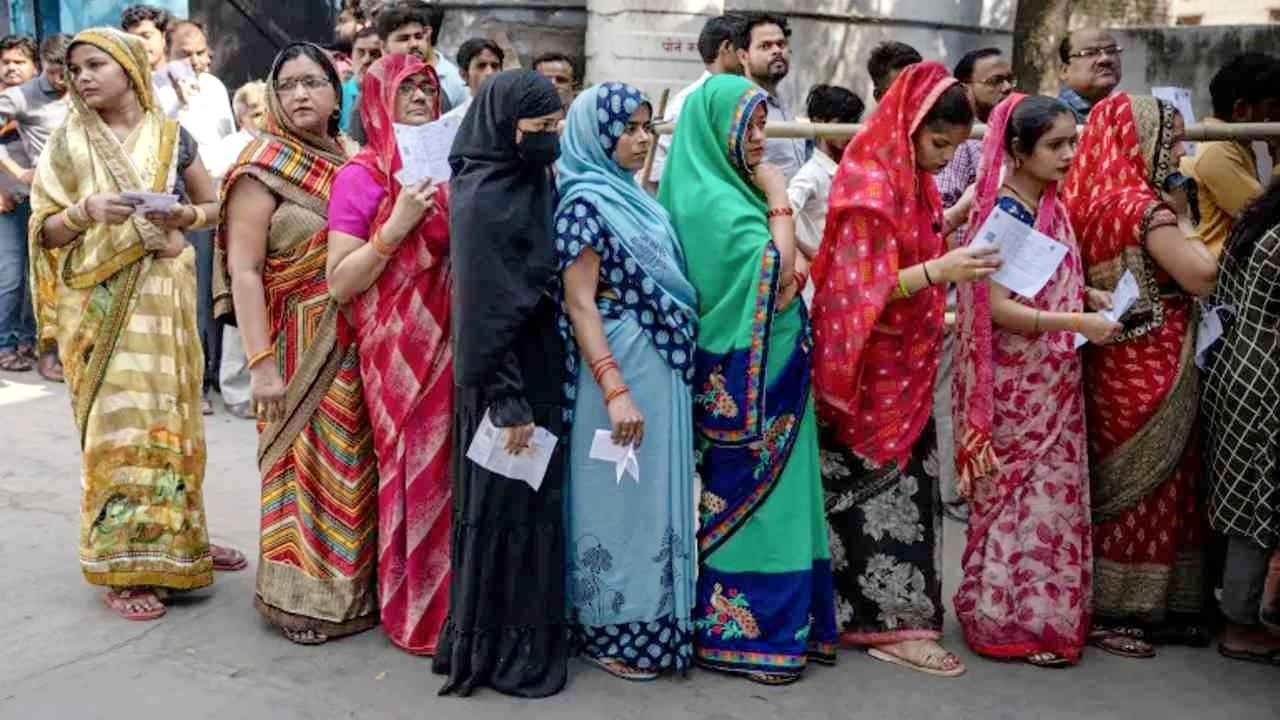
The sheer scale of the mobilisation points to the growing organisational penetration of the Sangh Parivar into Adivasi regions, but more importantly, the acceptance of its political project to reshape Adivasi consciousness. The Sangh Parivar rejects the term "Adivasi" and after toying around with "Vanvasi," (forest dweller) has settled for ‘Janjatiya’ (belonging to a tribe). This is not a semantic difference, but reflects a deeper ideological project. ‘Adivasi’ implies original inhabitants and is a political assertion of historical rights over land, forests and resources, whereas ‘Vanvasi’or ‘Janjatiya’ reduces indigenous peoples to a subset of a larger Hindu civilization.
For decades, organizations affiliated with the RSS have worked to assimilate Adivasi communities into a broader Hindu identity. Educational institutions, cultural programs and religious campaigns have been used to reshape Adivasi consciousness. This project serves both ideological and political purposes. It expands the social base of Hindutva while undermining autonomous Adivasi religious practices and identities and has introduced religion as a tool for communalising and dividing the pan-Adivasi identity. Thus, Christian Adivasis have increasingly become targets of violence, discrimination and campaigns of "reconversion". The violence in Dangs (Gujarat), Kandhamal (Odisha), attacks on churches and repeated allegations of forced conversions reveal how Adivasi communities have become battlegrounds for competing ideological projects.
Adivasis, Constitution and Religion
For generations, Adivasi identity has never been defined solely by religious affiliation. It has been shaped by a shared relationship with land, forests, community life, culture and history. Diverse faith traditions have coexisted within Adivasi society without eroding this shared identity. The Oraons and the Mundas have those who practice the Hindu, Christian and Sarna faiths. Among the Bhils of Central India, one finds practitioners of Christianity, Islam and Hinduism, just like the Siddis of Karnataka. Besides Sarna, scores of Adivasi communities practicing other traditional tribal religions that have historically challenged Brahminical authority, and live side by side with members from their communities practicing other established religions. While their religions differ, they share common cultural traditions.
No surprise then that the Constitution conceptualised Adivasi communities as historically distinct peoples requiring protection because of geographical isolation, exploitation and exclusion from governance rather than because of their religious preferences. The Constitution, in fact, adopts fundamentally different approaches to Scheduled Castes and Scheduled Tribes. While Scheduled Caste status is conditioned by the Constitution (Scheduled Castes) Order, 1950 upon profession of specified religions, no comparable limitation exists in relation to Scheduled Tribes. This article argues that Adivasi identity under Article 342 is founded upon descent, ethnicity, customary institutions, community acceptance and historical disadvantage rather than religious profession. This has been repeatedly laid down by the courts, and the Supreme Court has recently reiterated that conversion does not automatically extinguish Scheduled Tribe status. (judgement dated March 24, 2026 in the case of Chinthada Anand vs. State of Andhra Pradesh and Ors).
Delisting as a part of the Hindutva project
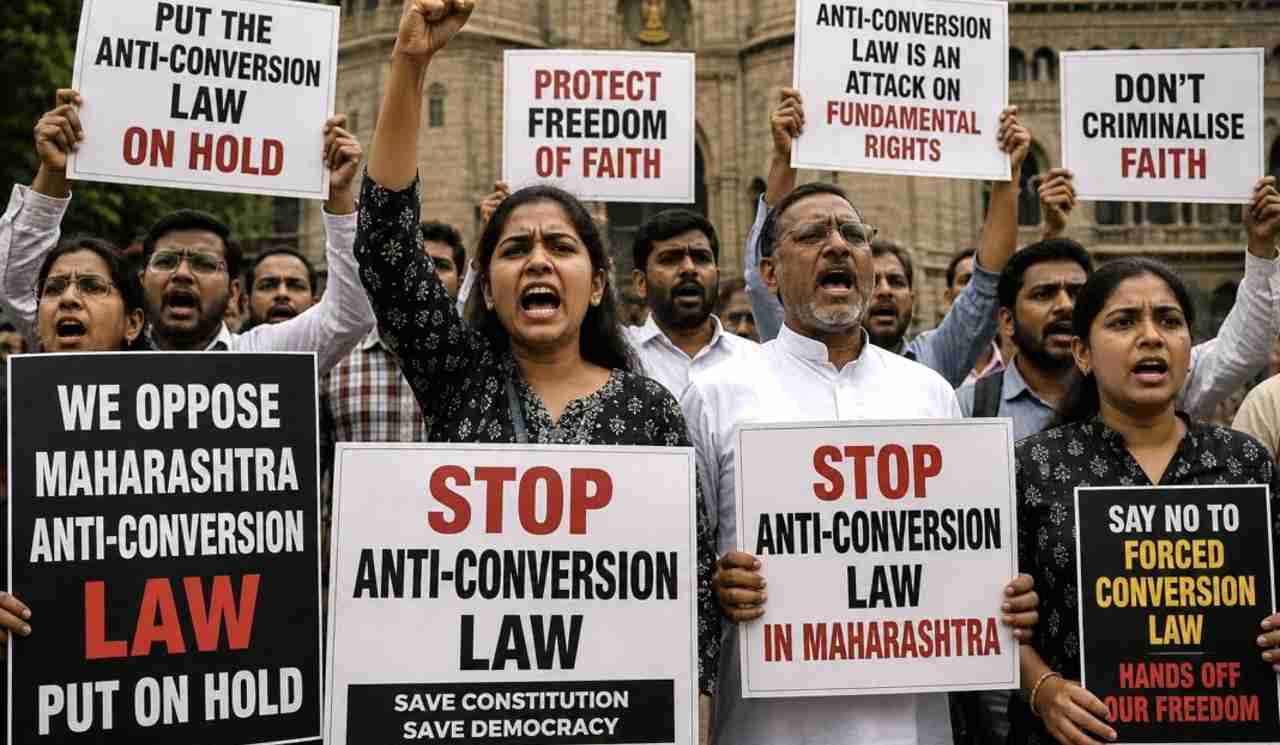
Even as anti-Muslim sentiment remains the central narrative underpinning Sangh Parivar’s attempts at consolidating Hindu majoritarianism, attention is also towards the Christians with a particular focus on Christian Adivasi communities. RSS’s broader interest in Adivasi communities is related to the threat that it perceives from the Christian and other non-Hindu communities to its Hindu Rashtra project. Hindu nationalists use the bogey of ‘forced conversion’ imperilling the numbers of the Hindu majority as a key tool to vilify the Christians and engaged in graphic violence against Adivasi Christians from the 1990s onwards which saw the burning and destruction of churches throughout Adivasi districts of Gujarat in 1998, the rape of nuns in an Adivasi district in Madhya Pradesh, again in late 1998, and the gruesome murder of Graham Staines, a foreign missionary and his two young sons in an Adivasi district of Orissa in early 1999. Thereafter, the biggest pogrom against Christians came in another Adivasi district, Kandhamal in Orissa where scores of Christians were killed, hundreds of Churches and thousands of houses burnt and nuns were raped followed by forcible campaigns of like ‘ghar vapasi’ (homecoming) or shuddhi (purification) of Adivasi Christians. Based on the premise that Adivasis are inherently part of the Hindu fold and that conversions to Christianity represent a loss of their original identity, it presented the framework of "reconversion" as a return to an ancestral faith. Beyond religious conversion, ghar wapsi and Shuddhi serves a broader ideological purpose: the incorporation of distinct Adivasi identities, cultures and belief systems into a homogenised Hindu nationalist framework, thereby weakening autonomous assertions of Adivasi religion and self-determination.
Thus, Adivasi Christians and Muslim traders in Adivasi-dominated areas are characterized by Hindu nationalists as being outside the bounds of the Hindu nation, creating a threat to Hindu society; and Adivasis are urged to assert their Hindu-ness and defend their threatened religion. While the focus on Christian communities among Adivasis invokes the issue of conversions, it is also driven by the desire to encompass the entire Adivasi community within the ‘Hindu fold’, which yet remains an unfulfilled task of the Hindu nationalist movement.
In recent years, Christian Adivasis, particularly in Chhattisgarh, have faced an escalating campaign of intimidation, social boycott, violence and forced displacement orchestrated by organisations affiliated to the Sangh Parivar, in particular the Janjati Suraksha Manch. Christian Adivasis are assaulted and threatened with expulsion from villages unless they renounced their faith. The discrimination extends beyond physical violence. Christian Adivasis have repeatedly been subjected to social and economic boycotts, including denial of access to common water sources, restrictions on harvesting crops, exclusion from village institutions and pressure to abandon their faith. In several villages, Christians have been prevented from using community burial grounds and even their own private land to bury their dead, whereas in some others, buried bodies are being exhumed. In February this year, the Supreme Court passed interim order restraining the forcible exhumation and relocation of the bodies of tribal Christians from their village burial grounds in villages of Chhattisgarh. A particularly disturbing feature of the persecution has been the use of village institutions and Gram Sabha resolutions to legitimise expulsions. Provisions of the Panchayats (Extension to Scheduled Areas) Act (PESA) were misused to pass resolutions banishing Christian Adivasis who refused to renounce their faith. Christian families were issued ultimatums to either return to Hinduism or forfeit their right to reside in their ancestral villages. This escalation to mobilisation is carried out under the banner of the Janjati Suraksha Manch, which they are able to do with total impunity and with state support.
Rather crucially, this is happening at a time when Adivasis are facing the most grave threat, at the hands of the Union government, to their very way of life and existence.
The Modi government has launched an unprecedented assault on the Adivasis that aims to annihilate their distinct identity, existence and cultural autonomy. The promises made at the time of independence, that Adivasis, the original inhabitants and protectors of the lands, lie shattered. Alongside the cultural homogenisation project driven by its Hindutva agenda, the Modi regime has subjected Adivasi communities to unprecedented displacement and economic exploitation. The symbolism of the appointment of the first Adivasi as the nation’s President has coincided with an abject decimation of Adivasis’ lives, livelihoods and culture, and, Operation Kagar, a veritable war on Adivasis in the name of fighting Maoists. More than ever before, lands and forests of Adivasis are being handed over to the corporates, laws meant to protect Adivasis from displacement and exploitation, are being systematically dismantled.
Adivasis continue to languish at the bottom of the country’s development pyramid as successive governments, at the Centre and States, have betrayed the belief that Adivasis would receive their due share in an independent India. On the one hand, Adivasis struggle for the most basic daily needs, while on the other, State-sanctioned corporate plunder of natural resources and forest conservation policies are dispossessing Adivasis of their forests and lands, and destroying their culture and identity. However, beyond poverty and a livelihood crisis, what the Adivasi communities are facing in India today is an existential crisis. There is no doubt that the Adivasis as a whole have gained least and lost most from seven decades of democracy and development in India, and the past decade establishes that they have been let down by the various institutions of democracy.
It is in the face of this unprecedent attack that a concerted effort is being made to subsume Adivasis into the Hindu fold by erasing their distinct religious identities and customs in an aggressive Hindutva push in Adivasi regions. Delisting has emerged as another front of the war on Adivasis where Adivasis as the original custodians of forests and these lands are up against the Sangh Parivar conceptualisation of them as Janjatiyas or Vanvasis.
Clearly then, there is no larger Adivasi welfare at the heart of the delisting drive, rather an ideological war embedded in Hindutva, an assault on the constitutional promise of Scheduled Tribe (ST) status irrespective of religious beliefs and an obvious endeavor at creating division among Adivasis and distraction from the fight for jal-jangal-jameen.
Birsa's Legacy Betrayed: The Sangh's Delisting Agenda
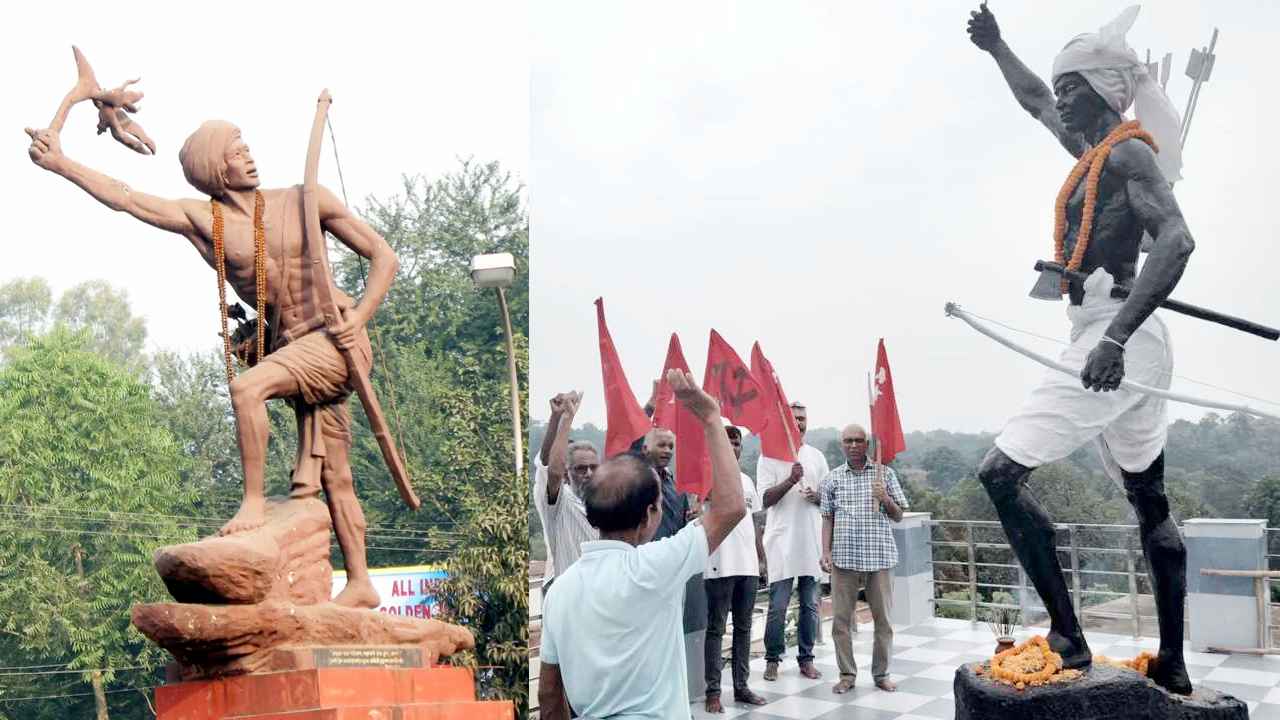
An inescapable aspect is the blatant effort of the Sangh Parivar to claim legitimacy for this ideological war by foregrounding Birsa Munda. At the recent Janjati Sanskritik Samagam, Union Home Minister Amit Shah repeatedly portrayed Birsa Munda as a leader who defended "faith, forests and identity" and who called upon tribal communities to protect their religion from outside influences, adding that Birsa spread the message that "this is our country, our religion is the true religion, and no one can occupy our forests".
Birsa Munda’s early life, like most Adivasis of his time, was marked by poverty, displacement and the relentless oppression of landlords and colonial authority. Forced to move from village to village in search of livelihood, Birsa grew up witnessing the daily humiliation and suffering of his people. His life brought him into contact with diverse religious and social currents—he was baptised into Christianity, educated in mission schools, influenced by Hindu reformist traditions and local spiritual leaders, and eventually returned to the indigenous beliefs of his community. Yet what shaped him most profoundly was not religion, but the growing crisis facing Adivasi society. The dispossession of land, the destruction of traditional institutions and the indifference of colonial rulers convinced him about the need for a militant and determined struggle of his people. Rooted firmly in the aspirations of the oppressed, Birsa transformed himself from a religious reformer into a political leader, uniting Mundas, Oraons, Kharias, Christians and non-Christians alike around the central question of land and justice. For Birsa, the real enemies of Adivasis were the British colonial state, the zamindars, the exploitative ruling elite and all those who benefited from the dispossession of indigenous communities. Birsa's legacy is therefore one of militant anti-colonial resistance, collective self-determination and the struggle for jal, jungle and jameen.
Yet, the Sangh Parivar seeks to portray Birsa as merely an opponent of Christian missionaries obfuscating Birsa's struggle that was directed against all forms of oppression. While missionaries came under criticism because of their proximity to colonial power, Birsa was clear that poor Christians and ordinary non-Adivasis were never the targets of the movement. His call was not for religious conflict but, for liberation from exploitation and the restoration of Adivasi control over land and society.
Birsa Munda led one of the most powerful anti-colonial uprisings in Indian history. He fought against land alienation, forced dispossession, exploitation by moneylenders and landlords, and the colonial state that facilitated this plunder. His struggle was directed against those forces that enriched themselves through the oppression of Adivasis. He mobilised people against exploitation and domination—not against fellow Adivasis because they worshipped differently.
The Sangh Parivar’s endeavour, this, is not merely a distortion of history; it is a political ploy, another instance of rewriting history to suit its agenda.
Conclusion
Post independence, Adivasis have been up in arms against the displacement of Adivasi communities from their ancestral lands, decimation of forests, handing over of natural resources to corporate interests and towards achieving a degree of statutory protections in the form of PESA and the Forest Rights Act.
It is this unity that the politics of Hindutva seeks to fragment them through religious polarisation. Thus, instead of larger unity and struggle against displacement, dispossession and corporate loot, the possibility of the collective resistance is frustrated by the divisive agenda of delisting.
As a commentor points out, the danger extends far beyond the demand for delisting. What is being introduced into tribal regions is the same poisonous politics that has already scarred much of Indian society. A politics that thrives on suspicion, hatred and division. A politics that encourages people to see neighbours as enemies and fellow victims of exploitation as adversaries.
Defeating this project is the need of the hour. Were this project to succeed, struggles over land, livelihoods, self-governance and constitutional rights will be displaced by conflicts manufactured around religious identity. That would represent a historic betrayal of Birsa Munda's legacy.
Instead, the greatest tribute to his memory is in uniting Adivasis across faiths in defence of their land, forests, resources, constitutional rights, dignity and self-rule. That alone would be a fitting tribute to Birsa Munda, to redirect Adivasi struggles away from vacuous questions of religious identity and communal division towards land, forests, resources and self-governance.