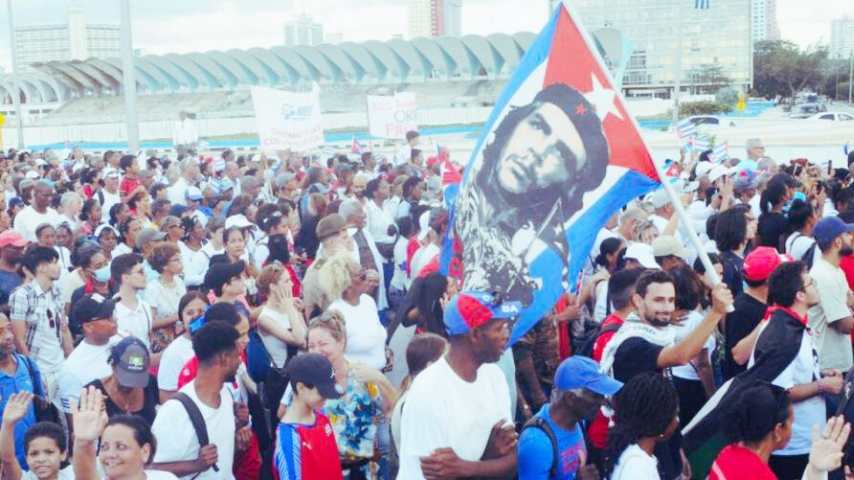
[W]e are prepared; each day we try to be better prepared; we will be better and better prepared. But one thing we can say; we are calm, we are secure, this little island will always be a revolutionary wall of granite and against it all conspiracies, all intrigues, all aggressions will be smashed to splinters. And high upon this revolutionary wall there will fly forever a banner with the legend: Patria o Muerte! Venceremos! [Homeland or Death, We Shall overcome!]
- Fidel Castro, August 10, 1967 in Havana’s Chaplin Theatre
In Cuba today, a resistance movement exists that transcends purely economic concerns and has become a struggle for sovereign dignity against the hegemony of the North. The intensification of the US blockade, which has lasted for more than 65 years, under the White House narrative of a "national emergency," is nothing more than the latest mutation of a low-intensity war that seeks, in the words of President Miguel Díaz-Canel himself in his recent special address, to impose a "hegemonic ideology" through energy strangulation.
Faced with this situation, the Cuban government declared a strategy for the survival of its population that is not merely reactive. The island is implementing a Multisectoral Contingency Plan that prioritizes vital services (health, water supply, and basic necessities) in the face of an unprecedented "naval pursuit" by Washington against its oil tankers. The adoption of exceptional measures, such as the temporary closure of non-essential activities, the reduction of the workweek, and the promotion of teleworking, are key pieces on a chessboard where Cuba's "War of the Entire People" now translates into extreme savings and energy sovereignty.
President of Cuba Díaz-Canel was emphatic: the leap from 3% to 10% in renewable energy generation in just one year is the concrete response to Trump's attempt to cut off supplies to Venezuela and Mexico. It's not just about surviving the blackout, but about breaking free from the dependency that the empire uses as a shackle.
In the diplomatic arena, the statements of Vice Minister Carlos Fernández de Cossío have served to dismantle the White House's media manoeuvre. While Donald Trump and Secretary of State Marco Rubio project an image of "negotiation" to their domestic audience, Cossío has been precise in denying the existence of any formal dialogue. The reality, according to sources at the Ministry of Foreign Affairs (Minrex), is an exchange of technical messages limited to security and migration issues, but with one insurmountable red line: the Cuban constitutional system is not up for discussion.
"Cuba is neither a colony nor a dominion of the United States," declared Cossío, emphasizing that any future dialogue requires the removal of Cuba from the infamous list of state sponsors of terrorism and the cessation of tariff threats against third countries.
From our perspective, what is happening on the island is a test of endurance for the new multipolar order. Mexico's offer of humanitarian aid and the support of the BRICS are not mere gestures of charity, but acts of self-defence against a sanctions model that, if successful in Cuba, would be applied by default against any nation that dares to exercise its national prerogative over its resources.
As the Cuban president rightly pointed out, the beauty of the Cuban Revolution today lies in its capacity to face the challenge, transforming the crisis into an engine of popular ingenuity and strategic unity.
(The author is from Cuba and an expert in political and social affairs of Latin America.)