From the rise and fall of the Indira era Emergency to the ascendance of the Sangh-BJP brigade in the early Advani-Vajpayee period, from the anti-feudal assertion of the people of Bihar to the quest for a progressive democratic alternative across India, Comrade VM captures it all with the sharp gaze and profound commitment of a revolutionary communist. Comrade VM gave us a paradigm of class struggle which rejects economism and abstract idealism and draws its strength from the lived reality of the classes in India where class meets caste and gender, and is deeply influenced by culture and generation shifts.
While starting with the reorganisation and revival of the CPI(ML), Comrade VM never took a narrow and isolated view of the communist revolutionary stream. For him the focus was always on reorienting and rejuvenating the entire communist movement along revolutionary lines by overcoming the illusion and inertia generated by the parliamentary trajectory, acquiring a deeper and more comprehensive understanding of India's complex and diverse social structure and developing a set of policies to ensure a dynamic communist intervention in the ever changing situation.
VM's political journey had begun against the backdrop of the great debate in the international communist movement powered by the ever inspiring impact of the Chinese revolution. But he was never a votary of the so-called Chinese path, always paying due attention to the Indian specificities. He knew revolution in India will need an Indian path, but he did not advocate any pre-determined trajectory as the ultimate path. The path, he would often say, is only formulated with the strength of hindsight because in real life one must be ready to navigate uncharted territories in unforeseen situations.
The last decade in VM's momentous political journey, where he covered so much ground in a short span of three decades, was marked by major social and political upheavals in India and the world. The Soviet Union eventually collapsed, disintegrated and disappeared after years of domestic stagnation and unsustainable superpower rivalry with US imperialism. This marked the onset of a new phase of imperialist aggression in both politico-miliary and economic spheres. In Gulf War we saw the beginning of a new series of most unequal wars of modern history where Iraq had to face the combined might of a US-led western coalition. The IMF and World Bank imposed a neoliberal policy regime across the world with liberalisation, privatisation and globalisation becoming the new global paradigm replacing the post-war welfare state model.
In India, the juncture was marked not just by corresponding paradigm shifts in economic and foreign policies but most crucially by the rise of aggressive Hindutva which started using latent faultlines in Indian history and culture to script a new chapter of unprecedented rise and consolidation that has now brought India to the brink of a well-entrenched fascist takeover. With partial implementation of Mandal Commission recommendations concerning OBC reservations, the social and political balance in North India also underwent a turbulent shift.
In several parts of Bihar, the CPI(ML) had already emerged as the leading centre of a powerful upsurge of the oppressed rural poor for their basic rights to land, wages and dignity. VM's visionary leadership gave a national dimension, forward-looking political perspective and deeper ideological impetus to this historic assertion of the oppressed in Bihar. The question of right to vote soon acquired its due place in the agenda for the effectively disenfranchised poor of Bihar. The quest for autonomy in the hill districts of Assam added a powerful new streak.
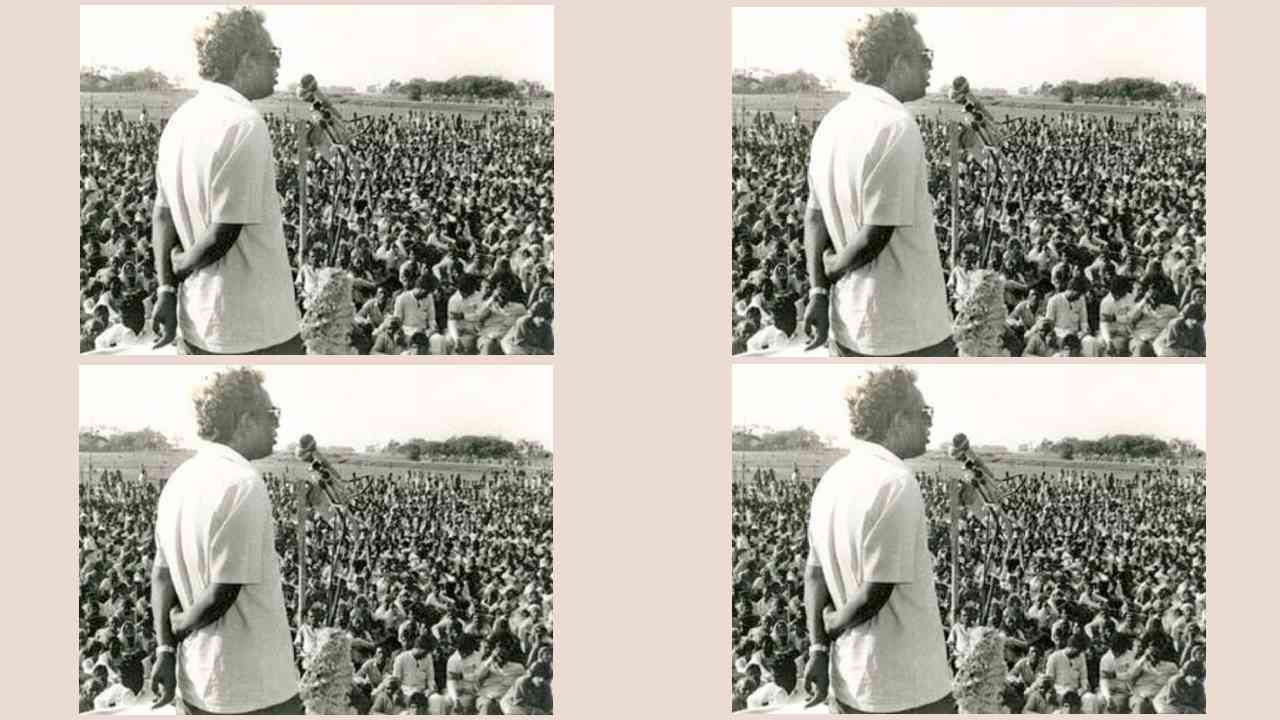
While remaining an underground organisation, under VM's inspiring leadership the CPI(ML) had created a unique mass polical platform in the shape of Indian People's Front. By the end of 1980s and early 1990s, the IPF and its ally Autonomous State Demand Committee in the hill districts of Assam had emerged as significant electoral forces in Bihar and Assam. As the daylight demolition of the Babri Masjid announced the onset of fascism on 6 December 1992, VM realised that the time had come for the CPI(ML) to become overground and lead from the front. The CPI(ML) came into the open on 28 December, 1992 at a historic mass gathering on Kolkata's Brigade Parade Ground.
Meanwhile, the collapse of the USSR and the Tiananmen Square massacre in China had already made it imperative for communists in different parts of the world to confront the new juncture and demonstrate their readiness to rise to the occasion. Communists in Nepal made an encouraging advance in the struggle for a democratic republic turning the Himalayan kingdom into a multiparty democracy, albeit first within the limits of a constitutional monarchy. Under the dynamic leadership of Comrade VM, the CPI(ML) launched wide-ranging initiatives to address the emerging set of challenges.
Mass organisations started taking shape and gaining strength on diverse fronts by challenging the growing convergence of neoliberalism and Hindutva. VM knew India could no longer take the Constitution, parliamentary democracy and the nationalism that had taken shape through the freedom movement for granted. India needed new energy and vision to reinvigorate the secular pluralist anti-imperialist nationalism that could overcome the hate and violence unleashed by aggressive Hindutva, and a new awakening and assertion of the working people to resist a complete corporate takeover of the Indian economy. When he passed away most prematurely on 18 December 1998, just six years after the party had come out into the open, he was busy fleshing out a clear anti-fascist revolutionary direction and a vigorous course of action for the party. All his speeches, articles and notes in the 1990s, right from his Brigade Ground rally speech in Kolkata on 28 December 1992 to his last note which he had presented in the meeting of the Central Committee in Lucknow in December 1998, reflect this growing concern and single-minded focus
The writings of Comrade Vinod Mishra are a storehouse of movemental energy, political wisdom and ideological clarity coming from one of the richest experiences in the Indian comnunist movement of integration of theory with practice and application of Marxist philosophy to the concrete conditions of Indian reality. As Indian communists take up the challenge of combating the heightened fascist offensive of the Modi regime and the Sangh brigade, and both communists and fascists complete their first centuries on Indian soil, Comrade VM's writings and his legacy will remain a powerful source of light and inspiration for the forward march of the communist movement.
(Introduction to the Telugu Edition of Collected Works of Vinod Mishra.).