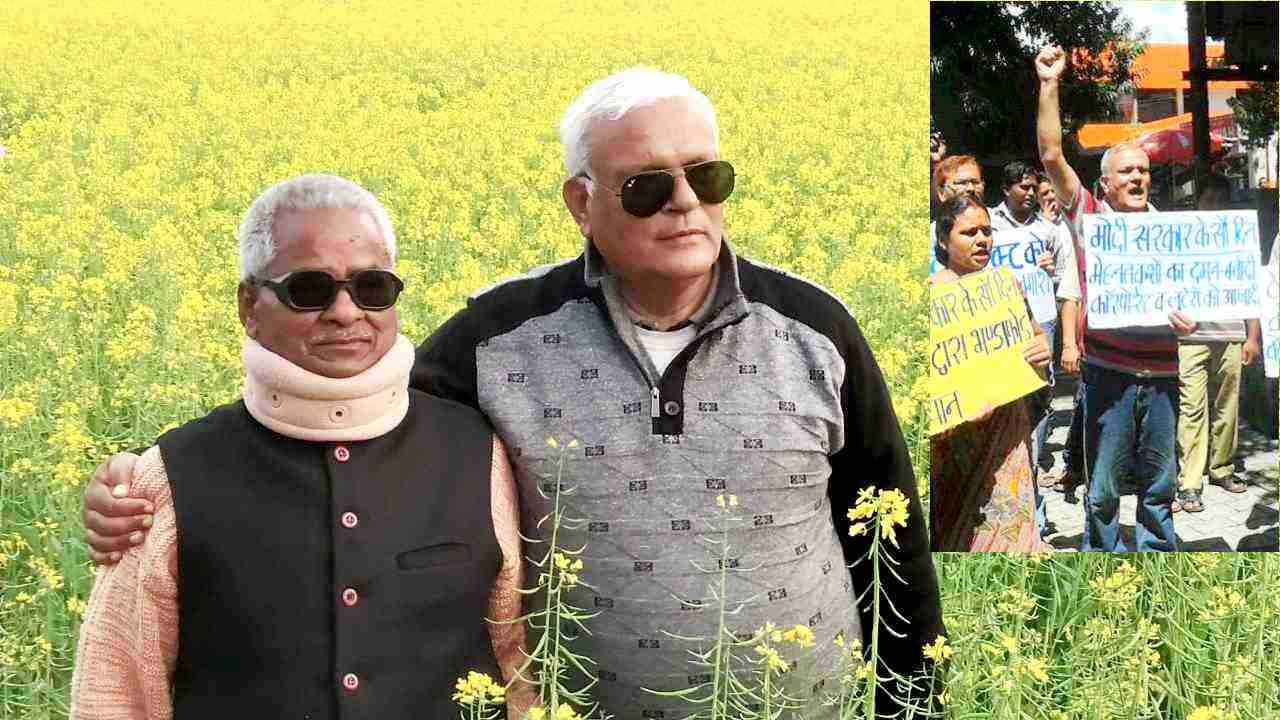
In 1979, CPI(ML) Liberation sent Comrade Deepak Bose to Uttarakhand to build contacts. In 1981, Raja Bahuguna and I together took party membership and pledged themselves to the revolutionary path. From that moment on, Comrade Raja Bahuguna remained inseparable from the struggles of the people.
Beginning in 1981, Comrade Bahuguna worked in Bindukhatta, providing leadership to the peasant comrades at the forefront of the land struggle. Alongside organisational work, he regularly conducted political classes, helping landless peasants consciously embrace communist revolutionary ideology.
The Bindukhatta land struggle faced relentless repression. From its early phase in the seventies to the year 1990–91, the Forest Department, police, PAC, paramilitary forces, and successive Congress governments launched repeated attacks on the movement. In 1997, the BJP government of Uttar Pradesh under Chief Minister Kalyan Singh prepared a multi-crore plan to forcibly evict Bindukhatta. Time and again, the state machinery— backed by both Congress and BJP— attempted to uproot the landless poor through brute force. Lathis, tear gas, bullets, and mass arrests were unleashed. Hundreds of landless women and men were injured; hundreds were jailed. Dozens of CPI(ML) leaders and activists were repeatedly imprisoned, often after being brutally beaten. False and fabricated cases of serious criminal charges were imposed, dragging on for years as a tool of repression.
In 1983, police and PAC patrols were reportedly ordered to capture Comrade Raja Bahuguna and other activists “dead or alive.” Even while suffering from a life-threatening fever, Bahuguna evaded arrest, took shelter in another area, and continued to lead the movement. That same year, a statewide campaign was launched across Uttar Pradesh against the detention of key leaders—myself, Subedar Bahadur Singh Chufal, and Ambadatt Kholiya—under the National Security Act. A writ petition was filed in the Allahabad High Court, and the case was pursued by Raja Bahuguna along with Kamla Pant, a lawyer and convenor of the Uttarakhand Mahila Manch. After seven months of sustained struggle, all three detainees were released unconditionally.
In 1988, following a brutal case of violence against women— widely known as the Mahatosh Mor gang-rape case— a powerful resistance movement erupted in Terai region of Nainital district under Comrade Bahuguna’s leadership. Instead of punishing the perpetrators, the Narayan Dutt Tiwari-led Uttar Pradesh government targeted the movement itself. Raja Bahuguna and many activists—Deepak Bose, myself, Prakash Chandra Phuloria, Bhuvan Chandra Joshi, Madan Singh Dhami, Jagdish Singh Bisht, Gajendra Shah, Krishna Adhikari, Vidya Rajwar, Nandini Joshi, and Man Singh Pal—were arrested and jailed in Nainital and Haldwani. Massive pressure from across Uttarakhand and Uttar Pradesh forced the government to retreat. After 40 days, all activists were released unconditionally, and the accused criminals were finally arrested.
Comrade Raja Bahuguna played a vital role in the Uttarakhand statehood movement. In 1994, he helped carry forward a campaign of people’s unity across the region through pamphlets, meetings, and mobilisations. On 30 May 1997, a massive state-level demonstration demanding a separate Uttarakhand was held in Almora, with large participation from women and men from across Kumaun and Garhwal.
On 7 March 2006, continuing the long tradition of resistance, more than 1,000 residents of Bindukhatta, and dwellers from many forest settlements, gathered at Jantar Mantar in New Delhi for a two-day sit-in under the leadership of Comrade Raja Bahuguna and Girija Pathak. The demand was clear and uncompromising: recognition of these settlements as revenue villages. A memorandum was submitted to the Prime Minister’s Office. On 25 May 2006, the central government responded in a letter addressed to Comrade Raja Bahuguna, stating that the Uttarakhand government had been directed to initiate action on this long-pending demand.
Until his last breath, he carried forward the torch of mass movements and the communist revolutionary current with unwavering resolve. His life continues to inspire today’s struggles and those of generations to come.