We all know that the revolution that Marx and Engels had anticipated as an imminent development in Europe while writing the Communist Manifesto in 1848 never happened. Yet if the Communist Manifesto has turned out to be a global classic of the modern era, it is because of what that text inspired and the tremendous human endeavours and revolutionary upsurges that followed in different parts of the world. That has been the historical power of Marxism, not just analysing the world but transforming it as Marx had famously emphasised three years before writing the Manifesto: philosophers have only interpreted the world, in various ways; the point, however, is to change it.
It is with this spirit that communists in India will have to analyse the present situation to find ways to change it. For much of the last one hundred years, the RSS had found itself isolated from the national political mainstream. As the greatest ideological opponent of the RSS and the most committed and consistent champion of the democratic rights of the Indian people, the communist movement will have to turn the tables on the fascist camp and rejuvenate the constitutional vision of India as a sovereign socialist secular democratic republic.
The first quarter century of the Indian communist movement was spent under colonialism and constituted a great chapter of India's protracted multidimensional quest for freedom from colonial rule. With its ideological clarity and militant resolve, the communist stream often set the agenda and direction of the freedom movement. From pioneering the call for complete independence to connecting the freedom movement with the anti-feudal struggle for the abolition of landlordism, the struggle for rights of the working class, and the transition of feudal monarchies to the new constitutional republican order, the communist movement served as a powerful pivot of India's anti-imperialist national awakening and a bulwark of the consolidation of post-independence India as a parliamentary democracy and planned economy.
From emerging as the leading opposition stream in the initial decades of India's electoral history, and giving India the first non-Congress government in a state within ten years of attainment of freedom and five years of India's journey as a parliamentary democracy, to the creation of high points of revolutionary mass upsurge like Telangana and Naxalbari, the communist movement has been marked by great phases of mass assertion and radical advance. Yet there can be no denying the fact that the last three decades and more particularly the period since 2014 have seen a major electoral decline of the Left. And this decline appears all the more acute when it is viewed against the unprecedented rise and consolidation of the BJP and the RSS.
How India reached such a pass is a matter of separate analysis and study beyond the scope of today's discussion. Obviously we have to locate the current juncture in the continuing trajectory of the RSS which completed ten decades of its fascist ideological and operational journey in October 2025, and the increasingly aggressive pursuit of the neo-liberal policy paradigm of liberalisation, privatisation and globalisation since the early 1990s. Episodic subversion of India's parliamentary democracy and federal framework, especially since the Emergency of the 1970s, and institutionalisation of various kinds of extra-judicial violence and draconian legislation, had in many ways prepared a template of authoritarian governance that is now being ruthlessly executed through a complete capture of institutions and brazen reversal of norms.
The foreign policy of non-alignment, third world solidarity and regional cooperation in South Asia had reflected the potential to carry forward the anti-imperialist spirit of India's freedom movement. But with the adoption of a policy of permanent strategic subservience to the United States, growing strategic and ideological alignment with Israel and degeneration of Indian nationalism from its global anti-imperialist context to the contentious realm of rivalry and conflict with neighbours like Pakistan, China and now increasingly even Bangladesh, India's foreign policy too became compliant with a more inward looking and less inclusive perception of India. The RSS has seized this opportunity to conflate its hate-filled sectarian and exclusivist Hindutva ideology with an ever insecure, beleaguered sense of ossified Indian nationalism.
Add to this the international climate of far-right resurgence where Israel can go on perpetrating a relentless genocide in Gaza for months on end and the US President can abduct the President of a sovereign country like Venezuela without a word of condemnation or even concern from any major European power and we can see how the rise of Hindutva fascism in India becomes just another example of the global trend. In its classical European phase too fascism was an international phenomenon with national peculiarities. The same is the case with the Indian variety of fascism. If we focus only on the increasingly repressive and centralised nature of the state, we might consider it just another authoritarian model. But if we factor in the aggressive Hindu supremacist nationalism and the virulent anti-Muslim, anti-minority violence built into this model, we begin to see why the Indian variety today is nothing short of a full scale fascist project.
For those who believe that the formal continuation of an electoral system and parliamentary framework is itself a guarantee against any fascist threat, we now have enough indications to tell us how the entire electoral system is being redesigned to push India towards a system of complete one-party domination. From establishing government control over the Election Commission to the execution of a wholesale electoral purge to prepare a customised electoral roll, elections in India are fast being reduced to a managed system of manufactured mandates. The combination of the next round of electoral delimitation, nationwide rewriting of the electoral roll and the threat of imposition of a 'one nation, one election' system may well sound the death knell of the electoral system that has till date served as the core of India's parliamentary democracy.
Foiling this growing design of fascist takeover remains the central challenge before the Left at the present juncture. Saving India's environment and working people from corporate plunder and devastation, protecting the constitutional rights and liberties of all sections of the Indian people, especially the right to dissent, and upholding the diversity and dignity of each part of the mosaic that is India - all these are pressing challenges before the organised communist movement at this critical juncture. Just as during the freedom movement communists had to fight alongside a broad spectrum of ideological streams and forces for the shared objective of India's independence, in this crucial phase of securing India's freedom from fascism, communists will once again have to forge a broad based alliance for democracy and justice.
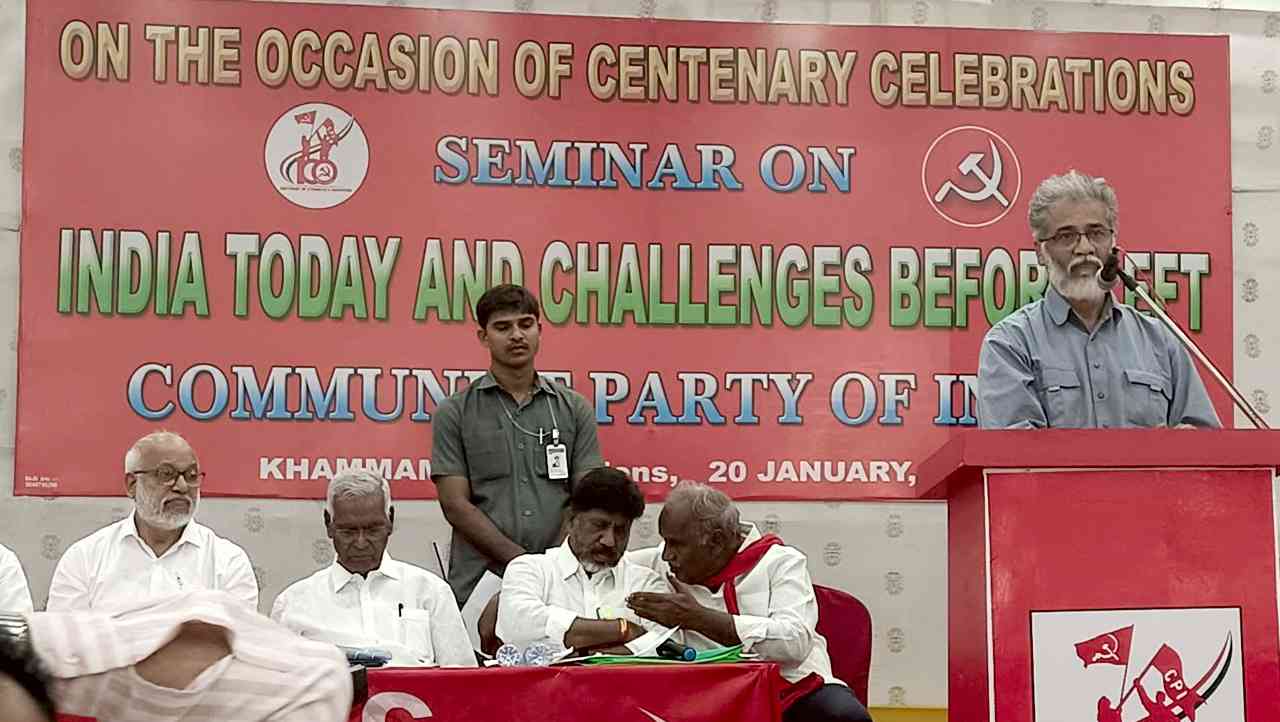
(The article is based on the speech by CPIML Liberation General Secretary Dipankar Bhattacharya at the seminar on 'India Today and Challenges before the Left' at Khammam on Jan 20 organised by CPI to mark the conclusion of the centenary of the Communist Party of India's foundation.)