
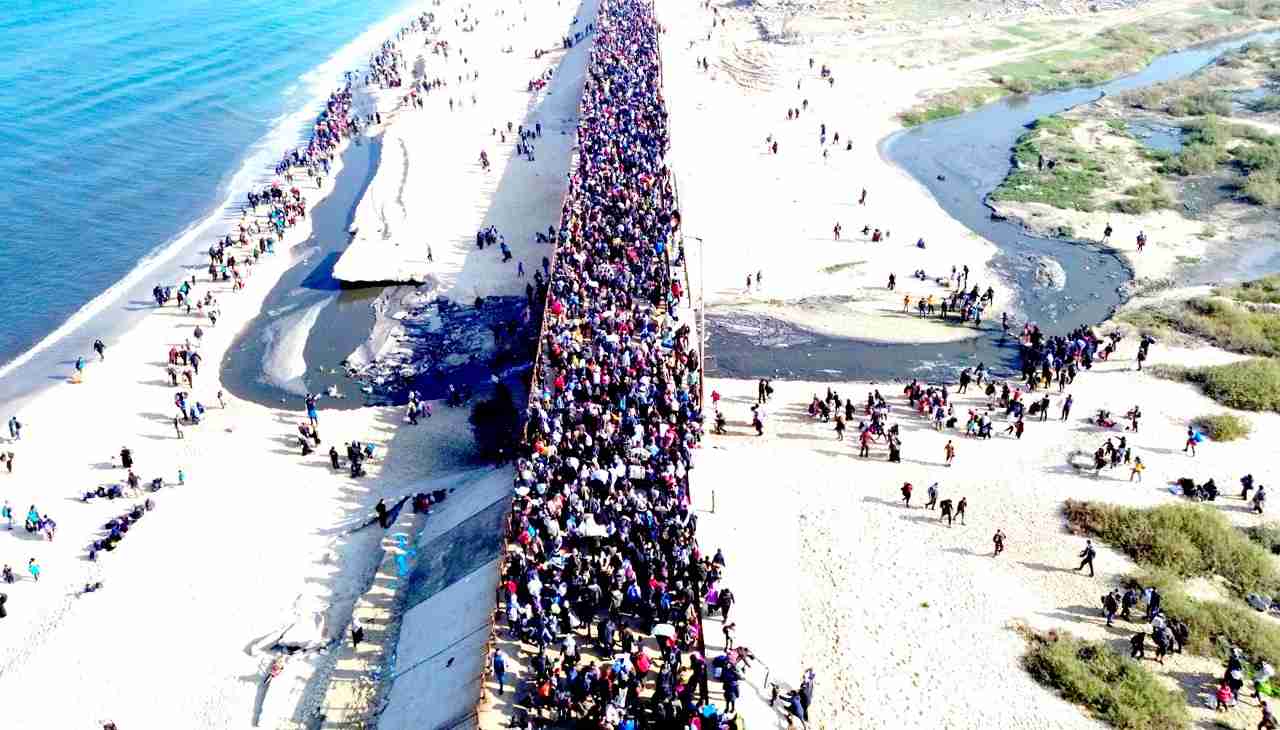
The first phase of the ceasefire in Gaza marks a long-overdue respite for a people who have endured unimaginable suffering under nearly two years of relentless, US-backed Israeli bombardment, siege and forced starvation. Since the beginning of Israel’s genocidal assault on Gaza in October 2023, more than 68,000 Palestinians have been killed, according to health-authorities in Gaza and multiple independent estimates. Thousands more remain missing, thousands lie buried under the rubble, children and women make up the vast majority of the dead, and the infrastructure of life: homes, hospitals, schools, roads, water and sanitation systems lies in ruin. In recent months, Israel created a colonial famine in Gaza, leaving nearly one in every four children suffering from severe acute malnutrition. The US and Israel-run so-called aid distribution centres became killing fields for Palestinians.
The scale of devastation in Gaza has no recent parallel: entire neighbourhoods flattened; hospitals and ambulances bombed; children starving; the means of living stripped away. Independent analysis shows that over 60% of health facilities, over 40% of water facilities, and nearly 70% of education facilities were functionally or structurally destroyed. Today, Gaza has the most child amputees per capita in the world.
Ceasefire Agreement
Just a few days into the ceasefire, Israeli forces bombed several areas in Gaza, killing at least 45 people. Despite Netanyahu formally agreeing to the truce, Palestinians and observers worldwide remain cautious, aware that the far-right Israeli regime will likely use every means at its disposal to derail the agreement and return to war. For Netanyahu, continuous conflict in the region is essential for his political survival. As the ceasefire took effect in Gaza, Israel simultaneously intensified its military operations in the occupied West Bank and along the Lebanese border.
The current ceasefire has come about throughpressure from U.S. President Trump, whose primary focus at present is waging war on people at home and in the Latin American and Caribbean region, which he considers the United States’ ‘backyard,’ rather than spending vast sums to sustain Israel’s genocidal war machine, a machine that relies entirely on U.S. backing.
This phase of the agreement, widely dubbed by genocide supporters as the “Trump peace plan for the Middle East,” is presented as a “peace framework,” but in reality, it consolidates Israel’s colonial expansion while imposing severe conditions on Palestinians. It ties humanitarian relief and reconstruction to the disarmament of Hamas and the acceptance of U.S.-monitored governance structures, effectively subordinating Palestinian self-determination to international oversight that favours Zionist colonial priorities. While hostages have been released and some Palestinian prisoners kidnapped by Israel have been freed, with their condition on release exposing once again the vast torture networks of the Israeli state, the plan leaves enormous leverage in Israeli hands, including control over crossings, enforcement of redeployment lines, and the power to veto governance decisions. In fact, seasoned war criminals such as Tony Blair, the former UK Prime Minister whose tenure was marked by his participation in the U.S.-led invasion of Iraq, in which he was responsible for hundreds of thousands of civilian deaths, have been proposed to oversee Gaza’s transitional governance.
The current ceasefire, accepted by Palestinian groups, largely reflects the terms that Palestinians themselves had proposed to mediators in May 2025. Palestinian factions, including Hamas, agreed to the first phase primarily in the interest of the people of Gaza, seeking an immediate end to the genocidal attacks and providing a breathing space for humanitarian relief.
However, the second phase is expected to be far more contentious. Palestinian groups have made it clear that their weapons, as part of the struggle against occupation, cannot be arbitrarily surrendered and that armed struggle for self-determination is legitimate under international law. They have noted that any disarmament must be conditional on the establishment of a Palestinian state run and governed by Palestinians themselves, ensuring that sovereignty and self-determination are preserved. The current agreement, however, provides no pathway toward a sovereign Palestinian state.
Furthermore, despite initial agreement calling for the release of prominent Palestinian leaders, figures such as Marwan Barghouti, one of the most unifying figures across Gaza and the West Bank, and Ahmed Saadat, leader of the Popular Front for the Liberation of Palestine, have not been released by the Netanyahu regime.
While the current ceasefire has provided a temporary breather for the people of Gaza amid relentless bombing and genocide, Palestinians and their supporters remain vigilant. The quest for justice, liberation, and a homeland for Palestinians will continue to intensify. The people of Gaza have shown the world that even under the ruins, the struggle for dignity and liberation cannot be bombed out of existence.