UP State Secretary Sudhakar Yadav and State Standing Committee member and Mirzapur District Secretary Jeera Bharati were arrested by Special Operations Group of UP Police (SOG) without any warrant or telling any reason at Adalhaat on 3 January 2026, while they were returning after attending the funeral of a party comrade.
At the time of arrest and under custody, a senior woman leader comrade Jeera Bharati was brutally beaten up by the male police leading to many injuries. For the next 24 hours people were in the dark about the whereabouts of these two comrades. The district SP and DM did not pick up phone calls and local thana personnels kept a silence.
The police arrested CPI(ML) leaders after framing them on false charges because villagers had resisted a mid-night bulldozer operation in Tendua Khurd village which falls under Lalganj police station. Comrade Jeera Bharti is named in the FIR, State Secretary Comrade Sudhakar Yadav's name is not mentioned in that. However, the administration implicated the CPI(ML) State Secretary among the fifty unnamed individuals mentioned in the FIR. Both leaders were not present at the site of the incident, but they have been targeted for leading movements against the displacement of Adivasis and the poor. They were arrested first (around 3:30 PM), and the FIR was registered later (3:46 PM).
The next day, a party delegation went to Mirzapur that included Central Committee member Ishwari Prasad Kushwaha and State Standing Committee members Om Prakash Singh, Rampyare Ram, and Anil Paswan. Even on the second day, the District Magistrate and the Superintendent of Police avoided meeting or engaging with party leaders. However, after sustained efforts, officials eventually disclosed that both leaders had been sent to jail late in the evening on the very day of their arrest.
The CPI(ML) team also visited Tendua Khurd village and extensively interacted with local residents to understand the situation on the ground. Party leaders also met the detained leaders and villagers inside the jail as well. Comrade Jeera Bharti told the team that she still being specifically targeted and subjected to harassment even while in custody. The matter was subsequently taken up with jail authorities by the visiting leaders.
The members of the Kol and Dharikar communities have been settled in Tendua Khurd village for four generations, sustaining themselves through agriculture. Several villagers have been granted residential land titles. The Kol community is recognized as an Adivasi group; however, despite persistent demands, they have not been accorded Scheduled Tribe (ST) status in Uttar Pradesh. For a long time, the Forest Department and the government has been attempting to evict them from their homes and farmlands.
The officials of the Forest Department had earlier, around one and a half month ago started digging pits with JCB machines in the fields of poor villagers in Tendua Khurd— fields where wheat and mustard crops had already been sown. The CPI(ML) Mirzapur District Secretary Comrade Jeera Bharti reached the spot and intervened, asking the officials to halt the operation. While the forest officials withdrew at that time, they attempted to resume the action later, prompting an indefinite sit-in protest at Lalganj tehsil in mid-December.
During the protest, officials from the Revenue Department, the local administration, and the Forest Department held discussions with party leaders and protesting villagers. Forest and revenue officials assured the protesters that within fifteen days, the dispute over land ownership in Tendua Khurd would be resolved between the Revenue and Forest Departments. They further committed that the Revenue Department would provide written confirmation stating that the lands occupied by Adivasi and poor villagers fell under the jurisdiction of the Revenue Department, not the Forest Department. On the basis of this understanding, the bulldozer action was halted.
There was a big protest rally and demonstration on 2 January 2026 organised by CPI(ML) at the office of the Vindhyanchal Divisional Commissioner (Mirzapur) against the ongoing bulldozer actions in many villages, including Tendua Khurd and Matwar, in the district. The Additional Commissioner assured the protesters that no bulldozer action would take place. However, just after a few hours at around 2 a.m. on the night of 2/3 January 2026, Forest Department officials arrived with approximately 150 people and seven JCB machines at Tendua Khurd. Among them were several local strongmen and lumpen elements.
Forest guards and those accompanying them forcibly entered homes and began dragging women out. One woman’s arm was broken, while another sustained serious injuries to her chest. A girl aged around 15-16 suffered severe injuries to her thighs, and another girl of the same age was picked up and thrown violently to the ground. These attacks created panic and chaos in the village. When the villagers regrouped and resisted collectively, the forest officials and other persons fled the scene.
The Forest Department later filed a complaint and the police registered FIR No. 04/2026 (dated 03 January 2026) at Lalganj police station. The FIR invokes sections 221, 352, 351(3), 324(5), 121(1), 132, 191(2), 191(3), and 109(1) of the Bharatiya Nyaya Sanhita (BNS), along with Sections 5 and 26 of the Forest Act and Section 7 of the CL Act. These are serious criminal charges, including provisions relating to attempted murder. Since the party State Secretary Sudhakar Yadav was not initially named and no direct case could be established against him, the police subsequently added Section 61(2) of the BNS, pertaining to criminal conspiracy.
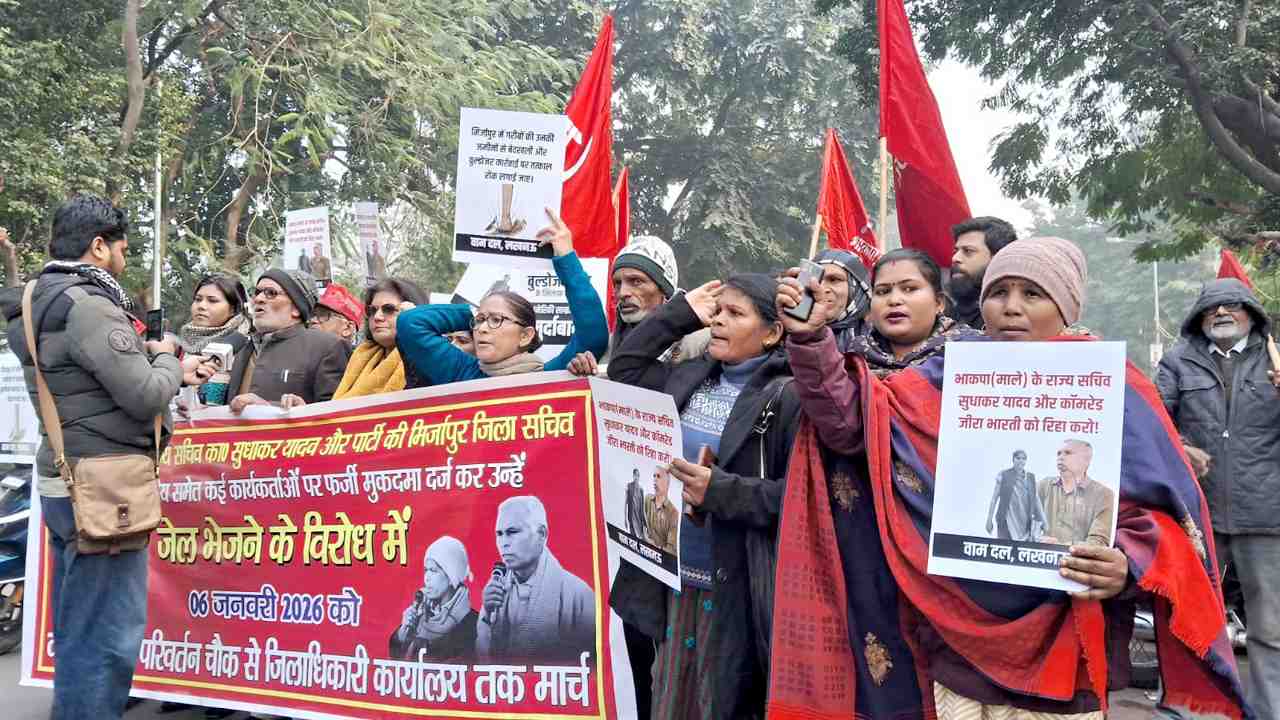
In protest against these arrests and repressive bulldozer action, CPI(ML) organised a statewide protest on 6 January 2026. Other major Left parties— including the CPI, CPM, and Forward Bloc— also participated at various locations.
In the Adivasi regions of Mirzapur, Sonbhadra, and Chandauli, Adivasis and other traditional forest dwellers are being forced into a two-front struggle to defend their land and forest rights. On one hand, non-Adivasi strongmen and mafias from outside are systematically grabbing their ancestral lands, forest produce, and mineral resources. On the other hand, the government, administration, and Forest Department are relentlessly pursuing campaigns to evict Adivasis and the rural poor. Through their actions, the government, administration, and Forest Department are effectively extending protection to land mafias and forest mafias at the expense of indigenous communities.
Only a few years ago, in July 2019, in Umbha (Ghorawal) in Sonbhadra district, land mafias attempted to seize Adivasi lands. When the Adivasis resisted, they were subjected to a brutal massacre in which nearly a dozen Adivasis were killed. More recently, in the name of setting up power plants, large-scale displacement of Adivasis from their ancestral lands is underway in Sonbhadra.
After prolonged struggles, a survey and settlement scheme was introduced in the Adivasi regions of Sonbhadra. However, instead of recording the names of Adivasis on the lands they had been cultivating and occupying for generations, land mafias influenced the government machinery and succeeded in getting vast tracts of land registered in their own names. This has led to repeated and often violent clashes over possession of land.
The Scheduled Tribes and Other Traditional Forest Dwellers (Recognition of Forest Rights) Act— commonly known as the Forest Rights Act— has effectively been transformed into an instrument of their dispossession, defeating its very purpose of securing land titles for Adivasis and other forest dwellers. In the above three districts, the majority of applications filed under this law have been rejected. Adivasis are being branded as illegal encroachers on their own ancestral lands, and bulldozer actions are being carried out against them.
This mirrors a broader national pattern where in Adivasi areas across the country, big corporations have cast a predatory eye on forests, land, and mineral resources. Acting in concert with forest officials, the government and its administration are facilitating this project of plunder by extending protection to corporate interests as well as land and forest mafias.
In Chandauli’s Naugarh as well, a sustained movement is ongoing, where on 9 January 2026 an angry ‘lathi march’ was organised. The bulldozer action being carried out in Tendua Khurd village is part of the same continuum of forced evictions and repression. It is this resistance movement that comrades Sudhakar Yadav, Jeera Bharti, and five villagers were sent to jail.
The two leaders were granted bail by the Sessions Court on 14 January.
The CPI(ML) has called for a big protest rally on 28 January at Mirzapur against the ongoing bulldozer evictions. Party General Secretary Dipankar Bhattacharya will address this rally.
===

Comrade Jeera Bharti
Comrade Jeera Bharti comes from a poor rural family in Mirzapur. Today, she stands out as one of the most outspoken and visible political voices in the district. Her leadership is not confined to women merely because she herself is a woman; rather, she has emerged as one of the most assertive and consistent voices of all oppressed people across the entire region.
In the broader context of Uttar Pradesh politics, Comrade Jeera Bharti represents a rare phenomenon: a woman leader from a rural, poor background who, through sustained struggle, has earned recognition at the national level. She is a national leader of the Khet Mazdoor Sabha (AIARLA) and a member of the State Standing Committee of the CPI(ML). In Mirzapur, her presence and influence are widely acknowledged. She has contested several Assembly elections from Mirzapur and has fought Lok Sabha elections once.
What is particularly striking is that a Dalit woman leader has been deliberately targeted by the police— framed, arrested, and assaulted. The fact that she has been lodged in jail underscores that the struggle she represents is part of a long-running battle against repression, injustice, and the systematic targeting of voices that challenge entrenched casteist power structures.
===

CPI(ML) MP’s Visit to Mirzapur
On 11–12 January, CPI(ML) Member of Parliament Comrade Sudama Prasad visited villages facing threats of imminent evictions in Mirzapur. He met many tribals and villagers who have borne the brunt of repres-sion and also visited the jail to meet imprisoned party leaders and villagers.
Comrade Sudama Prasad also submitted a memorandum of complaint and demands to the District Mag-istrate of Mirzapur, formally registering his protest. He demanded the unconditional release of the jailed leaders and villagers and the withdrawal of the fabricated case, and an immediate halt to bulldozer opera-tions on the lands and forest rights of the poor. He further demanded that land rights be granted to poor cultivators on the land they are currently tilling; that strict action be taken against male police personnel who assaulted woman leader Jeera Bharti; that cases be registered against forest personnel and lumpen elements who attacked women in Tendua Khurd; and that lands under illegal occupation by land mafias be freed.
He also addressed a press conference and said villagers had informed him that the Forest Department, in collusion with land mafias, had facilitated the felling of entire forests of khair (catechu) and sandalwood, turning the area into a hub of illegal plunder. He alleged that the Forest Department was evicting people by claiming ownership over all land— whether ceiling land, revenue land, or patta land. In villages such as Matwar and Nadna, land loot was being carried out under the pretext of cancelled pattas, with strongmen forcibly occupying land. Hundreds of acres in these villages, he said, were under illegal occupation by land mafias, yet administration takes no action against them.
This administrative bias against villagers was also reflected in granting permission to comrade Sudama Prasad to visit the bulldozer-affected villages. Several CPI(ML) leaders, including Mirzapur district com-mittee member Bhakt Prakash Shrivastava, were placed under house arrest on the day of his visit. Such mistreatment of opposition leaders, particularly those from the Left, has become a routine occurrence in Yogi’s Uttar Pradesh, he said. Drawing a sharp comparison, the MP asked why CPI(ML) leaders were framed in false cases when 23 cases against Chief Minister Yogi Adityanath could be withdrawn.
========