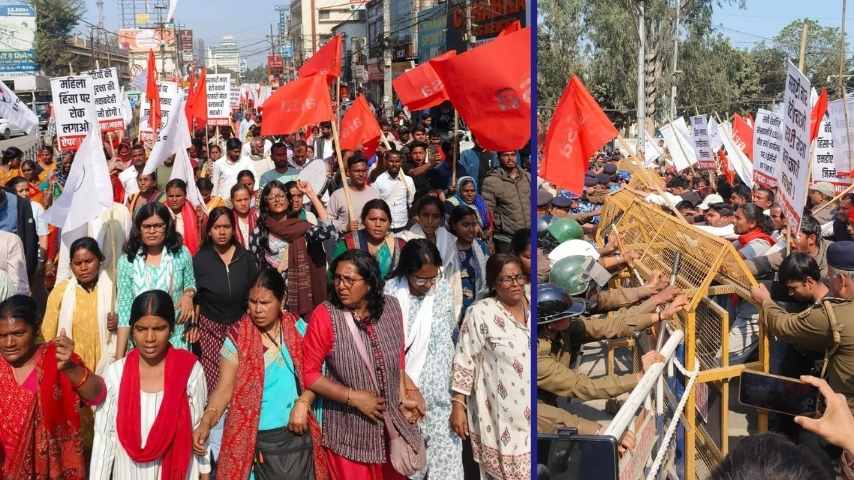
The demonstrators, who were moving peacefully to submit their memorandum to the Chief Minister, were met with force. Police resorted to pushing and a lathi-charge, injuring several women on their hands, heads, and legs. Hundreds were dispersed, and the main march was initially prevented from reaching Dakbungalow Chowk.
Despite the repression, the marchers broke through the barricades at JP Golambar and regrouped at Dakbungalow Chowk, where the police had again erected barriers. The demonstrators demanded a meeting with the Chief Minister and justice for Bihar’s daughters, including the NEET student. They later held a public assembly at the chowk.
Addressing the assembly, AIPWA General Secretary Meena Tiwari said that crimes against women and girls are increasing in Bihar. The NEET victim case, the six-year-old girl in Darbhanga, and incidents in Buxar reflect the state government’s failure to protect women. Instead of taking action against perpetrators, the administration is attacking women protesters.
CPI(ML) MLC Shashi Yadav criticised the government for attempting to suppress the issue both inside the Assembly and on the streets, humiliating women leaders and repressing peaceful protesters. Meena Tiwari demanded that the NEET student case be investigated under Supreme Court supervision, stating that a CBI probe alone cannot ensure justice.
The memorandum submitted to the Chief Minister included the following demands:
1. The NEET student case must be investigated under Supreme Court supervision, not solely by the CBI.
2. The Anamika case must be independently re-investigated, and strict action taken against guilty officials.
3. The Darbhanga (Bela) rape-murder case should be fast-tracked in court, and the perpetrators punished severely.
4. A state-level inquiry into the post-election rise in violence against women and girls.
5. An immediate security audit of all private hostels, student accommodations, and coaching centres.
6. Punitive action against police personnel and officials negligent in cases of crimes against women and children.
7. Ensuring that victims’ families are provided a safe environment along with legal and financial support.
The memorandum warned that any failure by the government to take immediate, impartial, and transparent action would amount to moral and political responsibility for the ongoing violence against women and girls.
The Assembly march was part of a seven-day Beti Bachao Nyay Yatra that began from Jehanabad on February 4 and witnessed participation by thousands of women and students. Prior to the march, a Jan Sunwai (public hearing) was held on February 3 at Buddha Smriti Park in Patna. At the hearing, a charge sheet was presented against the Bihar government, accusing it of complete failure in ensuring the safety of girls and of protecting criminals involved in crimes against women.
Passing through various areas of Jehanabad, the yatra travelled across regions of Nalanda, Nawada, Gaya, Arwal, and rural Patna before reaching the state capital. During the course of the yatra, more than 100 street-corner meetings were organised, with large participation from women, girl students, youth, and the general public.
Delegations met with the families of several rape survivors, bringing their pain, struggles, and demands for justice to the forefront. Besides the Patiyawan case, the yatra also examined the case of the NEET student from Aurangabad who died under suspicious circumstances. Leaders met the bereaved family and demanded an impartial investigation and strict punishment for those responsible.
The AIPWA–AISA march stood as a collective assertion for the dignity, safety, and justice of Bihar’s daughters.