
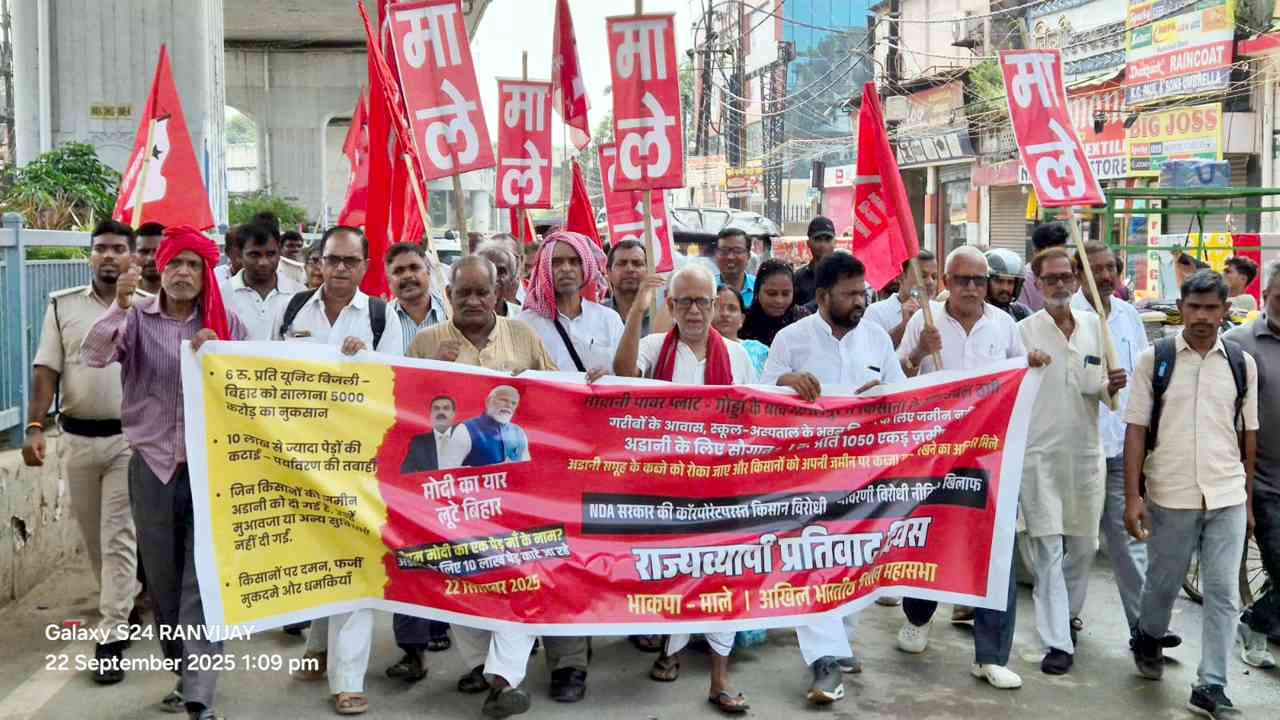
There are a few big landholders and BJP leaders in favour of land grab, but the poor small farmers from the backward castes as well as Dalit, Adivasi, and minority communities are opposing this decision. On 15 September 2025, the Prime Minister Narendra Modi laid the foundation stone of this power plant from Purnia. From the inauguration stage in Pirpainti, the local BJP MLA Lalan Paswan threatened farmers to vacate their land, while also tempting them with promises of employment for locals in the project. It is worth noting that this is the same Lalan Paswan who, before becoming an MLA, used to take part in the Zameen Bachao Sangharsh Morcha (Jan Chetna Samiti) programmes in support of the farmers.
In anticipation of people’s resistance at the foundation-laying event and to pre-empt protests, the administration arrested a local panchayat leader Deepak Singh of Ujjwala village (Harinkol Panchayat) two days earlier on what villagers allege was a fabricated case, and sent to jail. District officials and some BJP leaders toured villages beforehand intimidating people if any “outsider” seen near the orchards or lands earmarked for the project would be jailed along with those sheltering them. This fear was further spread by some local journalists sympathetic to the ruling party who reportedly echoed these warnings.

A CPIML fact-finding team visiting Pirpainti witnessed first-hand this climate of fear. A local resident Shatrughan Yadav whose land has also been acquired, offered them shelter and also arranged tea and water for the team, but could not gather enough courage to join a public meeting at the nearby Panchayat Bhavan. The meeting was announced for 11 a.m. at the Panchayat Bhavan, but was found shut when the team arrived. Only a few women were sitting around. Villagers later revealed that BJP supporters, including some journalists, had spread rumours that the visiting team was linked to “Naxalite” groups, warning people that attending the meeting would get them into trouble. After much effort, a few villagers—mainly from Yadav and Muslim communities—gathered and shared their accounts.
The fact-finding team included Sudama Prasad, MP from Ara; Rambali Singh Yadav, MLA from Ghosi; Rajendra Patel, State Joint Secretary, All India Kisan Mahasabha; Shivsagar Sharma, National Vice President, All India Kisan Mahasabha; Mahesh Yadav, District Secretary, CPI(ML), Bhagalpur; Randhir Yadav, District Convenor, All India Kisan Mahasabha, Bhagalpur; Vinandeshwari Mandal; Ranveer Kushwaha and Sanjeev Kumar.
The team found that some wealthier farmers, mostly Rajputs, are openly supporting Adani since many of them work as contractors or run heavy vehicles and expect to gain from construction contracts. But Rajesh Tiwari, Congress block president of Pirpainti, whose family lost 30 acres to the acquisition, has opposed the project.
The Nitish-BJP government has recently merged 2,600 primary schools which were mostly in poor Dalit hamlets citing “non-availability of 10 decimals of land.” Thousands of proposed health centres at the panchayat level were also stalled for the same reason. The government even abandoned its promise of providing three decimals of homestead land to landless poor, again claiming a lack of land. Yet, the same government did not hesitate to give 1,050 acres on a platter to Adani.
Ironically, the government can acquire lands for such projects, but has not made rules that provide a mechanism to purchase land for schools or hospitals; such buildings are constructed only on government or donated land. People have been opposing shutting down of schools and have long demanded land for education and housing, even staging protests at block headquarters. In the Bihar Assembly, CPI(ML) MLAs repeatedly raised the demand that land acquisition provisions be extended to schools and hospitals.
Deputy leader of CPIML legislative group in Bihar Satyadev Ram has also pressed for homestead land for the poor. When party MLA Rambali Singh Yadav demanded land for schools and hospitals in the Bihar Assembly, Chief Minister Nitish Kumar’s response was blunt: “There is no land available.”
For farmers in Pirpainti too, land is declared unavailable for the poor, for schools, for health centres—but is readily transferred to corporations at throwaway rates. The intimidation of villagers, arrest of local leaders, and silencing of dissenting voices underline how the state prioritises corporate interests over basic rights of education, housing, and livelihood.
The decision to acquire this land for the public sector NTPC was taken in 2014. Then it was verbally assured that the compensation would be provided based on the quality of the lands, and the cost of commercial trees will also be properly assessed. For example, for each mango tree a compensation amount of Rs 12 lakhs (considering a life span of 50 years) was promised, and that the payments will be decided for other cash trees in a similar manner. Besides, government jobs were promised for the children of affected farmers, and free electricity to each displaced family.
Then, people also shared their fear of environmental damage, and were assured in return of a perfect pollution control mechanism for the upcoming power plant. This was in view of the environmental damage seen after the Kahalgaon thermal power project, which had devastated the environment in a radius of 12 kilometres to the extent that people face various problems due to high levels of ash from the burnt coal in the air from that plant.
People were promised proper compensation even for those who are not able to provide land papers due to various reasons. This promise was not kept and many farmers have been running from pillar to post for 11 years. They are even being forced to pay bribes to the officials.
So far, the only relief was that the lands are still under farmers' possession, but now with a public sector project being handed over to Adani and inauguration done by the PM, people are being served with fresh notices to vacate their lands. These eviction notices have mentioned many orchards and lands with cash trees as barren lands. In Kamalpur village, the team found fifty farmers belonging to Yadav community have not received any compensation. While one villager, Vakil Yadav, who owns a 14 rooms house was approved a meagre compensation for the land only at the rate 40 thousand rupees per decimal.
Villagers also expressed their concern for the damage to the environment after felling of lakhs of trees.
With the inauguration, the lands have formally been handed over to Adani. There is no clarity as to how the promises made by the state government, most of them verbally, to the farmers will now be fulfilled. Villagers are fearing forcible evictions by Adani group with the help of administrative machinery and local henchmen backed by the ruling party leaders, as has been seen in many states.
====

Modi-Adani’s Godda Treachery
Bhagalpur acquisition by Adani is being publicised as a venture that will generate 10-12 thousands jobs. A similar promise was made by Adani group CEO Rajesh Chandra Jha on 12 December 2017 when he signed an MOU with the then Raghubar Das’ BJP government in Jharkhand for a power plant in Godda, which later on turned out to be a blatant lie.
The Adani Power (Jharkhand) Ltd. had acquired 558 acres of land in Godda, of which 517 acres was taken forcibly from farmers. Villagers who lost two or more acres of land were then promised jobs or an extra compensation amount of Rs. five lakhs. The promise of jobs was later turned out to be false even after people were made to undergo proper training. Jobs were given only as casual contract workers. The farmers are still agitating against this betrayal through legal as well as movemental means. Initially Adani had demanded 1363.15 acres including 1214.49 acres of private land belonging to local people, and it is still pressuring the government for more acquisitions to further expand its power plant and the coal block.
The Adani Power in Jharkhand employs a total workforce of 3316 by 14 July 2025. In March this year Adani group ‘transferred’ its 180 employees to a private contractor. This included 50 workers who were given jobs in exchange for their lands. When they protested they were forcibly suppressed, later given a hollow promise that the permanent job will be given when there will be vacancies.
The promises of protecting the environment and of social welfare measures also turned hollow. The local population still suffers from scarcity of electricity while the power produced to Godda is meant only to be exported to Bangladesh. Besides lands, Jharkhand is also being deprived of its coal and 36 MCM river water every year by this Adani project and gets nothing in return.
After the commencement of Godda power plant there is a rise in lung related ailments in the area as was revealed by a research team. The air quality index (AQI) worsened from earlier 80 to 120 presently and acidity in water has increased from ph 6.8 to 5.5. The affected area is given the status of special economic zone (SEZ) covering 11 villages directly but includes more villages through various subsidiary activities. The area comes under the SPT Act which prohibits acquisitions, but the government misused the clause pertaining to public welfare. How can a plant producing electricity exclusively for sale in a neighbouring country be considered of public welfare?
The official record claims that about 400 families have been displaced comprising a total population of 1500, but many independent agencies’ estimate this number at 5000 minimum. A promise was made for 10000 jobs generation which was never fulfilled.