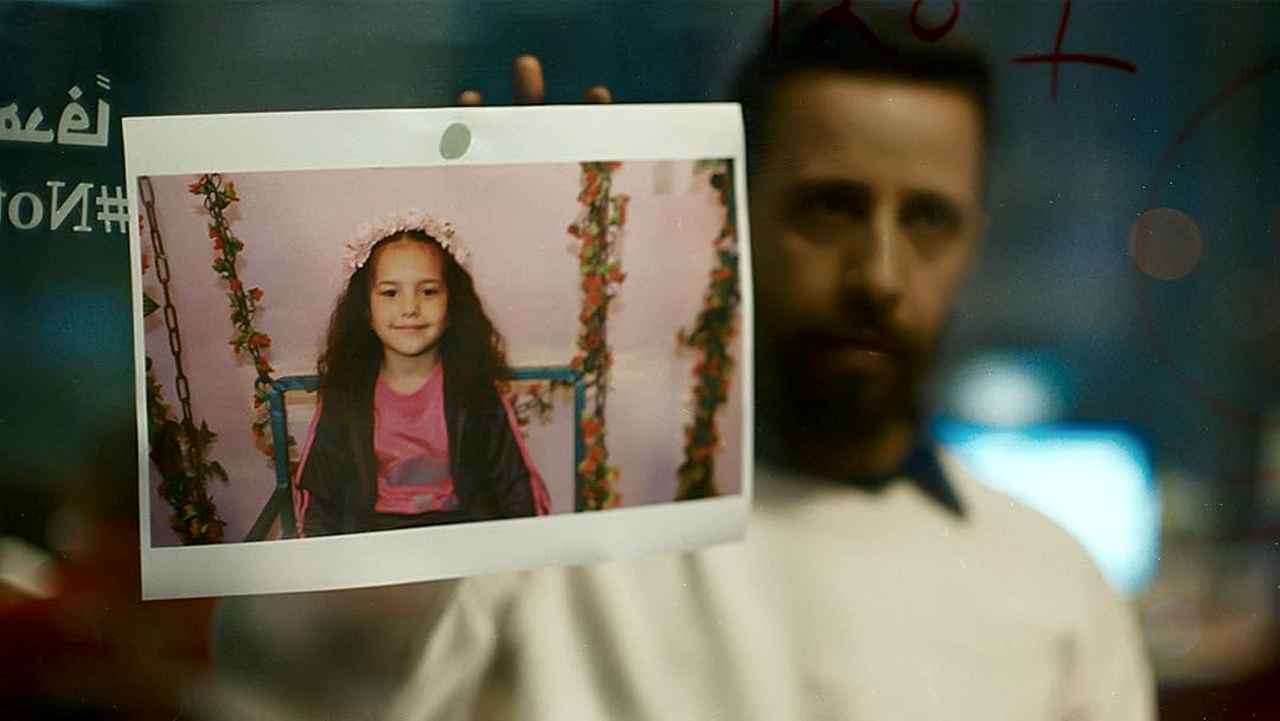
What sets this film apart from every other document of the Palestinian catastrophe is its formal honesty. Tunisian filmmaker Kaouther Ben Hania does not cast an actress to play Hind, neither does she reconstruct, dramatise, or soften the plot for world viewers. Hind speaks loud and clear for herself. Her actual voice, drawn from the real emergency call recordings, runs through all 89 minutes of the film, while actors playing Palestine Red Crescent Society (PRCS) volunteers respond to her in real time. The audience is made captive. There is no fast-forwarding, no averting of eyes, no refuge in the thought that what you are hearing is fictional. A child's voice, first seeking comfort, then frightened, then pleading, simply rings in your ears until it doesn't anymore.
On January 29th, 2024, Hind's family were fleeing their neighbourhood in Gaza to escape an IDF assault when their car was surrounded and fired upon. All six family members travelling with Hind were killed on the spot by Israeli forces. The six-year-old, trapped amongst the dead bodies of her relatives, called the PRCS. PRCS volunteers stayed on the line with her for hours, navigating military blockades and bureaucratic obstruction, trying desperately to route an ambulance through a city that Israeli bombardment has systematically turned to rubble. The ambulance that finally set out to reach her was blown to pieces by Israeli forces, killing paramedics Youssef Zeino and Ahmed Al-Madhoun. When Hind's body was found weeks later, journalists counted 335 bullet holes on the car.
The PRCS call centre becomes the film's entire world. Beige walls, computer screens showing digital maps of destruction, cursors tracing ambulance routes through streets that no longer exist in any passable form shows the impossible work being done in the wake of an active genocide. Ben Hania's direction favours claustrophobia and long silences. The restraint is a political choice. Hind's voice needs no amplification, and the PRCS workers around her doing everything humanly possible within a system designed by Israeli military policy to ensure they will fail, need no melodrama to break your heart.
To reduce the Gaza genocide to numbers is a form of anaesthesia that power has always relied on. Ben Hania refuses it entirely. This is the film's deepest political act. A child who told her rescuers she was scared and asked them not to hang up is not a casualty figure. She is Hind Rajab - specific, irreplaceable, six years old. By centering her voice, Ben Hania dismantles the abstraction behind which governments that arm and fund Israel have sheltered themselves. You cannot watch this film and continue to speak of Palestinian deaths as unfortunate collateral. You cannot watch it and call what is happening in Gaza a conflict or a war.
The People Who Answered
The film is equally a portrait of the Palestine Red Crescent Society, and this is where one of the most systematic crimes of this genocide must be named plainly. The PRCS is Palestine's primary emergency medical service. Since October 7th, 2023, its volunteers and staff have worked under conditions that no international humanitarian law framework was ever designed to handle, because that framework assumes, at its most basic level, that a Red Crescent emblem on a vehicle will be respected. In Gaza, Israeli forces have treated it as a target.
Over 51 PRCS staff and volunteers have been killed on duty since the genocide began. Every single one of them wearing the emblem that should have guaranteed their safety under the Geneva Conventions. On January 10th, 2024, nineteen days before Hind died, four PRCS paramedics were killed when Israeli forces struck their clearly marked ambulance. Then, on March 23rd, 2025, eight PRCS medics were among fifteen aid workers shot dead by Israeli forces in Rafah's Al-Hashashin area. Their ambulances had emergency lights on. Their uniforms were clearly marked. They had gone out to assist casualties from an earlier Israeli airstrike. Their bodies were found nine days later buried in a shallow mass grave, hands bound, shot in the head. The International Federation of Red Cross and Red Crescent Societies called it the single most deadly attack on Red Cross or Red Crescent workers anywhere in the world since 2017.
When the killings came to light, the IDF claimed the vehicles had been moving without lights. A video recovered from the phone of one of the murdered medics showed otherwise - emergency lights flashing, uniforms visible, as Israeli soldiers opened fire. The IDF's own investigation found, eventually, that there had been professional failures. It recommended no criminal charges. The PRCS called the report full of lies. Amnesty International called it evidence of war crimes. The IFRC's Secretary General asked one question that had no good answer: when will this stop?
The Ambulance That Never Came
The Red Crescent volunteers in Ben Hania's film are not failing Hind because they are incompetent. They are failing her because the infrastructure of rescue has been deliberately and methodically dismantled by Israeli military policy. Ambulances cannot move freely through a city where every street is a potential kill zone. Authorisations take time because the military controls every movement corridor. The bureaucratic agony on screen — the waiting, the rerouting, the desperate appeals up chains of command - is not dysfunction. It is the direct, intended consequence of an occupation designed to make Palestinian life unrescueable. The helplessness in the eyes and voices of the PRCS volunteers, watching their colleagues and fellow citizens being murdered while they sit with headsets on, hits you like a physical blow.
According to United Nations data, at least 1,060 healthcare workers have been killed in Gaza since October 2023. More aid workers have died in this single conflict than in any other conflict year since records began. These numbers are not collateral. They reflect a deliberate campaign against the infrastructure of survival, against hospitals, against ambulances, against the human beings who staff them, against the very institutional capacity that might allow a six-year-old child trapped in a car to be reached before she bleeds to death.
The PRCS workers kept the line open. That is what was left to them. The world that watched and continued arming Israel could have done far more.
What Cinema Can Demand
The Voice of Hind Rajab has been described as demanding, raw, and emotionally overwhelming- not easy cinema at all. That is precisely what it needs to be. Easy cinema produces feeling and then lets you go home. Ben Hania's film will not let you go home. It wants you to understand, not in your mind but in your body, what it means to be six years old and alone in a car in Gaza, asking the person on the other end of the line to please not hang up.
The film's global festival reception with the standing ovations, the prizes, the starry executive producer roster, reflects a cultural reckoning. It does not matter to Governments that continue to supply weapons to Israel that over 60,000 Palestinians have been killed, that medics have been massacred, that protestors across the globe are asking them to stop arming Israel. Perhaps they will not be moved by a film also. But a film creates memory in a way that a news cycle cannot. It preserves testimony in a form that outlasts the political moment and the comfortable forgetting that power always depends upon.
Hind Rajab's voice is now part of the world's cultural record. The PRCS workers who stayed on the line with her - who have gone on going out on missions knowing their marked vehicles offer no reliable protection, who have buried colleagues found in mass graves - they are part of that record too. The Voice of Hind Rajab demands that we ask not only what happened to one child on one January morning in Gaza, but what kind of world- what kind of government, what kind of international order- makes it possible for this to keep happening, day after day, with no end in sight. That is not a question any film can answer. It is a question this film makes impossible to stop asking.