
Renowned poet Hiren Bhattacharya once said: “Death too is an art, a selfless sculpture carved on the hard stone of life.”
In Zubeen’s case, it feels more apt to say: Death is a mass insurrection; waves of sorrow can roar like the ocean.
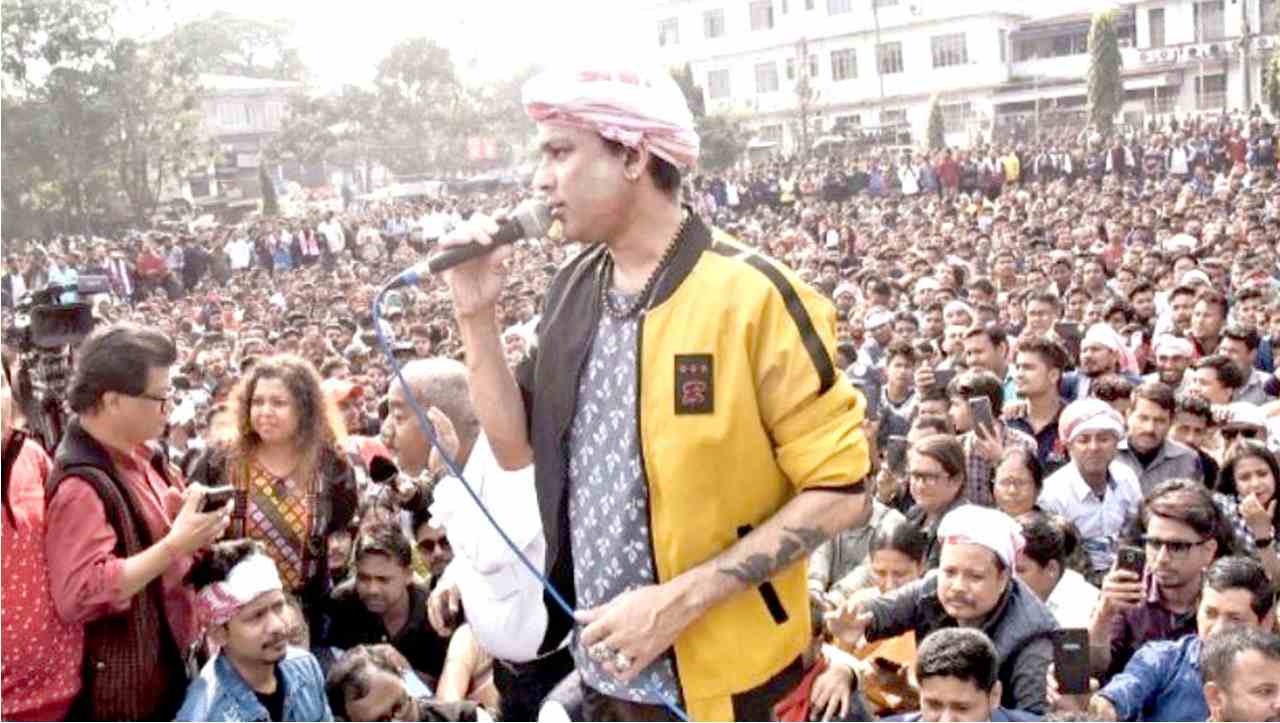
Zubeen sang songs, but his music resonated far beyond the ordinary. After Bhupen Hazarika, it was an artist who could command such a heroic farewell. By turning the sea of grief into a procession of communal harmony, what Hazarika had celebrated as “Mahabaahu Brahmaputra, the pilgrimage of great confluence”, he paid tribute to Hazarika and challenged the politics of the status quo.
His popularity cut across generations, communities, and classes, though it unsettled the ruling establishment. For over 33 years, Zubeen consistently delivered around 38,000 songs, filling the void left by Bhupen Hazarika in Assam’s musical sky. While many mourned Hazarika, the new generation had already embraced Zubeen, finding life in his songs.
The generational divide was evident. The youth of today, shaped by post-liberalization class conflicts, educational pressures, employment uncertainty, and the tension between freedom and conservative societal norms, found their voice in Zubeen. His songs expressed love, frustration, and defiance. His acts, rejecting caste hierarchies, tearing his hymn-thread (logun), advising Hima Das to eat beef for running, and using words like “Ghenta”, turned him into a hero of rebellion. His tragic death sparked a Gen Z movement in Assam.
Zubeen liked to call himself a communist and took pride in calling himself a follower of Bishnu Rabha. In that sense, he was like Eklavya, a communist disciple without a formal guru. In an interview, he called himself a socio-leftist, and I think that is the most appropriate term, where all potentials of revolutionary transformation were latent, which the left-wing could not discover. As a result, while Zubeen's songs and actions contained a jihad against the old society, the outline of a new society did not emerge.
Zubeen's artistic essence was inseparably integrated with his social identity, and this aspect differentiated him from other artists. From forming the Sur Bahini for flood-affected people to participating in the anti-CAA movement, from joining movements against tree felling to establishing the Kalaguru Foundation, from singing at charity events to providing personal help – all bore testimony to this. With his magical voice and melody, Zubeen entered the hearts of people of all ages, singing for a diverse spectrum of people, all genres of songs, from devotional to folk.
While almost all of Zubeen's contemporary artists pledged allegiance to the BJP, Zubeen never sought refuge in the BJP. Instead, he consistently criticized government policies, right up to the recent case of Jayanta Mall.
Zubeen's songs were like the tears of a tormented society and, simultaneously, a protest against it. Thus, his songs became like solace. In the absence of a real revolution, Zubeen thus became a symbol of rebellion against this tormented society. The true tribute to Zubeen would be to prepare for a great cultural rebellion against this tormented society and to advance the sea of great communal harmony.