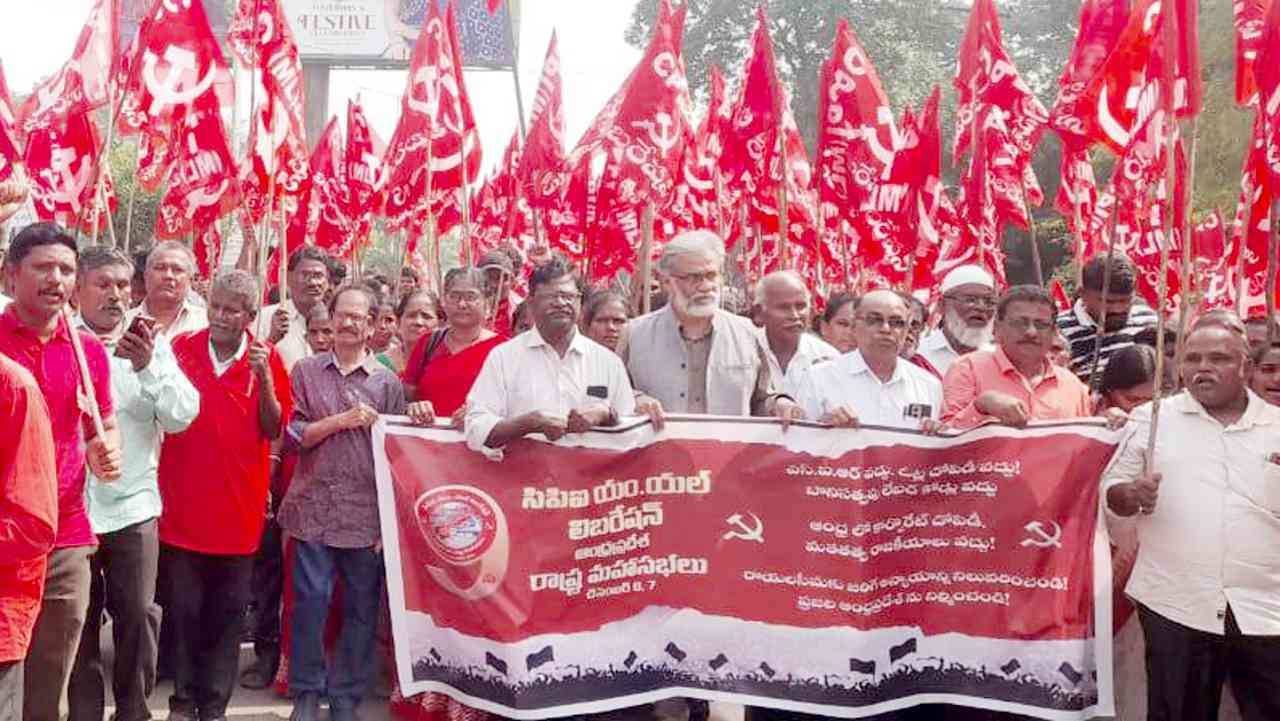
The two day conference began with a massive rally in Kadapa town which was led by the Party General Secretary Dipankar Bhattacharya. PBM and the senior leader Swadesh Bhattacharya, PBM and Incharge of the party affairs in Andhra Pradesh Shankar, the Central Observer to the conference Chandra Mohan, CCM and Incharge of Telangana state party Murthy, Telangana state secretary Rameshraja, the AP State Secretary Bangar Rao and CCM Nagamani and other leaders of state also marched in the rally. Party leaders paid respects to the statue of Dr. BR Ambedkar on the eve of Maha parinirwana Diwas.
Addressing the inaugural session, Comrade Dipankar said, we took anti-feudal struggle as the key link for the party. India is still largely rural, largely agricultural, and it is the assertion of the oppressed rural poor, the landless and marginal farmers, which constitutes the main social base, main arena of emphasis of the communist movement. This is what we did in Bihar and in many other parts including parts of Andhra Pradesh and Tamil Nadu. Our areas of work are basically the pockets developed through anti-feudal struggle, land struggle. That is the source of the party's main strength. We built an all-India party on the basis of these struggles which works on every front - students, youth, culture, state government employees, railway, organized sector workers, unorganized sector workers, women, tribals, autonomy movements, etc. This combination of theory and practice, local and national, the present and the future is our success story.
"Today, when we talk about fascism we must understand the link. Our anti-feudal struggle has today grown into anti-fascist resistance. Because those feudal forces who had been defeated politically and socially, who had been pushed back, are trying to come back in this new fascist era. When you see the bulldozers at work, the bulldozers are not just some officer or some district administration but the local feudal forces, who want the land, who want to evict the poor, are directing these bulldozers. Basically, those feudal forces who suffered one step back, who faced defeat locally, are trying to make two steps forward, trying to make a come back with the help of the state and the fascist aggression. In order to strengthen such an anti-fascist resistance, we are trying to strengthen our own party, and at the same time, we are also trying to develop various kinds of United Front experiments," Comrade Dipankar noted.
In the concluding statement, he said "I hope that this conference, the ninth conference, will pave the way for a stronger, bigger, a more dynamic, more active CPI(ML) across Andhra Pradesh in every district, and especially retaining all our old bases, expanding the mass base. This is a time for expansion, time for dynamism, greater unity and greater struggle.
The open session following the Rally was addressed by the guests from left parties including Comrade V Srinivasa Rao, the state secretary of CPIM and Comrade G Eswarayya, the state secretary of CPI along with the state committee members of CPIML. Comrade B Bangar Rao presided over while Uday Kiran coordinated the session and Obaiah, the district secretary welcomed the gathering.
Comrade Dipankar delivered the inaugural address of the conference. A book of Vinod Mishra’s selected works in Telugu was released by comrade Dipankar. The publisher Ramanamurthy spoke introducing the publication.
The Delegates session began on 6th afternoon. The conference elected a 9 member presidium comprising comrades Malleswar Rao, D Harinath, Nagamani, Aruna, Ramdev, Bhaskar Rao, Arjun Rao, Venkateswaralu and Chenniah. A 5 member steering committee was also formed. The delegates session began by paying tributes to the departed leaders of state and other leaders who martyred in the past four years. The secretary of the outgoing state committee, Bangar Rao placed the work report with a detailed plan for the future course of action and development of Party in Andhra Pradesh. Com Swadesh Bhattacharya delivered his message of greetings to the conference.
A 39 member state committee was elected and B Bangar Rao was re-elected as the new state secretary. A total of 329 delegates including observers and guests attended the conference. More than 30 percent of delegates were women.
Comrade Swadesh Bhattacharya, the PBM, in his special address of the conference, welcomed the new comrades joining the party. He called upon the entire party to rise up to the occasion and turn the CPIML Liberation as a centre of revolutionary movement in the state. He was hopeful that the party in Andhra could prepare to thwart the designs of fascist forces with the influx of youths and students into the organisation. He appealed to comrades to build a united and strong party with a large mass base in the state.
The party Incharge for the state, comrade Shankar delivered the concluding address. He called upon the party to build waves and waves of struggles of the people, strengthen the party at the grassroots and to organize district level struggles on people’s issues of land, wage, housing, liberation from loans, etc. He also appealed to the newly elected state committee to gear up towards a Chalo Vijayawada rally in the next budget session of the assembly. He called upon delegates to work towards routing out communal forces from the soil of Andhra, unseating the pro-corporate Chandrababu Naidu and TDP from the echelons of power and teaching an appropriate lesson to Pawan Kalyan who preaches Sanatan Dharma against the secular and progressive values and culture of Andhra Pradesh and its people.
********

The Link Between Anti-Feudal Struggle and the Anti-Fascist Resistance
[An Abridged version of inaugural speech by comrade Dipankar, the General Secretary of CPIML Liberation in the 9th state conference held at Kadapa on 6 – 7 Dec 2025]
Undivided Andhra Pradesh is one of those signature states of India, which is known for the Communist movement. The communist movement in India means the movement in Kerala and undivided Andhra Pradesh, which are known as historical strongholds of the communist movement. There can be no strong Communist movement in the country, there can be no strong CPI(ML) in the country, without a strong presence and without a strong organization and work in undivided Andhra.
Historically, in the 1980s, when our party revived after Naxalbari, several leaders came from Andhra. We inherited the legacy of comrade Nagbhushan who was in Andhra-Orissa border. In the 1980s, when we revived in Bihar in a big way, the common perception was that Andhra Pradesh was CPI(ML) People's War and Bihar was CPI(ML) Liberation. But now, after four decades, CPI(ML) People's War which eventually became CPI (Maoist), has reached a major crisis point. They never faced such a major crisis and a difficult situation ever since the People's War evolved into a Maoist party. A lot of their leaders are being killed in the name of Operation Kagar, but what is even more a bigger blow to the party is the surrender of so many leaders. Basically, the whole CPI (Maoist) trend has now failed which is proved by the history and the situation. I have no comment on their efforts to revive again, only the time can tell. But this is a comprehensive kind of crisis for that whole group. On the other hand, CPI(M) is also facing a big crisis. They could not revive after their collapse in Bengal. Now they are only in Kerala. It is a bigger challenge before us than ever before to carry forward the entire communist movement across the country, including Andhra. This makes it an important moment for us in CPI(ML).
Several people wrongly differentiate us from Maoists that we gave up armed struggle while Maoists continued the same. It's very superficial to take that kind of a view. We surely made a lot of changes in our mode of organization, in our mode of struggle and in our pattern of work over the years. But whatever we did, we did it independently. We did not enter into any agreement with the Indian state. Indian state did not dictate what we should do. It is our own political wisdom, our own understanding of the Indian society, our own understanding of the Indian situation and our own strength that gradually guided us into our changing modes of struggle and diversification of our initiatives. So whatever we did, we did it as an independent Communist party. But the Maoists now are dependent on the state’s offer. The state declined their offer of ceasefire. Now several Maoist leaders are surrendering and are basically speaking the language of the state. It is unfortunate that some of them are openly joining and working for the BJP. The moot point is not the mode of struggle but the independence of the communist party. We have remained an independent Communist party in every state, at every juncture of the Indian societal and political development. This is a crucial point that we should remember.
Secondly, we took anti-feudal struggle as the key link for the party. India is still largely rural, largely agricultural, and it is the assertion of the oppressed rural poor, the landless and marginal farmers, which constitutes the main social base, main arena of emphasis of the communist movement. This is what we did in Bihar and in many other parts including parts of Andhra Pradesh and Tamil Nadu. Wherever, whatever pockets we have, were basically the pockets developed through anti-feudal struggle, land struggle. That is the source of the party's main strength. But more important is that on the basis of some fighting pockets and some localities, we built an all-India party. The echo of that struggle did not become just a local affair. It is not about how many acres of land we captured and among how many people we distributed. That is not the success story of the CPI(ML). The success story is that, on the basis of that land struggle, we created a lasting local pockets of influence, pockets of work, and on that basis we created an all-India party which works on every front - students, youth, culture, state government employees, railway, organized sector workers, unorganized sector workers, women, tribals, autonomy movements, etc. Based on some local struggles, we created an all-India impact and grew as an all-India organization. This combination of theory and practice, local and national, the present and the future is our success story. We may be a small force in the state today, we can become a bigger force tomorrow. Whatever we theorize, we test it in practice. From our practice, again, we develop our theory, we improve our theoretical understanding. The combination of theory and practice, development and nurturing of local areas of struggle, and combination of that local struggle with a national perspective, national level initiative, has been the key to the revival of the CPI(ML).
Today, when we talk about fascism we must understand the link. Our anti-feudal struggle has today grown into anti-fascist resistance. Because those feudal forces who had been defeated politically and socially, who had been pushed back, are trying to come back in this new fascist era. When you see the bulldozers at work, the bulldozers are not just some officer or some district administration but the local feudal forces, who want the land, who want to evict the poor, are directing these bulldozers. Basically, those feudal forces who suffered one step back, who faced defeat locally, are trying to make two steps forward, trying to make a come back with the help of the state and the fascist aggression. Who are the fascists? One is the same feudal forces and another is all those big companies, the corporate sector who do not want any legal restriction. They want everything. They want to take control of, for example in the absence of Maoists in Chhattisgarh, all the jungles and every forest. Adani wants everything - energy, coal, thermal power, wind power, solar power and now even nuclear power. In this Parliament session now, there is a bill to privatize nuclear power in India. Adani wants everything - airports, roads, the entire infrastructure sector. So, they need this kind of a fascist state, fascist government where there will be no constitution, no rules, no rights to the people. We had all along been fighting such forces. We have been fighting against feudal forces, we have been fighting against all these employers, private employers, we have been fighting against even the Indian state. But today the combination is on a different level with massive aggression. So it's the old feudal forces, the unregulated corporate sector, the Indian capital, with the blessings of America, with the blessings of Israel, with the blessings of imperialism, and the Indian state is shedding all its democratic kind of pretensions now. They are shedding whatever constitutional, parliamentary veil, mask they had and are exposing themselves as a fascist kind of a regime. We do not say that the state has become fascist yet. But with more and more institutions being captured, the fascism is increasingly becoming a well entrenched kind of a force. If it really becomes entrenched, if there is a complete takeover, then even the character of the state will change. As of now, the fascist forces are trying to capture and restructure the state. The struggle is still on. We should understand the link. It is not that something new has suddenly happened and we are saying something completely new. No. Whatever we have been fighting all along – the feudalism and the capitalism – have become fascism now. Hence, our anti-feudal struggle, our anti-capitalist struggle will also have to become anti-fascist resistance now.
In order to strengthen such an anti-fascist resistance, we are trying to strengthen our own party, and at the same time, we are also trying to develop various kinds of United Front experiments. For example, there are many united fronts. In farmers movement, it is the Sanyukt Kisan Morcha, it is a united front exercise, united farmers organizations. In Trade Union front, we have a platform of all Central Trade Unions fighting against the labour codes and on many workers' issues. We have the INDIA coalition, a seat sharing arrangement. And this also may have different kind of nature in different states. In Bihar, we had a seat sharing understanding with the Congress and the RJD. In West Bengal, we are planning with CPIM. Which means we may have to join hands with a lot of parties against whom we were in opposition till the other day. It happens when you are in any United Front. You are forced to join hands with different parties which are ideologically and politically different. We have had to oppose them when they were in power, like the CPIM in Bengal, Rashtriya Janata Dal in Bihar, the Congress across India. Because, we need a powerful united front against fascism. The fascism is so aggressive and a major threat to the Constitution, the parliamentary system and to the entire idea of the notion of a modern India, united India. We need a bigger and more powerful opposition. We cannot do it alone. We will have to join hands with the whole range of forces.
Joining hands with others mean unity and struggle. We are united on some issues, we are united for some purpose against fascism. We have our own program. We will need to know how much to agree, when to agree, when to disagree, when to differ, when to do something independently. As I said initially, the party remains always independent, but it is the independent policy of the independent party that in the given situation, we need a larger unity. For the sake of that larger unity, we are definitely making many adjustments, like we are contesting less seats, we are supporting them wherever we are not contesting. This is again, the party's independent decision, independence of the Communist Party, but the Communist Party recognizes the intensity of the threat of fascism in India and that is why we are trying to forge a bigger unity. But that does not mean that we need to depend on other forces. The party will have to become stronger everywhere, in every possible way. Because, a weak Communist Party cannot have a strong anti-fascist front. Even in this anti-fascist front, communists will have to emerge as the ideological leader, as the political kind of champion, as increasingly powerful organizational force. This is why we need a broader unity, but with this broader unity, we need a more vibrant organization, a more powerful Communist Party.
We have always believed, as a revolutionary Communist Party, that wherever there is oppression, there will be resistance. The oppressed people will always fight back. And we have always believed in the last words of Comrade Charu Mazumdar that the people's interests are the party's interests. The party has people’s interest as the highest interest of the party. We stick to that principle in this phase of the movement too. We stand with all those who are being targeted and persecuted. If Muslims, as a community, are being sought to be marginalized we stand with them. Today is 6th December, the day of demolition of Babri Masjid. The whole country is facing a bulldozer raj today because of the demolition of that one mosque. People's houses, shops, entire settlements are being demolished everywhere. The Babri Masjid was not just a Muslim issue. The demolition was an attack on the constitution, on the culture and on the minority community. Today, various sections of people are facing similar kind of attacks. Likewise, something that happens in Manipur, or Kashmir, it is not confined to those states alone. It is now spreading everywhere. All states are facing the attack on federalism or similar kind of problem. We will have to stand with every section of the society, which is being targeted by fascism. It may be on the basis of religion, it may be on the basis of caste - Dalits, extreme backward castes, it may be on the basis of gender - women, it may be on the basis of linguistic minority - all South Indian states which are outside the Hindi belt. All kinds of minorities, migrant workers who are a minority everywhere. They are a mobile minority. Wherever they go, they are a minority in another state. They are a mobile working-class minority. So we will have to stand with the minorities, we will have to stand with their constitutional rights, fight for it. And this is what the party is trying to do.
In Andhra Pradesh we need a stronger party. We may have problems and even stagnation, in all those pockets which we had created through years of land struggle. We need to find out how to break that stagnation, how to create more motion. For example in an area where you capture and distribute land, it is not over. It is only one-step in the struggle. Suppose if it is an agricultural land, then there are issues of cultivation. If it is a land used for housing, then there will be question of amenities, housing rights, water, electricity, etc. If we fought for one generation of people, now we have to fight for their children, their education, their health. So one struggle leads to another. No struggle is self-sufficient. No struggle is complete in itself. Every struggle is part and parcel of a bigger movement. That's how we need to find out newer issues in all our old areas, generate more motion, more dynamism, and also go for expansion.
It is good that you are having this conference in Rayalaseema, in one of the most backward areas, one of the most backward districts in Andhra Pradesh, where we are holding our conference today. In all those areas - Girijan areas, agency areas - of Andhra which are most backward socially and economically, big corporates are now acquiring land, acquiring mines. There is a lot of destruction - environmental, societal. Vizag Steel Plant is being privatised. There are scores of issues in Andhra. We have to take up all those new issues.
We need a united party, a powerful party. We may commit mistakes when we are working. Somebody who doesn't work doesn't commit any mistake. There will be mistakes, there will be differences of opinion, there will be a lot of differences, including local differences. But we need to follow some principles. That all our differences are the differences within the party. Differences among comrades. They are not differences among two enemies. They are not differences among two enemy classes. Within the same class, within the same party, amongst same comrades, if there are any differences, I believe that all those differences can always be discussed and resolved. I appeal to all comrades through this whole conference to develop united and strong party in Andhra.
These days we often hear some comrade joining the party and leaving after two or three years. Why do we face this kind of a situation? Because, after all, the Communist Party is a lifelong commitment. When we join the party we do not join it for two years, three years or five years. We join the party as a mission in our life. We want to dedicate our life to serve the people through the communist party. Why does this lifelong commitment, becomes a short-term kind of an affair? Why do so many comrades leave? I think, the whole party will have to think about it, and the whole party will have to create an environment, create an understanding where we can all work together, fight together, trust in each other, help each other, learn from each other, cooperate with each other. How we can create a big party working on many fronts, working on both feet, using all our fingers, using all our eyes, using all our ears, using all our resources. The party will have to work together as one man, as one person. That is the kind of unity that we need in the party. I hope that this conference, the ninth conference, will pave the way for a stronger, bigger, a more dynamic, more active CPI(ML) across Andhra Pradesh in every district, and especially retaining all our old bases, expanding the mass base. We need more and more new people, new generations, students, youth and women. We need more Dalits, we need more Adivasis in the party, we need more people from all minority communities - whether Muslim or Christian. The party will have to reach out to the larger society. We need more workers, more farmers. This is a time for expansion, time for dynamism, greater unity and greater struggle. I hope the new state committee to be elected will be able to lead the Andhra Pradesh party with the spirit of unity and spirit of struggle and with greater determination. I wish the conference every success.
Inquilab Zindabad!